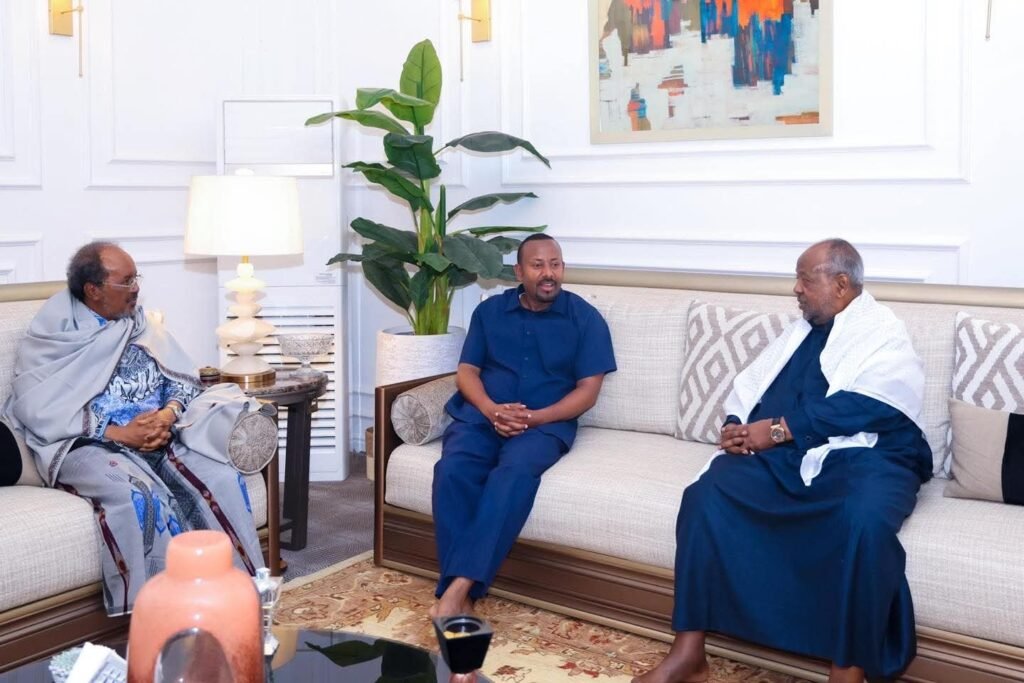
Djibouti City (TDI): Djiboutian President Ismail Omar Guelleh hosted Somali President Hassan Sheikh Mohamud and Ethiopian Prime Minister Abiy Ahmed on Wednesday, convening over an Iftar dinner to address the potential spillover effects from the Middle East conflict on the Horn of Africa.
The agenda covered peace and security, counter-terrorism cooperation, and regional economic integration, but the Middle East crisis and its “possible economic repercussions and harms” were at the center of the talks.
Global oil prices have surged since the war began. Iran’s partial closure of the Strait of Hormuz, through which roughly 20 percent of global oil flows, has disrupted tanker traffic and caused Gulf oilfields in Iraq and Kuwait to cut production.
Shipping lines have rerouted away from both the Strait of Hormuz and the Red Sea, adding to disruptions already caused by Houthi attacks since late 2023.
Djibouti’s own Finance Minister Ilyas M. Dawaleh warned publicly last week that the war would bring severe economic consequences for developing countries, cautioning that small states dependent on maritime trade risk are being pulled into deeper economic uncertainty as the shocks ripple across the region.
Read More: Uncertainty Over Iran Conflict Sends Oil Prices Surging and Sliding
On the same day as the summit, the United States Embassy in Djibouti issued a security alert advising American citizens to exercise heightened caution as the military conflict in the Middle East does not show any major signs of receding.
Ethiopia’s prime minister was joined by his deputy, finance minister, minister of peace, and national security chief. Somalia’s president brought his defense minister and transport officials. Djibouti’s foreign affairs, finance, and defense ministers attended alongside President Guelleh.
No joint statement was issued, but the gathering marks a notable diplomatic moment for three neighbors navigating both shared pressures and unresolved bilateral tensions.
The presence of senior defense officials in the meeting suggests easing tensions between the countries driven by shared economic interests.
Djibouti framed the summit as part of a series of meetings aimed at defining “a new strategic course of actions and objectives” for the countries of the sub-region, signaling an intent to institutionalize coordination.
Relations between Ethiopia and Somalia have been strained since January 2024, when Addis Ababa signed a memorandum of understanding with Somaliland granting Ethiopia port access in exchange for potential recognition of Somaliland’s independence