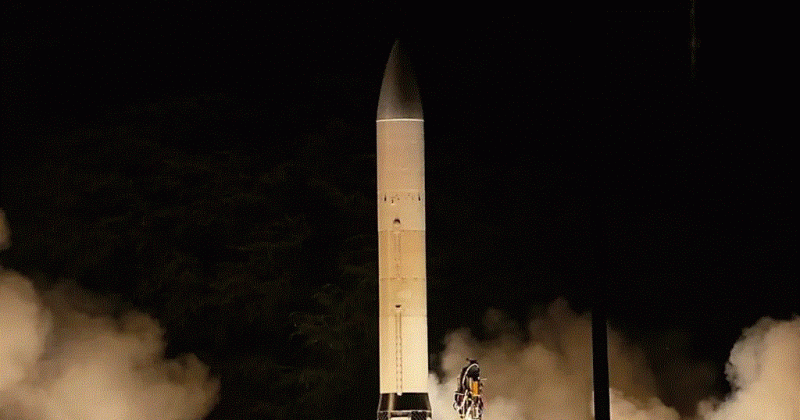
The stability since the Cold War has been based on a single assumption and that is even when one party makes a first attack, the other party has retained enough capabilities to respond and strike a final blow. This concept, which is known as second strike capability, has given the basis of the strategic stability between the key nuclear powers.
The new technology that jeopardizes the stability today is Hypersonic weapons. One of the most significant innovations in the contemporary military technology and nuclear deterrence is, perhaps, the development of hypersonic weapons. speeds are now in arsenals of the leading powers and they are available in two types: hypersonic glide vehicles(HGVs) and hypersonic cruise missiles(HCMs).
As compared to traditional ballistic missiles, the trajectories of which can be easily predicted, hypersonic missiles may alter their course of flight. As a result, the leading global superpowers such as the United States, Russia and china are pouring a lot of resources into development and deployment of these missiles to be able to penetrate the enemies defense system.
However, their velocity and ability to alter their trajectory changes the computation of the warning time, detection reliability, and nuclear force survivability. The result is a compression of decision-making time leading to psychological and operational burden on hierarchical structures. Deliberation is replaced by impulse when minutes turn into seconds.
Technical Overview of Hypersonic Weapons
Hypersonic weapons are thus the new category of the sophisticated missile systems that are meant to travel faster than Mach 5 or five times the speed of sound yet still maneuver in the air. The weapons do not take a straight path like the other ballistic missiles, but rather move through the air at much lower altitudes. This renders them far more difficult to find, track and intercept by the use of traditional missile defense systems.
There are two broad types of hypersonic weapons, on the basis of deployment or development, which are classified as hypersonic glide vehicles and hypersonic cruise missiles. The Hypersonic glide vehicles employ the boosters made up of ballistic missiles and then glide across the upper atmosphere to reach the targets at extremely high speeds. Hypersonic glide vehicles can also turn and navigate during their flight as they head towards targets.
Conversely, hypersonic cruise missiles have highly developed propulsion engines that propel it within the atmosphere at hypersonic speeds. Supersonic combustion ramjet engine also commonly known as scramjet is one of the sophisticated propulsion systems that have been developed to propel hypersonic missiles. The Scramjet can enable the air to pass through the engine at supersonic speed at the combustion point to provide sufficient thrust to accelerate the missiles at Mach 5 to Mach 15.
The technological features of hypersonic missiles have been a significant threat to the existing missile defense systems. The current missile defense systems were initially developed to deal with ballistic missiles that travel in a predictable manner and have a high altitude flight path.
Hypersonic missiles on the other hand travel at a lower altitude and deviate in their flight paths hence it is hard to keep track of their flight patterns and predict them. In addition to that, hypersonic missiles also travel faster and a missile travelling at Mach 5 and a distance of 1,200 kilometers to its destination and could be there in ten minutes.
Read More: World Military Spending Grew From 2.48 trillion to 2.63 trillion in 2025: Report
These attributes make it believed that hypersonic missiles would prove very useful in cutting through advanced missile defenses and making precision attacks on high-value targets such as command centers or military facilities.
The USA, China, and Russia, which are major world powers, have not been left behind in their efforts to invest more in research and development on the hypersonic technology as a part of their general military modernization efforts. Even though these technologies are having enormous military advantages to the countries that have them, there exists concern among strategic security analysts as to how it would affect strategic stability.
These are the key ways in which hypersonic weapons can be used to destabilize the concepts of strategic stability. The capability to provide nuclear deterrence against a second strike is one of the key elements. It is described as the capability of a nation to strike back with nuclear blows even after having been attacked using nuclear bombs. The hypersonic missiles are a threat to the nuclear deterrence stability due to its speed and agility as they can easily launch attacks to destroy nuclear facilities before any form of retaliation can be enforced.
Research conducted by the Stockholm International Peace Research Institute (SIPRI), hypersonic glide vehicles can travel in unpredictable flight paths with low altitudes than the traditional ballistic missiles. This implies that they cannot be easily detected and intercepted by radar and missile defense. The other notable disruptive effect of the hypersonic weapons is that it causes a squeeze in time during emergencies.
Current intercontinental ballistic missiles are already high-speed, and they are capable of being detected when they are in flight and in predictable trajectories and can therefore determine the point when they hit. Instead, hypersonic missiles will be able to modify the directions and can be used at lower altitudes, which complicates the detection of their targets locations. Hypersonic missiles usually can carry conventional or nuclear warheads.
When hitting an adversary with a hypersonic missile, it is hard to tell what type of attack one is pursuing. According to analysts of the RAND Corporation, that this ambiguity will cause serious escalation risks because states will tend to see the worst-case scenario in a situation where their survival is at stake. Technological rivalry among the major powers has also increased as a result of the development of the hypersonic weapons.
Hypersonic capabilities are frequently sought by states as the means to overcome the missile defense systems of their enemies as well as staying credible with their deterrence measures. Nevertheless, the developments may provoke security dilemma, whereby defense technology improvements introduced by a given state are considered offensive to others.
China-US and Russia-West Strategic Dynamics
The development of the hypersonic Weapons has emerged as a significant aspect of the larger strategic competition between the US and the China. China has achieved a lot especially the introduction of the DF-17 missile with a hypersonic glide vehicle. The hypersonic program of China is aimed at providing the country with greater capability of breaching the U.S. missile defense systems and reinforce its presence of deterrence capabilities within the region, especially in the Indo-Pacific region.
Chinese strategists are of the opinion that hypersonic systems can guarantee the plausibility of their deterrence capacities by surpassing defensive technologies that would possibly counter their capability to strike. Consequently, hypersonic weapons are considered a key to preserving the strategic balance with the United States and preventing possible military intervention of the regional conflicts, especially that one’s involving Taiwan or the South China Sea.
Simultaneously, the United States has been speeding up their hypersonic weapon development, as a reaction to the Chinese and Russian developmental progress. The U.S. defense agencies are engaged in various hypersonic systems including the Long -Range Hypersonic Weapon (LRHW) and Air-Launched Rapid Response Weapon (ARRW).
Russia has been among the first to use operational systems of hypersonic weapons, such as Avangard hypersonic glide vehicle and Kinzhal air-launched hypersonic missile. The Russian authorities have introduced these systems as technological advances to counteract the western missile defense systems, and make sure that the Russian nuclear deterrent can survive. The Russian development of the hypersonic weaponry, is directly associated with Russia feeling that U.S. missile defense systems might eventually weaken its nuclear deterrent credibility.
Russia does not want to lose strategic equality with the United States and NATO by creating weapons that can be used to overcome the modern missile defenses. Simultaneously, the introduction of Russian hypersonic weapons has created a sense of concern among the Western analysts on how this will affect the strategic stability. These systems might be able to hit critical military facilities, command centers or early-warning systems with minimal warning because of their speed and maneuverability.
Read More: Tactical Success or Strategic Miscalculation? The Iran Strikes and Asia’s Nuclear Future
The fact that the arms control agreements between the United States and Russia have deteriorated and further exacerbated such concerns. The collapse of the Intermediate-range Nuclear Forces (INF) Treaty and other concerns related to the future of other arms control systems have minimized the institutionalized systems that used to guide strategic competition in the past.
The analysis of the nature of hypersonic weapons, as well as case studies of the nuclear deterrence as it relates to U.S.-China and Russia-West, have given a number of important analysis on the effects these weapons have on nuclear deterrence. Hypersonic systems have extreme speed, maneuverability and low-altitude, the combination of which significantly decreases time on early-warning and decision-making.
This shortened response time, will enhance chances of making errors during the crises and may force decision-makers to either take pre-emptive or launch-on-warning tactics. The use of hypersonic weapons brings about a possibility of erosion of second-strike stability that has been the foundation of nuclear deterrence in history.
As it is noted by the Stockholm International Peace Research Institute (SIPRI, 2022) components of hypersonic glide vehicles and cruise missiles, which can break through the traditional missile defenses, can contribute to weakening the confidence in the survivability of the nuclear forces.
This disruptive influence is especially relevant in high-stakes areas like the Indo-Pacific where the Chinese DF-17 missile reinforces Chinese deterrence against the U.S intervention, and in Europe, where Russian Avangard and Kinzhal missiles offset the NATO air defense. Nuclear-diverse forces such as submarine-launched ballistic missiles, mobile launchers, and hardened silos also secure the advantage of a second strike.
Read More: The GBU-57, Fordow, and the Future of Tactical Nuclear Weapons
Moreover, new technological developments in early warning systems such as space-based sensors and command-and-control networks can help to counter the benefits of hypersonic weapons that are presently deployed.
A typical counterargument is that hypersonic arms do not entirely alter the concept of nuclear deterrence; ballistic projectiles have been moving at hypersonic velocities. The main distinction between the hypersonic weapon and the conventional ballistic missile is its maneuverability and not merely speed.
Others therefore believe that hypersonic weapons are an extension of technological advancement as opposed to a paradigm change in the war plane. The other argument that has been brought forward is that the survivability of the nuclear forces has not been diminished due to the advancement of hypersonic technologies. Nuclear states have diversified nuclear weapons stocks comprising of submarine-launched ballistic missiles (SLBMs), mobile surface-to-air missile launchers, and hardened command-and-control systems.
Another opposing argument is the possibility of adaptation to hypersonic threat through technology. In the history of strategic competition, the development of offensive weapons has frequently been succeeded by the development of defensive inventions and early-warning systems.
The role of hypersonic weapons can be limited due to their technological sophistication and high cost of development. Hypersonic systems need both state-of-the-art materials and specialized propulsion technology as well as a large test system.
Policy Recommendations
Since these systems are fast and maneuverable, enhancing early-warning and detection systems ought to be a priority of nuclear armed nations. Development of space based sensors, advanced radar systems, and integrated networks of command and control might assist in enhancing capacity of states to detect and monitor hypersonic threats within real time.
Moreover, the policymakers must take into consideration extending the arms control and transparency measures to cover hypersonic technologies.
The current arms control systems were mostly constructed to control the traditional ballistic missile systems and thus fail to control the exceptional attributes of the hypersonic weaponry. Further reinforcement of the channels of crisis communication and military-to-military dialogue might serve as an additional means of avoiding the possibility of accidental escalation as states will be able to timely explain their intentions in the situations when the tension increases.
Lastly, policymakers must concentrate on formulating strategic doctrines that would present restraint and stability without the need to look at policies like launch-on-warning that would add to the risk of unintended nuclear war.
One of the biggest technological changes in contemporary strategic warfare has been the rapid development of the hypersonic weapons. As the large powers continue to invest in the systems, we are witnessing more arguments as to whether the systems will affect the nuclear deterrence and the global strategic stability.
It is revealed that the major destabilizing effects of hypersonic weapons are based on speed, maneuverability, and unpredictable trajectories, which make it difficult to detect early-warning detection and intercept a missile defense. These properties can erode the credibility of the states in the survivability of their nuclear forces, and therefore the stability that has long been granted by second-strike capability.
The U.S.-China strategic competition case study and the Russia-West dynamic explain how the hypersonic weapons are becoming integrated into the larger geopolitical confrontations. To sum up, it can be asserted that hypersonic weapons will continue to assume a more significant role in determining the future of nuclear deterrence and international security.
Although it is unclear what these systems will lead to, their existing evidence indicates that new risks are being brought out, which have to be carefully managed by a blend of technological adjustment, diplomatic intervention, and restraint of strategy.
The implication of hypersonic weapons and their knowledge is thus essential to policymakers, scholars and security practitioners who would be able to navigate the changing dynamics of strategic competition in the twenty first century.
*The views presented in this article are the authors’ own and do not necessarily reflect the views of The Diplomatic Insight.

Warda Tehreem
Warda Tehreem is a student of International Relations at the International Islamic University, Islamabad. She takes a keen interest in analyzing emerging defense and maritime trends in South Asia.