Five years after the Taliban seized power in August 2021, Afghanistan has become what UN Women calls a “global outlier,” the only country systematically excluding women and girls from nearly every sphere of public life.
A new UN Women report warns this crisis, far from stabilizing, has deepened over the past year and now risks slipping from international attention.
Since 2021, de facto authorities have issued more than 100 decrees targeting women and girls, according to the report.
Two decrees in the ongoing year have drawn particular concern; Decree No. 12 which abolishes legal equality between men and women, placing husbands in authority over their wives and criminalizing marital violence only when it causes severe, visible injury.
Another is Decree No. 18 which makes it far harder for women to leave a marriage while preserving men’s unilateral right to divorce, and implicitly permits child marriage.
Read More: Home, Displacement & the Cost of Hope: A Young Afghan Girl’s Struggle
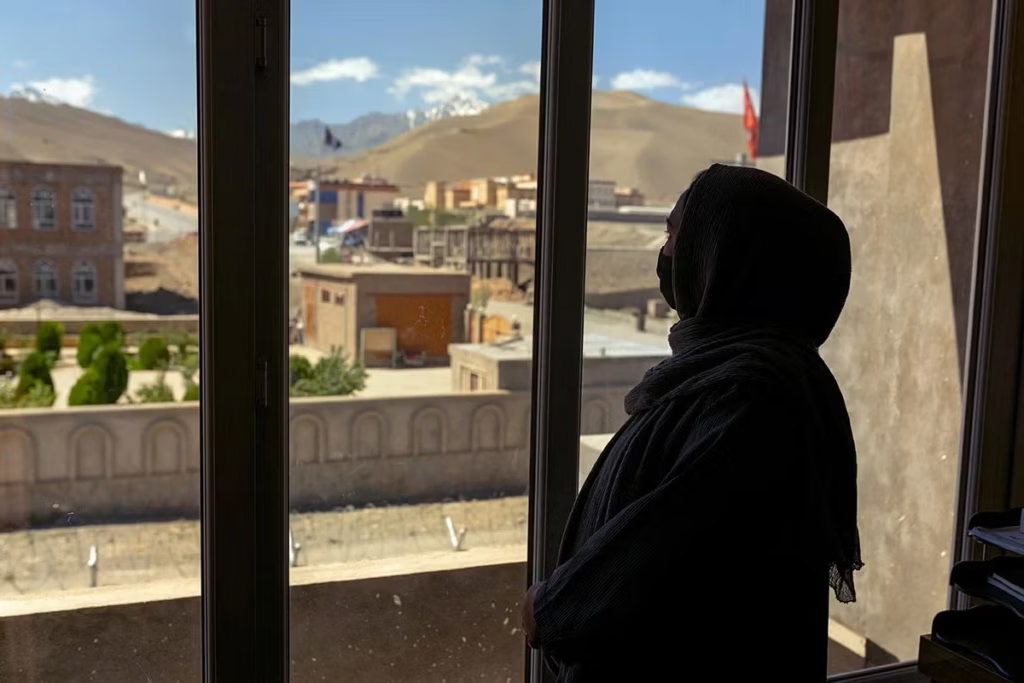
The restrictions have confined women largely to their homes; more than half of women surveyed by UN Women now leave home only twice a month or less, and nearly three-quarters say they feel unsafe leaving without a male guardian, or mahram, with over half avoiding public spaces such as markets and clinics altogether.
The report also points to a growing surveillance and enforcement apparatus with wide-ranging powers to detain people, deepening a climate of fear.
The toll on mental health is stark; seven in ten women now describe their mental health as “bad” or “very bad,” the report found.
Healthcare access has also worsened amid mobility restrictions and a shortage of female medical staff; significant given Afghanistan’s maternal mortality rate of an estimated 638 deaths per 100,000 live births in 2024, among the highest in the world.
Education remains severely curtailed. Afghanistan is the only country enforcing a systematic ban on girls attending high school and women attending university, and researchers project the country could lose more than 25,000 female teachers and health workers by 2030 if the restrictions continue.
Read More: Afghanistan’s Classrooms of Silence: The World Is Running Out of Time
Economically, women have been pushed almost entirely out of the workforce: just 7% of women are employed, compared with 84% of men, with the exclusion projected to cost the economy roughly $920 million between 2024 and 2026.
Meanwhile, humanitarian need is climbing, with more than 10.7 million women and girls requiring assistance in 2026, compounded by continued returns of Afghan refugees from Iran and Pakistan.
Compounding the crisis, international funding cuts are straining the women-led organizations that remain a lifeline for many.
Nearly three-quarters of women-led organizations in Afghanistan reported funding cuts in 2025, and more than half expect to suspend operations or close within the year.
UN Women has urged the international community not to let the crisis fade from view, calling continued support for women’s organizations essential to preserving what services remain.

Nuzhat Rana is the Managing Editor (website) at The Diplomatic Insight.