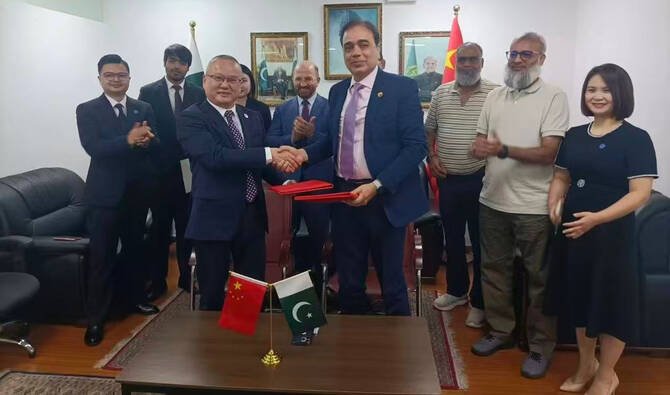
Guangzhou (TDI): The Federation of Pakistan Chambers of Commerce and Industry (FPCCI) and the Guangzhou Chamber of Commerce and Industry signed a memorandum of understanding (MoU), aimed to enhance commercial ties between Pakistan and China.
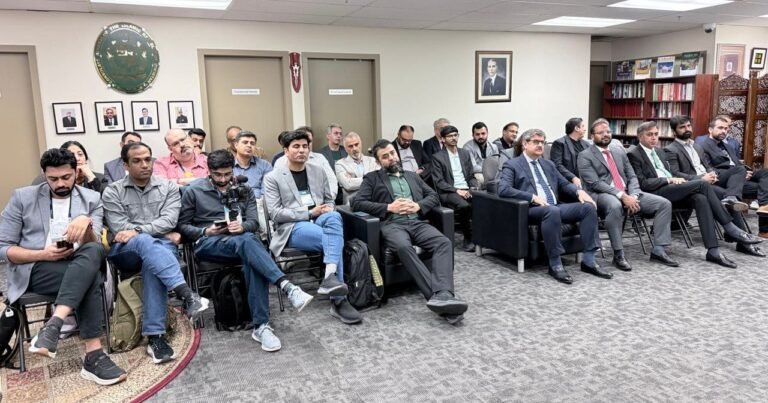
The agreement was signed at the Consulate General of Pakistan by FPCCI Senior Vice President Saquib Fayyaz Magoon and Guangzhou Chamber Chairman Richard Wu under Phase two of the China-Pakistan Economic Corridor (CPEC).
The central feature of the agreement is the creation of arbitration desks, which will provide a clear process for resolving business disputes and reducing trade barriers and aiming to create a more stable environment for private companies.
Saquib Fayyaz said, “China remains Pakistan’s most trusted and reliable economic partner” as this agreement acts as the foundation for a business-to-business (B2B) investment conference, which will take place in Lahore on 9-10 May 2026.
The Organizers stated that the forum is the first of its kind and is designed to connect Chinese investors with Pakistani businesses.
The conference will focus on several important sectors, including renewable energy, information technology, agriculture, home appliances and energy storage.
Read More: Pakistan’s Finance Minister to Make Keynote Address at EU-Pakistan Business Forum
After the MoU Richard Wu said, “China’s current economic policy is firmly oriented toward global expansion, driven by high-tech transfer and increased outbound investment.”
By facilitating direct meetings, this aims to turn business interest into concrete joint ventures that benefit both countries and building a steady network of cooperation.
A delegation of over 60 Chinese business leaders will visit Pakistan from 8-14 May 2026 and during their visit, the delegation plans to inaugurate the Pakistan Digital Economy Headquarters for IBI Guolian Gufan.
This move intends to improve digital trade and technology connections. These activities signal a strategic shift in the economic relationship between Beijing and Islamabad.
By moving the focus from large-scale infrastructure projects toward high-tech industrialization and technology transfer, both nations are working to establish Pakistan as a regional hub for manufacturing and investment.
It also reflects a coordinated effort to foster a long-term and sustainable economic framework that addresses trade imbalances and encourages deeper private-sector integration.

Muhammad Usman Hashmi is a researcher in International Relations, focusing on climate diplomacy, global governance, and political economy in the Global South. He has contributed to policy dialogues with the Foreign Policy Community of Indonesia and serves as a Senior Research Fellow at the International Council on Human Rights, Peace and Politics. He is also associated with Rethinking Economics Islamabad, contributing to research on development and sustainability.