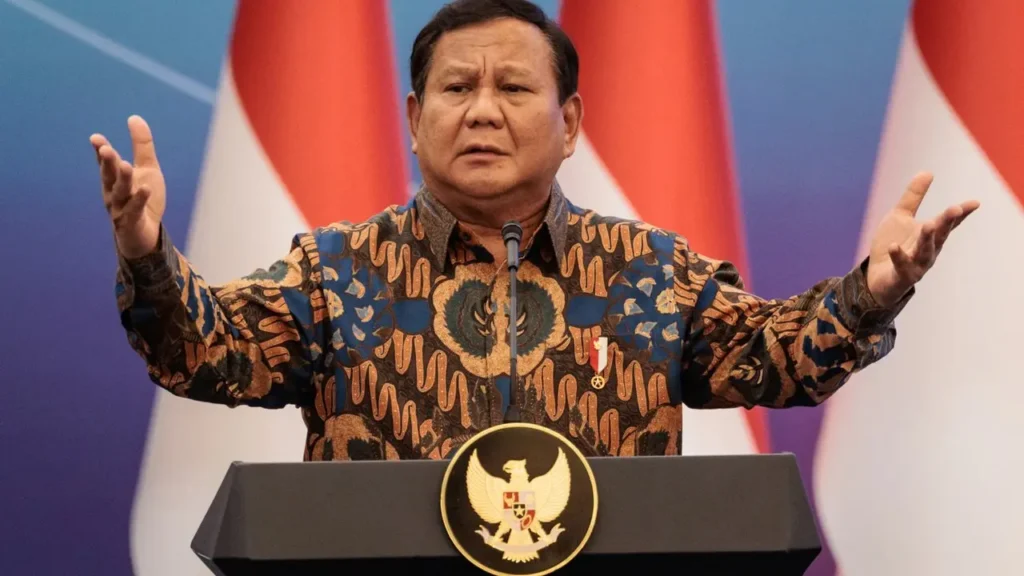
In the midst of the increasingly sharp rivalry between the United States and China, Indonesia under President Prabowo Subianto shows a foreign policy pattern that is difficult to place simply as a category of balancing, bandwagoning, or hedging, Jakarta is seen trying to embrace almost all forces at once.
The United States is embraced through economic, trade, technology, and defense cooperation. China remains a strategic partner through trade, investment, and economic cooperation. And countries such as India, France, Turkey, Australia, Japan, and middle power countries are also increasingly approached.
This pattern is finally read through omnidirectional diplomacy, which is diplomacy that moves in all directions to expand the room for maneuver and avoid dependence on one power.
This strategy is actually consistent with Indonesia’s tradition of active free foreign policy, but in Prabowo’s hands he acquires a much more aggressive, personal, and transactional character. The goal is not simply to maintain strategic autonomy, but to convert as many external relations as possible into benefits for national interests at home.
This can be seen from the intensity of Prabowo’s diplomacy since the beginning of his administration. The government not only maintains ties with traditional powers, but actively expands Indonesia’s network to various new organizations and powers. Prabowo himself has explained that Indonesia wants to participate in the BRICS as well as pursue relations with the OECD, CPTPP, and various Indo-Pacific forums.
He emphasized that Indonesia can build relations with the United States and China at the same time without losing its strategic sovereignty. The simple logic of diplomacy carried out by Prabowo is that the more friends, the bigger Indonesia’s bargaining room.
Embracing the West and China Simultaneously
Relations with the West are one of the most obvious examples. In February 2026, Indonesia and the United States reached an Agreement on Reciprocal Trade, while the two countries’ business forums resulted in trade and investment commitments worth US$38.4 billion.
Washington even used the term “new golden age” to describe the bilateral relationship. However, this proximity does not automatically make Jakarta leave Beijing. Precisely at a time when Indonesia-US relations are intensifying, relations with China remain one of the foundations of Indonesia’s economy.
This makes sense because China is one of Indonesia’s most important trade and investment partners, especially in the manufacturing, critical minerals, electric vehicles, batteries, and infrastructure sectors.
Prabowo himself sees the Washington-Beijing rivalry not solely as a threat. In his statement in 2026, he even mentioned that Indonesia could benefit from the US-China trade war because the two powers both need strategic minerals and Southeast Asian industrial capacity.
The same logic is seen in defense policy. Indonesia is strengthening cooperation with France through Rafale, opening up space for cooperation with the United States, considering Chinese weapons options, and at the same time deepening defense ties with India through the BrahMos deal. Indonesia has even handed over six Rafales to the Indonesian Air Force in May 2026 as part of the modernization of the defense posture.
Middle Powers as a Strategic Buffer
Omnidirectional diplomacy also does not stop at Washington and Beijing. In fact, the middle powers are an important instrument to reduce Indonesia’s dependence on the two great powers. India is an important example. Jakarta-New Delhi relations are increasingly expanding to the fields of defense, trade, energy, and technology.
The BrahMos agreement shows that Indonesia can acquire strategic capabilities from countries that are not directly involved in the US-China rivalry. Similarly, France offers strategic alternatives in the defense sector, while Japan, Australia, Turkey, Canada, and other countries are part of Indonesia’s cooperation network.
Strategically, this approach has advantages. If Indonesia only depends on the United States and China, then any change in the relationship between the two countries will directly affect Jakarta’s space to move. On the other hand, the more diverse Indonesia’s partners, the greater the risk diversification capabilities they have.
The Indonesian Ministry of Foreign Affairs noted that throughout the one year of Prabowo’s administration, Indonesia agreed on seven defense cooperation and conducted various two-plus two dialogues with China, Japan, Australia, and Turkey. To emphasize the establishment of strategic partnerships with Belarus and Thailand as well as comprehensive strategic partnerships with Vietnam.
From Diplomacy to Domestic Resilience
The diplomacy carried out by President Prabowo Subianto has a strong connection with the domestic agenda. This explicitly appears in the concept of Diplomacy of Resilience conveyed by Foreign Minister Sugiono in the 2026 Foreign Minister’s Annual Press Statement.
The Ministry of Foreign Affairs defines it as adaptive diplomacy to manage risks, maintain stability, strengthen bargaining power, and ensure that Indonesia does not only survive but is able to determine the direction in the midst of global pressure. This diplomacy is based on security, economic, energy, and food security.
Prabowo has repeatedly placed food and energy as the foundation of sovereignty. He repeatedly emphasized that the ability to meet their own food and energy needs is an important condition for state sovereignty. Prabowo’s logic is that a country that depends on imports of food, energy, technology, and defense equipment will have limited bargaining power when a crisis occurs.
Therefore, military modernization must also be read in the same framework. The acceptance of Rafale, strengthening air capabilities, purchasing missiles, developing the defense industry, and diversifying defense supplies are efforts to build deterrence. Prabowo himself stated that strengthening defense is needed because geopolitical conditions are increasingly uncertain and defense is a guarantee of sovereignty.
Although it provides strategic maneuverability, Omnidirectional Diplomacy has serious weaknesses. Diplomacy that moves in all directions can turn into directionless diplomacy if it does not have clear strategic priorities. The first problem is the potential loss of principle. Embracing all parties can indeed provide short-term benefits, but not all partners’ interests can be aligned.
Indonesia faces an increasingly difficult question to what extent can economic cooperation proceed without sacrificing security interests? To what extent does defense cooperation with one country not create a perception of partiality towards another country?
These risks are seen especially in the defense sector. Indonesia can buy or consider weapons systems from France, the United States, China, India, and other countries. Politically, this indicates independence. But technically, too many weapons ecosystems can create problems of interoperability, logistics, training, maintenance, and technological dependency. Indonesia should consider system compatibility when evaluating various fighter jet options from the United States, China, and France.
In other words, diversification can be a strength, but diversification without a clear defense architecture can be redundancy.
The second problem is the tendency of diplomacy to become too transactional. If every foreign relationship is primarily judged on investment, trade, technology transfer, purchase of defense equipment, or economic gains, Indonesia risks losing the normative dimension of its foreign policy. Being free to be active is not just about not choosing a block. It also contains principles regarding sovereignty, multilateralism, international law, and the interests of peace.
Centralization in Foreign Affairs
The next issue is the personalization and centralization of foreign policy. Prabowo’s approach is characterized by the centralization of foreign policy as well as the diversification of partners and agreements, the question then is whether the approach is able to produce effectiveness and coherence.
Prabowo does have the advantage of being the top executive leader, who can move quickly, build personal relationships with other countries’ leaders, and conduct direct negotiations. In a fast-paced international system, this capability is an asset.
However, centralization creates problems when almost all strategic decisions rest on the president. Diplomacy requires institutional continuity. The Ministry of Foreign Affairs, the Ministry of Defense, the Ministry of Trade, the Ministry of Finance, the TNI, and economic institutions must have a common understanding of the country’s strategic objectives.
If not done, Indonesia could experience what is called policy fragmentation under centralize leadership. These decisions are indeed centralized at the top, but the implementation is scattered and not always synchronous.
This risk is even greater when the domestic agenda is also managed in a highly centralized manner. For example, the government encourages strengthening state control over the export of strategic commodities such as palm oil, coal, and nickel products.
Such policies can be justified within the framework of economic sovereignty, but the issue is how they are designed, communicated, and implemented. National resilience requires not only a strong state, but also institutions that are able to make policies consistently, measurably, and predictably.
In the end, Prabowo’s omnidirectional diplomacy is not a wrong strategy. Even in an increasingly fragmented international environment, this approach may be the most realistic option for Indonesia. It does not make sense for a country like Indonesia to choose Washington or Beijing when national interests require it to be related to both.
The problem is not in too many friends, but in the absence of a hierarchy of interests among those friends. Indonesia needs a grand strategy that answers three questions.
First, what are Indonesia’s core non-negotiable interests? Second, which relationship is truly strategic and which is purely transactional? Third, how does all of these cooperation strengthen Indonesia’s domestic capacity? If these three questions can be answered, then Resilience Diplomacy could be an important evolution of a free and active foreign policy.
But otherwise, omnidirectional diplomacy will simply be a catalog of foreign visits, deals, and partnerships that look impressive but don’t necessarily form national power.
*The views presented in this article are the author’s own and do not necessarily reflect the views of The Diplomatic Insight.*