The international order is moving towards an increasingly realistic phase. Competition between the United States and China, trade wars, supply chain fragmentation, geopolitical conflicts, and the increasing use of economic instruments as weapons show that international relations are no longer solely determined by cooperation and multilateral institutions.
The state increasingly places national interests, economic security, supply chain resilience, and the ability to maintain strategic autonomy as priorities. In such conditions, ASEAN faces the classic dilemma, how to maintain centrality when the great powers are increasingly trying to shape the architecture of the region according to their respective interests?
The answer is not enough to maintain ASEAN as a diplomatic forum. ASEAN needs material instruments that make its centrality bargainable. This is where the Regional Comprehensive Economic Partnership (RCEP) becomes important. The RCEP should be seen not only as the world’s largest trade agreement, but as one of the foundations for ASEAN to maintain its strategic position in the midst of great power competition.
For Indonesia, the challenge is not just to ensure that the RCEP runs, but how to make it part of a larger strategy, building a dynamic equilibrium and carrying out diplomacy of resilience so that ASEAN does not become an arena for influence, but remains one of the leaders of the Indo-Pacific order.
ASEAN centrality is often understood as ASEAN’s ability to become the center of regional architecture through various mechanisms such as the ASEAN Regional Forum, the East Asia Summit, the ASEAN Defense Ministers’ Meeting Plus, and various ASEAN+1.
Read More: Indonesia-Australia in Critical Minerals Politics
However, political centrality without economic power has limitations. A regional organization can host dialogue, but it is not necessarily able to determine the direction of the game if its economic dependence is too great on external forces.
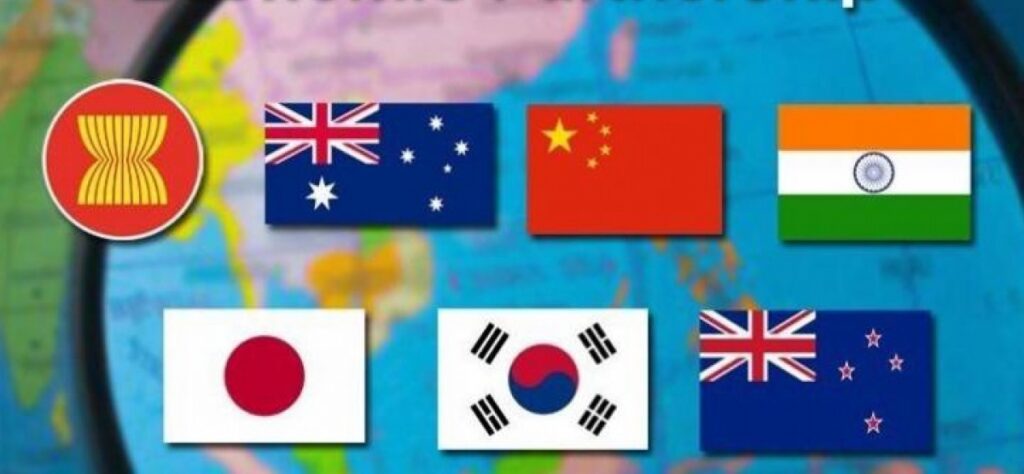
RCEP provides a material dimension to this problem. RCEP is an agreement initiated by ASEAN and connects ten ASEAN countries with Australia, China, Japan, South Korea, and New Zealand. The bloc covers about 30 percent of the world’s GDP and about one-third of the global population.
In 2023, ASEAN trade with RCEP member countries reached around US$1.9 trillion, while foreign direct investment from RCEP partners reached US$66.3 billion or 28.9 percent of total FDI to ASEAN. RCEP creates an interdependent space that brings together the great powers in one ASEAN-led framework. In other words, ASEAN does not need to be the biggest power to be relevant.
ASEAN can be a hub that makes various major powers have interests in maintaining regional stability. This is the essence of ASEAN centrality in a new context. Centrality does not mean that ASEAN dominates major countries.
Centrality means that ASEAN has such an important position that the United States, China, Japan, India, Australia, South Korea, and other powers must take into account ASEAN’s interests and institutions when implementing the Indo-Pacific strategy.
The problem is that the strategic environment in which RCEP operates is not getting more liberal. Instead, the world is moving toward what can be called competitive interdependence. The country still needs trade and investment, but at the same time seeks to reduce dependency that is considered risky.
The United States is encouraging de-risking and diversifying supply chains from China. China is strengthening its technological and economic independence. Japan, South Korea, Australia, and European countries have also begun to place economic security as part of national strategies. Trading is thus no longer completely neutral. Semiconductors, critical minerals, energy, digital technology, and infrastructure can be instruments of strength.
In this kind of environment, ASEAN cannot rely on the assumption that interdependence automatically creates peace. Interdependencies can also result in vulnerabilities. Dependence on a single market, one energy source, one logistics line, or one technology can turn into strategic pressure when relations between countries deteriorate. Therefore, ASEAN needs a balance that is not static.
Dynamic Equilibrium
The concept of dynamic equilibrium that was initiated by former Indonesian Foreign Minister Marty Natalegawa can be Indonesia’s strategic approach. In contrast to the traditional balance of power which tends to see balance as the distribution of power, dynamic equilibrium sees balance as a process that is constantly adjusted to changes in the strategic environment.
In the context of ASEAN, it means not choosing the United States to confront China or getting closer to China to keep pace with the United States. ASEAN must ensure that no single power gains such dominance as to deprive the region of strategic autonomy.
RCEP can actually be an important instrument to create this balance. By bringing together China, Japan, South Korea, Australia, New Zealand, and ASEAN countries in one economic framework, RCEP creates a web of interdependence that makes unilateral dominance more difficult.
ASEAN can take advantage of economic relations with China without having to lose strategic relations with Japan, Australia, South Korea, and other countries. Indonesia has a special position to play this role.
As the country with the largest economy in ASEAN, the largest archipelagic country, as well as a middle power, Indonesia has the capacity to become one of the drivers of regional balance. However, Indonesia should not interpret leadership as domination. Indonesia’s leadership must be directed towards the ability to build consensus and connect different interests.
RCEP should be used not only to open markets for foreign products, but to increase Southeast Asia’s production capacity. This means driving the integration of the manufacturing industry, electric vehicles, electronics, food, energy, critical minerals, and the digital economy into regional production chains.
Thus, RCEP becomes an instrument of industrial upgrading, not just a trading instrument. Resilience must also be extended to the food and energy sectors. When geopolitical conflicts disrupt global trade routes, Indonesia needs the ability to maintain strategic supplies. Therefore, economic diplomacy must go hand in hand with food, energy, technology, and maritime diplomacy.
Ultimately, the future of ASEAN centrality will be determined not by how often ASEAN issues statements, but by how much ASEAN has the ability to influence the behavior of major powers. Indonesia should therefore not only be a passenger in the Indo-Pacific architecture. Indonesia must be one of the leaders.
In a world increasingly filled with power competition, the best option is not to choose American ships or Chinese ships. Indonesia’s choice is to make sure ASEAN has its own ship, strong enough to withstand storms, flexible enough to change course, and important enough that all major powers have a reason to keep it from sinking.
*The views presented in this article are the author’s own and do not necessarily reflect the views of The Diplomatic Insight.*