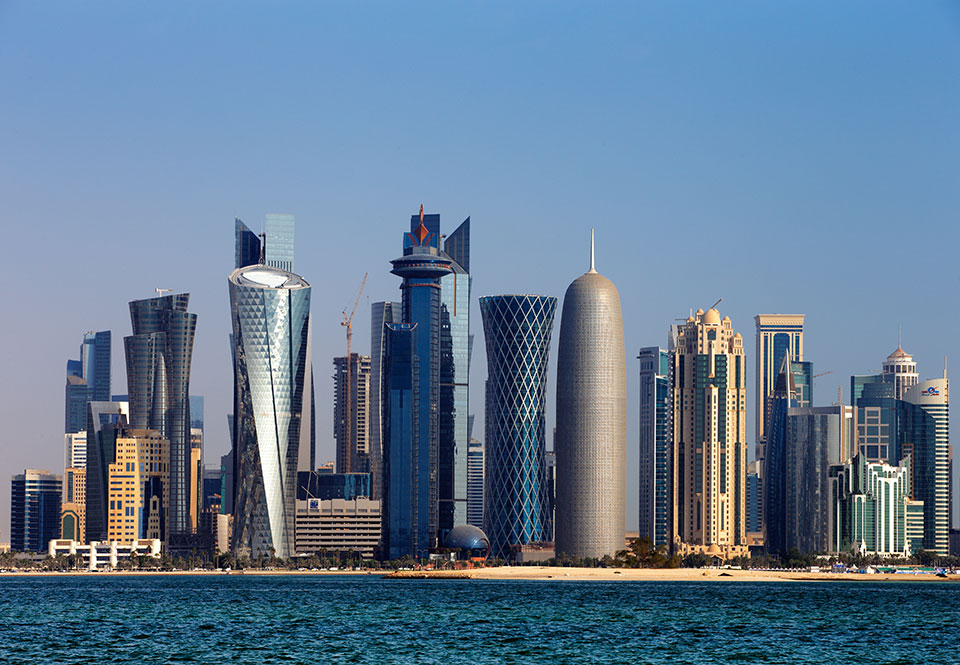
For a long time, the Gulf was seen more as a place people moved to for work than for studying at a university. Families from countries like Pakistan, India, Bangladesh and elsewhere built their lives in Qatar, Saudi Arabia and the UAE, but when their children reached university age, many still looked towards the UK, the US, Europe or back home.
Higher education was simply not one of the things the Gulf was widely known for. This is slowly changing, and Qatar is one of the countries trying to change that. Today, Doha has a growing mix of local and international universities that are open to students from outside the country.
There is Qatar University, the country’s main public university, along with Hamad Bin Khalifa University and several well-known international campuses based inside Education City, including Georgetown University, Carnegie Mellon University, Northwestern University, Weill Cornell Medicine and Virginia Commonwealth University.
For an international student, this creates an option that did not really exist in the Gulf at this scale before. A student can now study at an internationally recognized university, access research and academic networks connected to major global institutions, and still remain within the region.
Read More: Geography of Neutrality: Qatar’s Strategic Position Between Washington and Tehran
This also fits into Qatar’s wider effort to move beyond an economy associated mainly with oil and gas and build a stronger knowledge-based economy. Universities bring researchers, students, professionals and international partnerships into the country.
They also help Qatar strengthen its image beyond energy and diplomacy. In that sense, international education is also an investment. It is a way for Qatar to bring talent in, create research capacity and build long-term links with people who may later work, invest or remain connected to the country.
For students, however, the more practical question is whether Qatar actually offers enough to make it worth considering. One of the strongest arguments is financial support. Studying in Qatar is not automatically cheap, especially at some of the international branch campuses where tuition can be similar to what students would pay at the main university abroad.
For an average Pakistani family, those figures can immediately look unrealistic. This is where scholarships begin to change the picture. Qatar University, for example, offers an International Students Scholarship that can cover tuition fees and textbooks, university accommodation and transport, while also providing an annual return ticket and a monthly allowance.
The university also sponsors the student’s residency. For someone coming from Pakistan, this matters because tuition is only one part of studying abroad. Accommodation, flights and everyday living expenses can quickly become the bigger financial burden.
Qatar University also offers a Talent Scholarship for students who have performed particularly well in areas such as research, innovation, technology, literature, media or sports. International students selected under this program can receive support that includes tuition, accommodation, airfare and a monthly allowance.
These scholarships are competitive, of course, and admission does not automatically mean full funding. Still, the important point is that Qatar is not only opening university seats to international students who can afford them. It is also trying to attract students who can bring academic, research or other forms of talent into the country.
Postgraduate students have options too. Hamad Bin Khalifa University offers programs across public policy, law, Islamic studies, science and engineering, health and social sciences, among other fields. Depending on the program and the applicant, international graduate students may qualify for tuition waivers and monthly stipends.
For Pakistani graduates considering a master’s or PhD, especially those interested in research, policy or technology, this can make Qatar far more attractive than it may initially appear. Education City also has broader financial-aid mechanisms, while individual universities have their own systems.
Georgetown University in Qatar, for example, offers need-based financial support based on a student’s family circumstances. This is why looking at tuition alone can sometimes give the wrong impression. A university may appear unaffordable at first, but the actual cost can look very different once scholarships and financial aid are taken into account.
For Pakistani students, Qatar also has another advantage – proximity. It is only a few hours away, which makes travelling home easier and usually less expensive than studying in North America or Europe. There is also a large Pakistani and South Asian community already living in the country.
For many families, the cultural environment, halal food, Muslim-majority society, and familiarity of the Gulf may make the transition easier. That does not mean international students will experience Qatar exactly like home, but it can remove some of the cultural distance that comes with moving much further abroad.
The academic environment itself is another part of the attraction. Education City places several international universities, research institutions, Qatar National Library, technology centers and other organizations within a relatively small area. For students interested in internships, research or networking, this can be useful.
A student studying at Georgetown University in Qatar, for example, is still part of Georgetown’s academic system rather than simply attending a local institution using an international name. This is important because the value of studying abroad is not only the degree itself. It is also the exposure, networks, faculty, research opportunities and professional connections that come with it.
At the same time, students should be realistic. Without a scholarship, Qatar can be expensive. Living costs are not necessarily low, and fees at some international universities can be significant. Scholarships are also competitive, so students should not assume that funding will automatically follow admission.
The other thing to keep in mind is timing. Scholarship deadlines can close months before the academic year begins, and applicants may need transcripts, letters of recommendation, English-language test scores, and other documents, depending on the university.
Pakistani students in particular often begin thinking seriously about studying abroad only after receiving final school or university results, but by then some of the strongest scholarship opportunities may already have passed.
Read More: Exciting Opportunity for Pakistani Students to Study in Russia
Qatar is still not a study destination on the scale of the UK, US, Canada or Australia. Its university system is smaller, and the number of programs available is naturally more limited. But it is becoming difficult to ignore.
The country now offers a combination that did not really exist in the Gulf before: international universities, research institutions, scholarships and a multicultural student environment, all within the region.
For Qatar, bringing international students into the country helps strengthen its universities, research sector and wider global profile. For students, especially those from Pakistan, the attraction is much simpler.
Qatar can offer the possibility of studying at a recognized university, staying relatively close to home and, if the right scholarship comes through, doing so at a cost that may be far more manageable than expected.
This does not make Qatar the right option for everyone, but it does mean that when Pakistani students begin making their university lists, Doha probably deserves a place on them.

Anoush Taimur
Anoush Taimur is an International Relations graduate from DHA Suffa University, Karachi, currently based in Doha. Her research interests include Gulf politics, small-state diplomacy, Global South studies and conflict
mediation. Her work examines how states create influence through connectivity, institutions and strategic relationships. She can be reached at [email protected]