For women in Pakistan, mobility has never been just about distance. A university may be 10 kilometers away. An office may be on the other side of the city. A tuition center, hospital or workplace may technically be within reach. But getting there can mean depending on a father, brother or husband, finding a rickshaw every morning, paying for two ride-hailing trips a day, or navigating public transport that does not always feel safe.
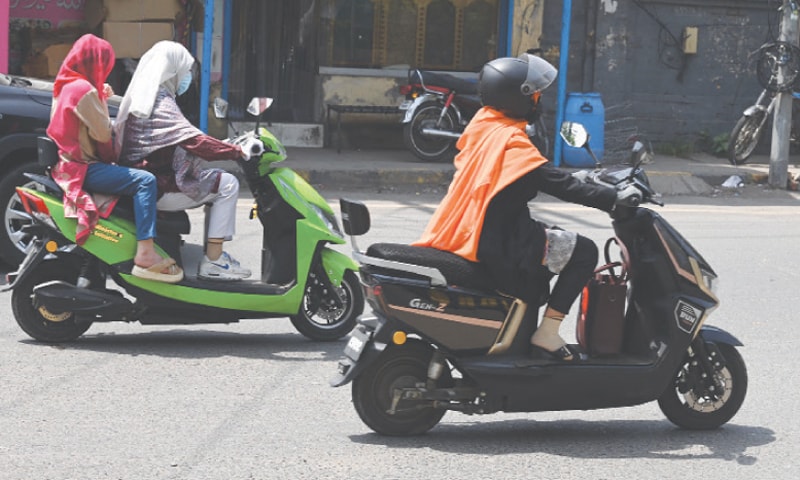
For years, these have been accepted as ordinary parts of being a woman who needs to move around a Pakistani city. E-bikes are beginning to disrupt that reality. The conversation around electric vehicles in Pakistan has largely focused on petrol prices, emissions and the country’s energy transition. But for girls and women, the impact can be much more personal.
An e-bike can mean getting to university without waiting for someone to drop you. It can mean accepting a job slightly farther from home. It can mean leaving work when your day actually ends.
Pakistan has one of the world’s lowest rates of female labor-force participation. According to the World Bank, only around 21 percent of Pakistani women participate in the workforce. There are several reasons for this, from social expectations and childcare responsibilities to education and employment opportunities. But transport is also part of the problem. The numbers show how serious it is.
Read More: The Road Ahead Is Electric: Why Pakistan Cannot Afford to Wait
Research cited by the World Bank found that 80 percent of women surveyed in Karachi had experienced harassment while using public transport. In Lahore, 75 percent of women said they would be willing to work if safe transportation was available.
More recent World Bank research makes the connection even clearer. When women in urban Pakistan were offered access to women-only commuting services, their job application rates more than doubled. That is an important finding because it changes how we should look at transport.
For women, mobility is not only a transport issue. It can become an education issue, an employment issue and, eventually, an economic participation issue. Think about a university student whose classes finish at different times every day. If a family member drops and collects her, she has to work around their schedule.
Public transport might require multiple connections. A rickshaw is another option, but paying for one twice a day, five or six days a week, adds up quickly. Then she graduates and starts working. The problem does not disappear. It simply changes form. How far is the office? What time does work finish? Will transport be available after dark? How much will the commute cost every month?
These questions can influence which university a girl attends and which job a woman accepts. An e-bike will obviously not fix Pakistan’s public transport system or make harassment disappear. Pakistan still needs safer buses, better transport networks and public spaces where women can move without fear. But an e-bike gives women another option. Sometimes that is enough to change the equation.
The Appeal Is Actually Quite Simple
Part of the reason e-bikes work well for this market is their design. Many electric scooters come with step-through frames, automatic operation and relatively simple controls. There is no clutch and usually no manual gear shifting. They are quieter than conventional motorcycles and comparatively straightforward to operate
Then comes the money. This is perhaps where the e-bike makes its strongest argument. The upfront price is still an issue. Some entry-level electric bikes in Pakistan are now available around the Rs150,000 mark, while models with larger lithium-ion batteries and longer ranges can cost considerably more.
For many families, that is not a small purchase. Financing will therefore matter if e-bikes are going to become a mass mobility solution rather than a product limited to consumers who can afford the initial investment. But once the bike is on the road, the calculation begins to change.
A 2026 comparison by PakWheels estimated an electric bike’s running electricity cost at approximately Rs1.71 per kilometer, compared with around Rs6.69 per kilometer for a Honda CD70, based on the energy prices used in its calculation. Actual costs will vary, of course. Electricity tariffs change, petrol prices change and different batteries perform differently, but the basic advantage remains.
Charging an e-bike costs considerably less than filling a petrol tank. Maintenance can also be simpler. There is no engine oil to replace and fewer mechanical components requiring regular servicing. Batteries eventually need replacement, which is a significant cost and something buyers should factor into their decision. After-sales support and battery warranties will become increasingly important as the market grows.
Compare these costs with booking a rickshaw or ride-hailing service twice every working day. For a student, that can make a difference. For a woman earning her first salary, it can make an even bigger one. Pakistanis are already responding to these economics. In April 2026, electric motorcycles had crossed 10 percent of monthly two-wheeler sales for the first time, while one Rawalpindi dealer reported a 70 percent rise in sales in March as consumers looked for alternatives to expensive petrol.
Government programs are pushing in the same direction. Punjab’s student bike initiative has also brought electric bikes into the conversation around affordable student mobility, including for female students. The market is moving. The industry needs to understand where some of its most important demand could come from.
Pakistan Needs E-Bikes Designed Around Real Mobility
This is where platforms such as the Pakistan EV Expo can be useful. Not because Pakistan needs another place to simply display electric vehicles. It needs a place where manufacturers, policymakers, technology providers and consumers can have a serious conversation about what electric mobility should look like in Pakistan. If more women are going to ride e-bikes, manufacturers should be asking different questions:
Can the bike be lighter? Can the seat be lower? Is it easy for a first-time rider to balance? Is there enough storage for a laptop or handbag? What happens when the battery needs replacing? Can a university student finance it? Can someone get it repaired easily outside Lahore, Karachi or Islamabad?
These are not minor design questions. They determine whether an e-bike becomes a practical mobility solution or remains another interesting product sitting in a showroom.
An E-Bike Expo is already being organized alongside the Pakistan EV Expo, which is encouraging because the two-wheeler segment deserves its own space. But there is also a gap in how that space is currently presented.
The E-Bike Expo’s official page speaks largely in the familiar language of motorcycle culture. It talks about the latest and most powerful rides, passionate riders, biking clubs, enthusiasts and adrenaline seekers. There is nothing wrong with that. Bike enthusiasts are obviously part of the market. But they are not the whole market anymore.
Read More: Pakistan Opens Its Biggest Electric Vehicle Expo in Lahore
The woman travelling to university every morning may not consider herself a biker. The teacher looking for cheaper transportation probably does not either. Neither does the young professional calculating whether buying an electric scooter would cost less than booking rides every day. They are not necessarily looking for the fastest bike. They are looking for a reliable way to get somewhere, and that is where the EV Expo has an opportunity.
It can become a space where manufacturers are encouraged to see women not as an afterthought in the motorcycle market, but as a mobility market in their own right. That could mean bikes specifically designed around first-time riders. Better financing. Longer battery warranties. Safer designs. Riding lessons and test-riding spaces for women. Charging partnerships with universities and workplaces.
The next breakthrough in Pakistan’s e-bike market may not be a bigger battery or a more powerful motor. It may simply be a bike that understands its rider better. Pakistan still has a long way to go before women can move through its cities without having to think about safety, affordability or dependence. E-bikes cannot solve all of those problems, but they can solve one very practical part of them.
For years, a woman wanting to go somewhere often had to begin with another question: who will take me? With an e-bike, increasingly, the answer can be much simpler: I can go myself.

Anoush Taimur
Anoush Taimur is an International Relations graduate from DHA Suffa University, Karachi, currently based in Doha. Her research interests include Gulf politics, small-state diplomacy, Global South studies and conflict
mediation. Her work examines how states create influence through connectivity, institutions and strategic relationships. She can be reached at [email protected]