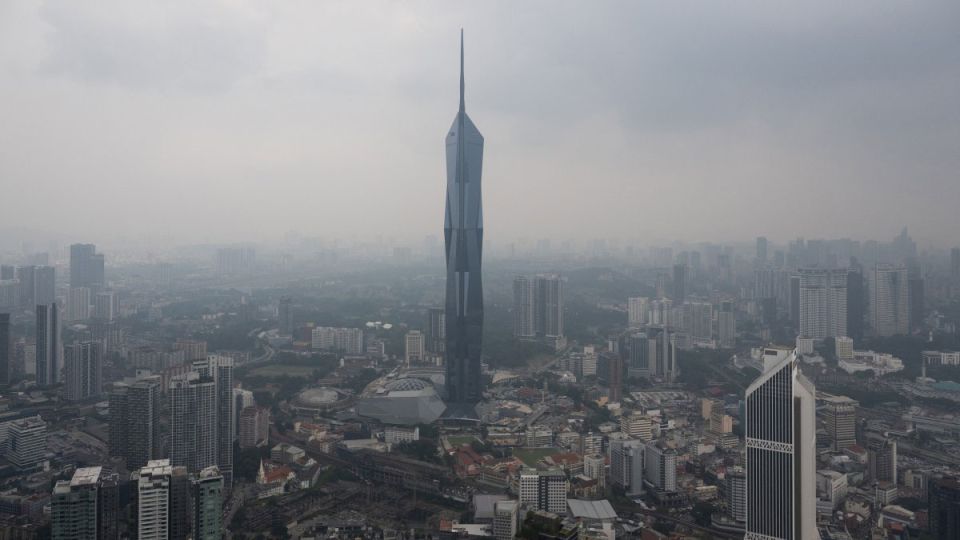
Malaysia and Brunei have agreed to raise the issue of transboundary haze pollution at the ASEAN level, as thick smoke from forest and peatland fires in Indonesia continues to drift across borders and affect its neighbors.
The agreement was reached over the weekend during Malaysian Prime Minister Anwar Ibrahim’s working visit to Bandar Seri Begawan for an annual consultation with Brunei Sultan Hassanal Bolkiah, where the leaders discussed possible measures to address the recurring problem.
“We both agreed to use the ASEAN mechanism as the best option. We have asked (Malaysian Foreign Minister Mohammad Hasan) to manage this issue,” Anwar told a press conference after the meeting.
A day earlier, Hasan told media that Kuala Lumpur would soon submit an official letter to the ASEAN Secretariat through Malaysia’s Natural Resources and Environmental Sustainability Ministry.
Read More: Malaysia, Indonesia Deepen Cooperation as Haze Season Looms
The move comes as forest and peatland fires blaze across Indonesia, with thousands of hotspots detected in Kalimantan and on Sumatra amid prolonged dry conditions as El Nino intensifies. Thick haze has shrouded parts of Kalimantan for weeks, with visibility in some areas falling to just one meter, disrupting road traffic and delaying flights.
The haze crossed into Malaysia, where air quality in parts of Sarawak has reached unhealthy and very unhealthy levels. Nearly 600 schools in the state were closed, affecting around 200,000 students, while authorities urged residents to limit outdoor activities.
Recurring haze has long been a source of tension between Indonesia and its neighbors, with ASEAN adopting the Agreement on Transboundary Haze Pollution in 2002 to strengthen regional cooperation on preventing and mitigating haze from forest and peatland fires.
With Malaysia set to formalize its complaint through the ASEAN Secretariat and Indonesia already scrambling to contain the fires on the ground, the coming weeks will test whether decades-old regional mechanisms can deliver a faster, more coordinated response than in past haze season, or whether this year’s El Nino-driven crisis will once again outpace the tools designed to manage it.