Brussels (TDI): The European Union has suspended its ratification of a major trade agreement with the United States after a sharp escalation in tensions over Trump’s Greenland rhetoric and statements.
On Wednesday, the European Parliament’s trade committee indefinitely postponed a scheduled vote to approve the pact, citing Trump’s threats to impose tariffs on European countries that oppose his bid to gain control over the autonomous Danish territory.
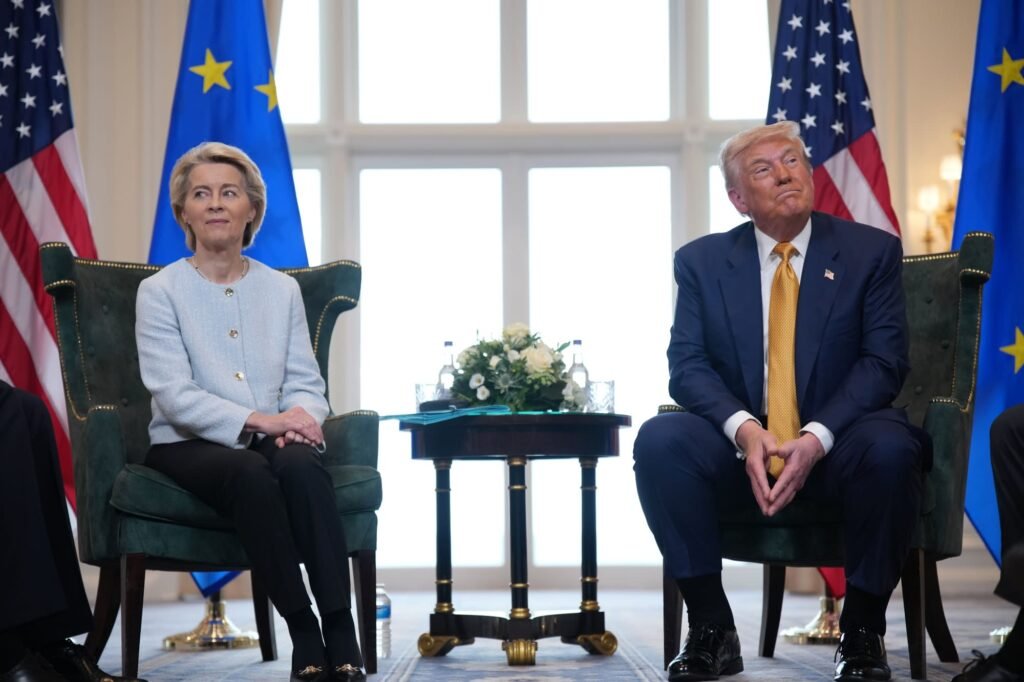
The trade agreement, often referred to as the Turnberry deal – named after the Scottish resort where the framework was initially agreed last July by Trump and European Commission President Ursula von der Leyen, sought to lower trade barriers between the world’s two largest economic blocs.
Under the deal, the United States had agreed to eliminate tariffs on most European industrial goods, while the EU would reduce duties on various US products. However, final implementation required approval from the European Parliament, which is now in jeopardy.
European lawmakers expressed strong objections to what they describe as coercive tactics; Trump’s repeated comments linking tariff threats to concessions on Greenland have crossed a line, many say, undermining trust and the stability of transatlantic trade relations.
Read More: Europe Draws Red Line on Greenland as Trump Escalates Rhetoric
“By threatening the territorial integrity and sovereignty of an EU member state and by using tariffs as a coercive instrument, the US is undermining the stability and predictability of EU-US trade relations,” European Parliament Trade Committee Chair Bernd Lange wrote in a social media statement.
Trump has threatened to levy tariffs of 10% as early as February on several European nations; including Denmark, France, Germany, and others, if they resist his push to initiate negotiations over Greenland’s future status, with threats rising to 25% in June.
These actions have compounded longstanding concerns among European leaders about Washington’s reliability as a trading partner. The parliamentary voting freeze reflects broader unease in Brussels and across EU capitals.
Centre-right leader, Manfred Weber, warned that without clarity on political reliability and a pause in hostile rhetoric, there would be “no ratification” and “no zero percentage tariff access to the EU for US products.”
Brussels has signaled potential retaliation, with discussions underway about re-imposing tariffs on up to €93 billion worth of US goods that had been frozen during negotiations.
With an extraordinary EU summit on Greenland issue happening today, the future of transatlantic trade cooperation now hinges on whether Washington will change its approach or face a deep rupture with its traditional allies.