In an increasingly interconnected world, diplomacy has evolved far beyond traditional political engagement. Today, it encompasses economic cooperation, cultural exchange, diaspora engagement, and strategic global partnerships. At the heart of this evolving practice are diplomats who serve as both representatives and negotiators of their country’s interests across diverse international platforms.
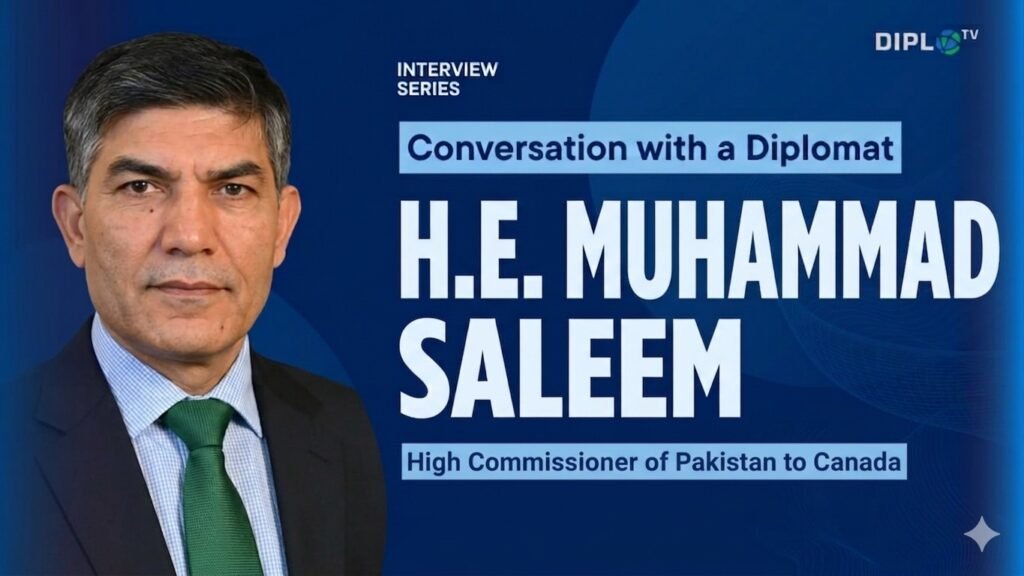
His Excellency Muhammad Salim, High Commissioner of Pakistan to Canada, is a seasoned career diplomat with over three decades of service in Pakistan’s Ministry of Foreign Affairs. Throughout his career, he has served in key international postings including Germany, Bahrain, and Tanzania, and has also held important assignments within Pakistan. Currently, he serves as High Commissioner to Canada and is concurrently accredited to the Federation of St. Christopher and Nevis, while also representing Pakistan at the International Civil Aviation Organization (ICAO) in Montreal.
In this interview, he reflects on his diplomatic journey, the demands of foreign service, and Pakistan’s expanding priorities in economic diplomacy, trade, and international cooperation.
Tell us about your personal journey towards becoming a diplomat and what truly drives you?
Diplomacy is the first line of defense of a country and also the first line of projection of your home country. There is no profession more prestigious than diplomacy in the Ministry of Foreign Affairs of Pakistan. The role of a diplomat is to represent Pakistan, promote its interests, and protect its vital national interests at the international stage while carrying the national flag everywhere you go abroad.
Can you share your educational and professional journey? How did you begin your career?
I joined the Ministry of Foreign Affairs in 1995. I completed German language training in Berlin. My first posting was in Berlin from 2000 to 2005. Later, I served in Pakistan’s embassies in Bahrain, Malaysia, and Romania. I also served as Deputy High Commissioner in Canada earlier in my career. My first ambassadorial posting was in Tanzania, and currently, I am serving as High Commissioner to Canada, which is my second ambassadorial assignment.
When did you realize that representing your country internationally would become your life’s mission?
It starts at the university level when you work hard and appear in the competitive CSS examination in Pakistan. If you qualify with a high score, you enter a good service group. Foreign Service is among the most popular choices. It depends on performance, hard work, and sometimes luck, and you end up where you are meant to be.
Was there any mentor or personal experience that inspired you to choose this profession?
Mostly, it is about hard work. You prepare, and then luck also plays its part. If you qualify for CSS, you have different service options. Even if you do not like one group, you can switch by reappearing. For me, Foreign Service has always been the best choice because there is no better profession than representing Pakistan abroad and promoting its interests at bilateral, multilateral, regional, and global levels.
Diplomacy is often described as the art of patience under pressure. Can you share a challenging phase in your career?
Diplomacy requires you to ensure that Pakistan receives its share in international goodwill, tourism, trade, investment, and soft image. Pakistan is a young country with 79 years of history and has faced multiple challenges since 1947. We operate in a highly competitive global environment. Our diplomats must ensure Pakistan is properly represented in terms of trade, culture, civilization, and people-to-people ties. It is a continuous, competitive process.
Is diplomacy a 24/7 responsibility? How demanding is the role?
Yes, it is a round-the-clock job. We operate with a 9 to 10-hour time difference between Pakistan and Canada depending on the season. Diplomats must stay updated on social media, international developments, host country affairs, and Pakistan’s domestic situation. We also engage actively with the Pakistani diaspora, which is around half a million in Canada. It is a full-time responsibility.
When you join the Ministry, you go through Foreign Service Academy training and language courses. You are prepared for long-term postings away from family. You may stay one to four years abroad, away from your extended social life. It is a sacrifice, but the institution prepares you for it.
Is this sacrifice worth it?
Yes. There is nothing more worthy than representing your country. The passport you carry and the identity you hold make it a matter of pride and responsibility.
What core principle has guided your career?
Pakistan started from very modest beginnings in 1947. Today, it is the fifth most populous country, a nuclear power, and an active member of global organizations such as the UN, OIC, SCO, ECO, and D-8. We have contributed significantly to peacekeeping and global humanitarian efforts. My guiding principle is to serve Pakistan with competence, loyalty, and responsibility.
What initiatives have you taken to strengthen Pakistan–Canada relations?
In the past year, we have had multiple official delegations between Pakistan and Canada covering immigration, investment, foreign affairs consultations, and development cooperation. We also had delegations related to sports, food exports, textiles, and minerals. Trade and investment relations have expanded, including Canadian investment in mining and renewable energy sectors in Pakistan. We also maintain strong academic linkages and people-to-people contacts.
What is the role of economic diplomacy today?
Economic diplomacy is the number one priority of all foreign ministries. Pakistan’s exports to Canada are around $500 million, while Canada exports around $200 million to Pakistan. We are focusing on expanding trade across all Canadian provinces. We also receive around $750 million in remittances over 10 months from the Pakistani diaspora. Additionally, around 15,000 Pakistani students are studying in Canada, contributing to education and economic exchange.
What are the key sectors of opportunity for Pakistan in Canada?
Key sectors include mines and minerals, energy, agriculture, machinery, ICT, AI, software, IT-enabled services, trade, banking, and finance. We are also promoting IT exports, sports goods, and winter apparel, especially with opportunities arising from major international events in North America.
How does the Pakistani diaspora contribute to bilateral relations?
The Pakistani community in Canada is highly skilled and includes professionals in IT, medicine, law, engineering, banking, and academia. They have built a strong reputation in Canadian society and are represented in parliament, provincial assemblies, and local governments. This diaspora is a major bridge between Pakistan and Canada.
What is one truth about diplomacy that no textbook teaches?
Diplomacy requires patience. Negotiations take time and multiple rounds. A good diplomat must be a reader, listener, thinker, writer, speaker, and negotiator. Everything must be based on logic, articulation, and reflection.
What guiding lesson would you draw from your service for Pakistan?
The country gives you everything you achieve in your career. In return, it becomes your moral, ethical, and national responsibility to give back with full dedication, competence, patriotism, and loyalty.
What opportunities excite you most for the future of Pakistan–Canada relations?
There is strong potential in sports goods, especially with international sporting events in North America, as well as IT services, winter apparel, textiles, and digital exports. Pakistan has over 75,000 IT graduates annually who can contribute significantly to global digital markets.
What message would you like to give to viewers and to Diplo TV?
Platforms like Diplo TV play an important role in connecting the youth of Pakistan with diplomatic institutions and foreign missions. This improves awareness and understanding of Pakistan’s foreign policy and global engagement. I wish them continued success in their efforts to build this bridge.

Established in December 2008, The Diplomatic Insight is Pakistan’s premier diplomacy and foreign affairs magazine, available in both digital and print formats.