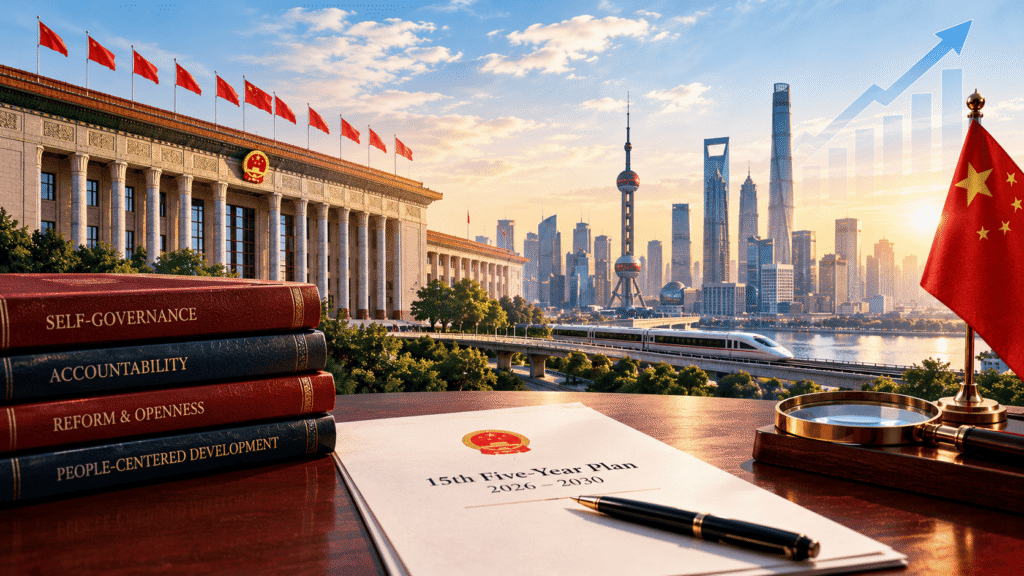
China’s modernization rests on a political strength that deserves greater international attention: the capacity to identify institutional weaknesses and organize sustained action to address them. As development becomes more technologically advanced and socially demanding, that capacity gains greater importance. The fifth plenary session of the 20th Communist Party of China Central Committee places this relationship at the center of national deliberations. Its focus on rigorous Party self-governance reflects a clear understanding that enduring progress requires institutions capable of renewing themselves.
The session opened in Beijing on October 26, with Xi Jinping, general secretary of the CPC Central Committee, explaining a draft decision on strengthening full and rigorous Party self-governance with perseverance. Scheduled through October 29, the gathering addresses the political and organizational foundations of China’s development. Its significance lies in connecting the Party’s responsibilities with the country’s growing ambitions for prosperity, technological advancement and public well-being.
The timing is significant. China has entered the first year of its 15th Five-Year Plan, covering 2026 to 2030, a crucial period for advancing toward socialist modernization by 2035. The priorities ahead require coordination across industrial policy, scientific research, public services and regional development. Strong Party leadership provides continuity across these interconnected tasks. Rigorous self-governance strengthens that leadership by reinforcing accountability, improving official conduct and keeping institutions focused on national development.
The fifth plenary session of the 20th CPC Central Committee distinctive significance lies in strengthening the governing capacity needed to deliver the country’s development ambitions. While the third plenum in 2024 concentrated on deepening reform and the fourth in 2025 adopted recommendations for the 2026–2030 development plan, this session focuses on full and rigorous Party self-governance. The progression has ben based on the fact that reform establishes direction, planning defines priorities, and stronger governance supports implementation. By addressing institutional weaknesses, reinforcing accountability and improving official conduct, the session can help ensure that investment, innovation and public resources translate into sustained improvements in people’s lives.
Recent economic figures help explain the demands of this transition. China’s economy expanded 4.6 percent during the first three quarters of 2026, while high-tech manufacturing grew 14.3 percent. Equipment manufacturing increased 10.2 percent. These achievements demonstrate the growing contribution of advanced productive capacity. They also underline the importance of capable institutions that can support innovation, coordinate infrastructure and help technological progress generate wider economic opportunities.
This is where Party self-governance acquires developmental meaning. Public resources produce greater value when decisions follow national priorities, professional judgment and clear responsibilities. Scientific funding works best when merit guides allocation. Industrial investment delivers stronger returns when projects reflect genuine capabilities and market demand. By addressing corruption and administrative misconduct, China can protect the resources and institutional credibility essential to its next stage of growth.
The benefits extend to the business environment. In May, the Ministry of Justice reported correcting approximately 66,000 improper enterprise-related administrative enforcement cases. The campaign addressed excessive inspections, arbitrary fines and improper asset seizures, among other problems. Such action demonstrates a practical commitment to improving the relationship between public authority and productive enterprise. Fairer enforcement helps businesses devote more time and resources to investment, employment and innovation.
For private entrepreneurs and international investors, consistent implementation carries particular weight. Confidence grows when enterprises can understand the rules, anticipate administrative decisions and pursue opportunities through fair competition. Strong supervision of official conduct can make these conditions more dependable. The resulting improvement reaches beyond individual businesses, supporting the wider circulation of capital, knowledge and talent throughout the economy.
China’s approach also recognizes the importance of institutional endurance. In March, the National People’s Congress adopted the National Development Planning Law alongside approval of the 15th Five-Year Plan outline. The legislation formalizes planning procedures and establishes requirements for implementation and evaluation. Read alongside the plenum’s agenda, this development illustrates a broader effort to connect strategic ambition with durable mechanisms of delivery and oversight.
The human dimension remains central. Citizens experience governance through the quality of schools, healthcare, social protection and local services. Improvements in official conduct can make these encounters fairer and more responsive. When public institutions resolve practical concerns efficiently, they strengthen confidence in the larger development project. This gives substance to China’s people-centered philosophy: modernization earns its meaning through improvements in everyday life.
From Pakistan’s perspective, this emphasis offers a valuable lesson about development capacity. Ambitious partnerships need institutions that can translate agreements into functioning projects, competitive enterprises and opportunities for communities. China’s experience highlights the importance of policy continuity, administrative learning and sustained implementation. Each country must develop arrangements suited to its circumstances, while cooperation creates opportunities to exchange practical experience.
The plenum’s international relevance follows from China’s economic reach. More effective governance can support reliable investment partnerships, stronger project implementation and greater confidence among trading partners. These gains matter across interconnected supply chains and development initiatives. China’s institutional progress therefore carries benefits that extend beyond its borders, especially for partners seeking stable cooperation amid global uncertainty.
The significance of this gathering lies in treating self-renewal as a continuing responsibility of leadership. China’s development has reached a stage where institutional quality increasingly determines the value of investment, the reach of innovation and the credibility of public commitments. Sustained Party self-governance can strengthen all three. Its promise is a more capable governing system that turns national ambition into lasting public benefit.

Muhammad Asif Noor
The writer is Founder, Friends of BRI Forum and Advisor to Pakistan Research Centre, Hebei Normal University