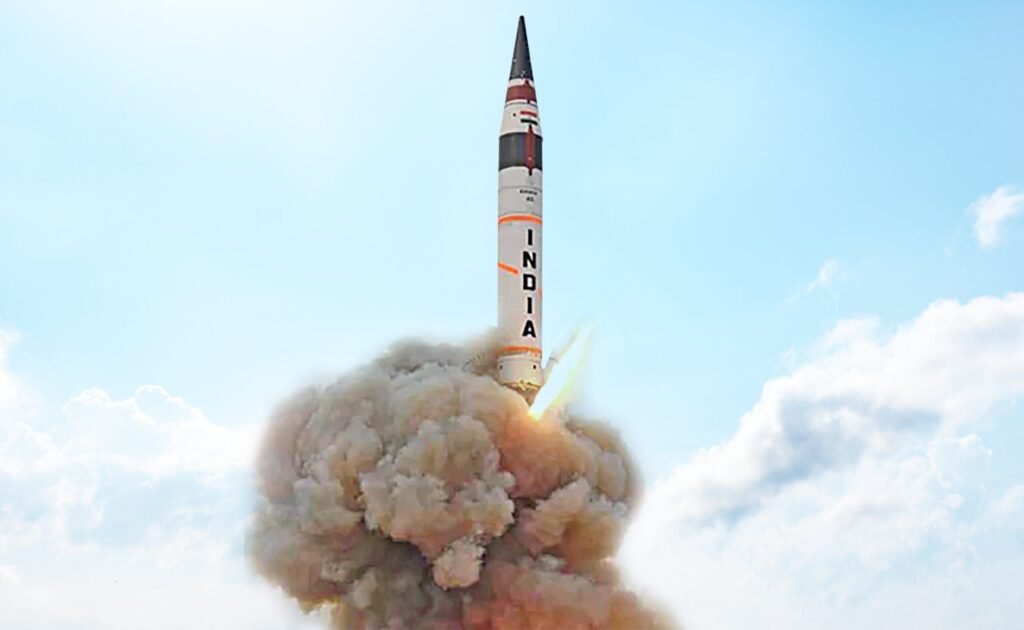
According to the Defense Research and Development Organization (DRDO), India is reportedly prepared to test its intercontinental ballistic missile Agni-VI with a capability to carry multiple warheads and an estimated range of 12,000 km.
Primarily, India explained the development of long-range missiles as part of its deterrence to counter China and Pakistan, but now the range of India’s missiles has extended beyond regional rivals to reach the United States, Europe, Canada, and other regions. This development has serious concerns for global security and the international nonproliferation regime.
Over the past 20 years, India has dramatically accelerated its military modernization and developed capabilities similar to those of major military powers like the United States, Russia, China, France, and the United Kingdom through anti-satellite (ASAT) tests, rail-based missile systems, nuclear-powered submarines, space technologies, advanced fighter aircraft, and ballistic missile defense systems.
A large portion of this progress has been made possible by the strategic cooperation and exceptions of the United States and other Western powers. India’s special focus on long-range missile systems that can reach areas far outside of South Asia, such as the Middle East, Europe, and North America, and is also increasingly pursuing dual-use technologies and advanced conventional weaponry, including laser systems, sophisticated missile systems, precision-guided munitions, and sensors. The capabilities increase the chances of quick escalation during crises and reduce the threshold for nuclear conflict.
Read More: Destabilizing Global Impacts of India’s Agni-VI
These developments highlight that India is moving away from a regional deterrence posture and towards a power projection stance. Therefore, Agni-VI’s development shows ambitions that go beyond short-term security issues and are more closely associated with strategic influence and escalation of domination.
As a result, concerns are raised about the continued implementation of India’s stated doctrines of Credible Minimum Deterrence and No-First-Use in light of its growing missile program. India’s expanding conventional and strategic capabilities reinforced defensive or preemptive military choices during crises. The examples are the 2019 and May 2025 crises, in which India chose offensive strikes over long-term diplomatic engagement with Pakistan.
As a result of India’s ongoing modernization and pursuit of counterforce capabilities, South Asia is becoming more unstable. Another significant issue is the selective approach of major powers to non-proliferation matters in South Asia. While muted about India’s rapidly growing missile ranges and strategic initiatives, Western countries often voice concerns over Pakistan’s nuclear capabilities despite being a responsible nuclear state with robust nuclear safety and security under the IAEA safeguards.
Geopolitical double standards of the international community, motivated by strategic and commercial goals, can be seen through discrimination and biased approach, such as special exemption to India in the Nuclear Suppliers’ Group in 2008 and membership of the Missile Technology Control Regime in 2016, ignoring Pakistan’s request and efforts for joining such groups.
Concerns about the changing nuclear situation in South Asia are further bolstered by a recent report published in the Stockholm International Peace Research Institute’s Yearbook 2025. According to the report, India continued to modernize and expand its nuclear arsenal, growing its estimated warhead inventory from 172 to 180 while concurrently developing cutting-edge delivery systems, such as Canisterized missiles and MIRV-capable technologies.
In this context, India’s growing strategic capabilities and development of longer-range weapons like Agni-VI put more stress on the stability of regional deterrence and raise significant concerns about the long-term viability of international non-proliferation regimes and norms.
India’s larger geopolitical goals are also closely related to its strategic aspirations. India is pursuing domination in the Indian Ocean Region (IOR) as a result of its “Act East” policy and growing marine vision. The reduction of the strategic presence of foreign countries, such as the US and its allies, in this area, India wants to achieve its long-term goals. Western nations’ ongoing strategic support to India will eventually have unexpected repercussions.
India poses a threat to these nations that are currently supporting its rise due to its expanding military and nuclear capabilities. According to the logic of international politics, alliances are more likely to be contingent on changing national interests than on long-term alignments.
Read More: Pakistan Warns India of Stronger Response to Any Aggression
India’s economic expansion, military modernization, and growing technology capabilities all support the country’s ambition to become a major power. However, the standards of minimum deterrence are being surpassed by the development of ICBMs and longer-range Submarine-Launched Ballistic Missiles (SLBMs). These patterns give rise to worries that India may progressively adopt a stance that prioritizes escalation dominance and first-strike capability.
India’s rising strategic capabilities and expanding missile program pose a challenge to nonproliferation regimes’ normative goals. As India has a track history to convert peaceful nuclear technology into nuclear weapons, the change of fissile material for the development of long-range systems such as Agni-VI and advanced SLBMs is also alarming. International scrutiny by the International Atomic Energy Agency, NSG members, and MTCR is compulsory to investigate whether India’s strategic program aligns with IAEA safeguards and non-proliferation commitments.
These developments also have broader implications for increasing regional arms competition, heightened risk of escalation, and crisis instability in South Asia. India’s advanced nuclear capabilities will produce the continued military options that can change the dynamics of the regional and international balance of power.
At the international level, India’s expanding missile program needs a closer inspection because it will shape long-term strategic realities.
Along with that, South Asia risks entering a more volatile and unpredictable nuclear era, without meaningful diplomatic engagement, balanced international oversight, and renewed commitments to strategic restraint. Escalation dominance strategies, offensive strikes, and crisis miscalculations will increase in such an environment.
*The views presented in this article are the authors’ own and do not necessarily reflect the views of The Diplomatic Insight.

Nazia Sheikh
Nazia Sheikh is a Research Officer at the Centre for International Strategic Studies, AJK. She holds an MPhil degree in International Relations from the International Islamic University, Islamabad, Pakistan. Her research interests focus on arms control and disarmament. She can be reached atnsheikh536@gmail.com