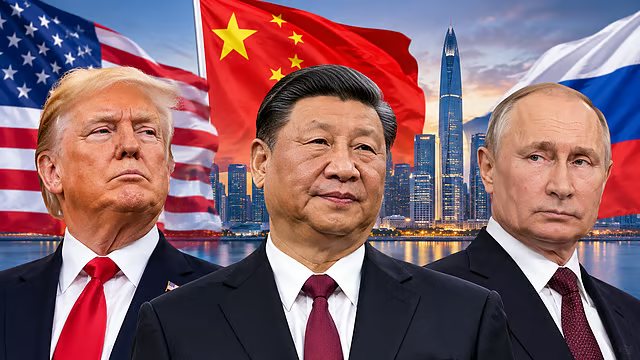
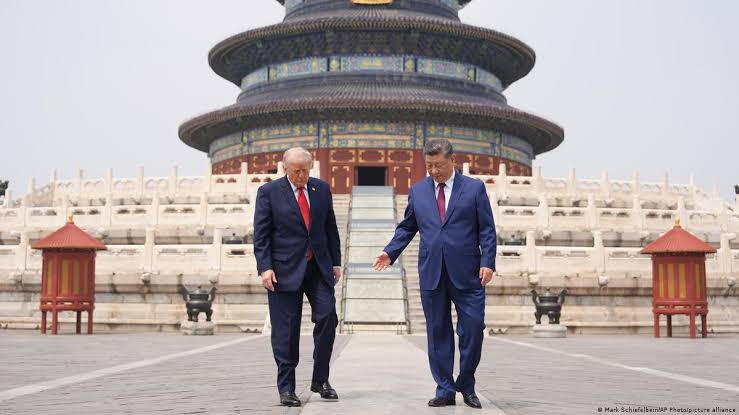
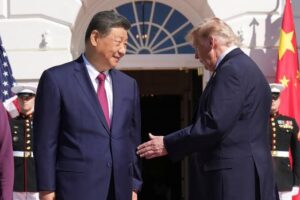
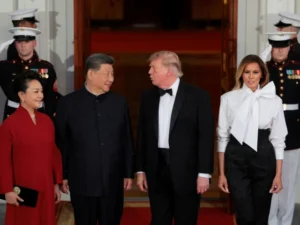
The recent summit in Washington between Donald Trump and Xi Jinping presented itself to the world as a major event, marked by expressions of friendship and cooperation. Indeed, the US president extended one of the most lavish welcomes accorded to a foreign leader in recent decades. He personally received the Chinese leader at Joint Base Andrews military airfield—an honour reserved for very few foreign heads of state—and hosted a gala dinner in his honour at the White House, attended by prominent business leaders and institutional figures. In his official remarks, Trump spoke of “a great friendship, a really great one, built on mutual respect and on the vital interests of our peoples” and highlighted the “enormous progress” made by the United States and China on trade.
Xi was more measured. He said that the interests of the two countries are “deeply intertwined”, that competition must remain “healthy and within certain limits”, and that it should be “a race to catch up with each other, rather than a struggle in which one side wins and the other loses”. He repeated his warning about the “Thucydides Trap” and called for both sides to “maintain the line of no conflict and no confrontation”. Xi also referred to the “rejuvenation of the Chinese nation” and “Make America Great Again” as “ambitious” goals that could potentially complement each other and therefore provide possible common ground between the two countries.
Yet among the events experienced by the Chinese leader in Washington, there was one that received relatively little media attention but carried resonances that were anything but cordial: his visit to the US National Archives, where Xi was shown documents associated with some of the most humiliating chapters in Chinese history.
The Treaty of Wanghia of 1844, although presented as a treaty of peace, friendship and commerce, is regarded in China as the first unequal treaty imposed by the United States. Although the treaty was not preceded by a direct military conflict between the United States and China, it contributed to the collapse of China’s traditional trading system in favour of Western imperialism. Together with the agreements imposed by Britain and France, the Treaty of Wanghia marked the beginning of what Chinese historiography defines as the “Century of Humiliation”, fuelling deep anti-Western resentment among the Chinese population.
A similar historical memory is associated with the Treaty of Tientsin of 1858. The 1895 letter from the Guangxu Emperor to President Grover Cleveland also had a controversial and humiliating background from the perspective of Chinese historical memory. The letter thanked the American diplomat Charles Denby for his mediating role during the Sino-Japanese War. Historical accounts, however, indicate that the American diplomat had in fact exerted considerable pressure on the Chinese government to accept the terms imposed by the 1895 Treaty of Shimonoseki, which forced China to cede the island of Taiwan to Japan.
Even more sensitive is the 1951 Treaty of San Francisco, which formally ended the war with Japan while excluding China, despite China having been an ally of the United States in the war against Japan. Beijing maintains that the treaty violated the wartime alliance and regards as illegitimate the provisions that removed Taiwan from Chinese sovereignty.
Read More: Trump and Xi Wrap Washington Summit with Talk of Harmony
For Washington, these are archival documents; for Beijing, they evoke memories of injustices suffered and concessions imposed. Yet beyond this diplomatic insensitivity on the part of the United States, the summit projected the image of two presidents apparently in tune with one another. In practice, however, the trade truce was extended by only two months, and the agreements announced remain limited in scope. Beijing had wanted to extend the truce for two years and effectively freeze the situation until the next US presidential election. Washington, however, said no.
The issue of rare earths is emblematic. Chinese export controls introduced in April 2025 remain in force. The widening price differential illustrates the extent to which the market remains decoupled: dysprosium oxide, which is used in high-performance magnets, costs roughly seven times more outside China than on the Chinese market.
Japan is the country suffering most severely from the restrictions: this year it has received neither dysprosium oxide nor terbium oxide from China.
What remains to be seen is whether Beijing will now accelerate export authorisations and shipping procedures for civilian applications. Europe has so far been only partially affected by China’s restrictions on rare earths. It is paying a high price for them, but it has not experienced a full-scale blockade comparable to the one faced by Japan.
Read More: Trump Welcomes Xi to Washington for High-Stakes Trade Talks
Nevertheless, the sword of Damocles hanging over European industry is intended above all to deter Brussels from adopting effective protectionist measures against Chinese imports. Keeping imports from China largely unrestricted contributes to deindustrialisation. Imposing significant restrictions, on the other hand, would create serious problems for Europe’s electronics industry—problems that none of the governments of the European Union’s member states appears willing to confront.
Elenoire Laudieri
The writer is an analyst and expert on diplomacy.