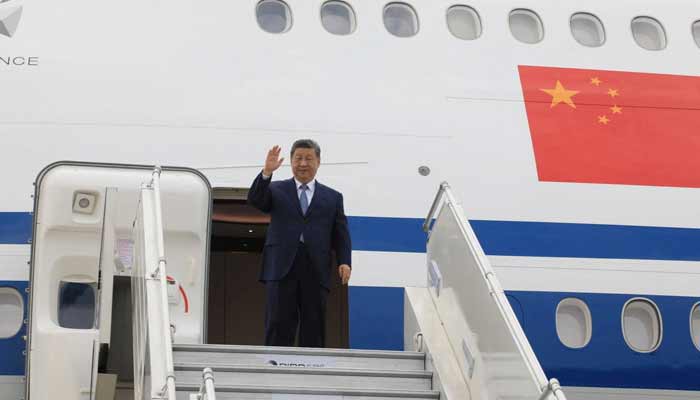
New Delhi (TDI): Chinese President Xi Jinping arrived in New Delhi on Saturday for a BRICS summit bringing together leaders from India, Russia and Iran, with conflicts in the Middle East and Ukraine, global trade tensions and energy security expected to dominate discussions.
Xi’s visit is also drawing attention as his first trip to India since 2019 and the most significant step so far in a cautious improvement in relations between the two nuclear-armed neighbours.
Xi received a red-carpet welcome in New Delhi, including a guard of honour and traditional performances by dancers in colourful attire.
His arrival comes six years after a deadly military confrontation between Indian and Chinese troops along their disputed Himalayan border in 2020. Relations have since gradually improved through the restoration of flights, visa arrangements and high-level diplomatic contacts.
Beijing said on Friday that it was ready to strengthen communication and cooperation with India while properly managing differences between the two countries.
However, the long-running territorial dispute remains unresolved. Both sides continue to maintain substantial military deployments along their roughly 3,500-kilometre high-altitude border.
Read More: BRICS Financial Chiefs Issue Joint Call for Overhaul of Bretton Woods Institutions
Xi is scheduled to hold face-to-face talks with Indian Prime Minister Narendra Modi later on Saturday, according to India’s Foreign Ministry.
China-India relations remain complicated by strategic mistrust, the unresolved border dispute, India’s growing trade deficit with China and broader competition between the two Asian powers.
Modi held talks with Russian President Vladimir Putin on Friday after publicly welcoming him. Putin, who last visited India in December 2025, remains one of New Delhi’s key strategic partners.
India has also turned to Russia to help manage energy pressures arising from the US-Iran conflict, despite Moscow’s ongoing war in Ukraine and pressure from Washington and other Western capitals.
Iranian President Masoud Pezeshkian, who arrived in New Delhi on Friday, said pressure on Tehran had reached a “critical and dangerous stage” following what he described as military aggression by the United States and Israel.
Modi also held talks with Pezeshkian as India sought to maintain its longstanding relations with Iran while preserving its strategic partnership with Washington and its ties with Israel.
Established in 2009, BRICS was created as a platform for major emerging economies seeking a greater role in global institutions traditionally dominated by Western powers.
Read More: 25 Years After 9/11: From Al-Qaeda to ISIS to the Next Threat
Modi told leaders that BRICS countries collectively represent around half of the world’s population, 40 percent of global GDP and more than a quarter of global trade.
The grouping now includes Iran, Saudi Arabia and the United Arab Emirates, despite their differing positions on the ongoing US-Iran conflict. UAE President Mohamed bin Zayed Al Nahyan, Saudi Foreign Minister Prince Faisal bin Farhan and Egyptian President Abdel Fattah al-Sisi are also expected to attend the summit.
Brazil is represented by Foreign Minister Mauro Vieira, as President Luiz Inacio Lula da Silva campaigns ahead of October elections.
The bloc’s internal divisions were highlighted in May, when BRICS foreign ministers failed to agree on a joint statement during their meeting in New Delhi.