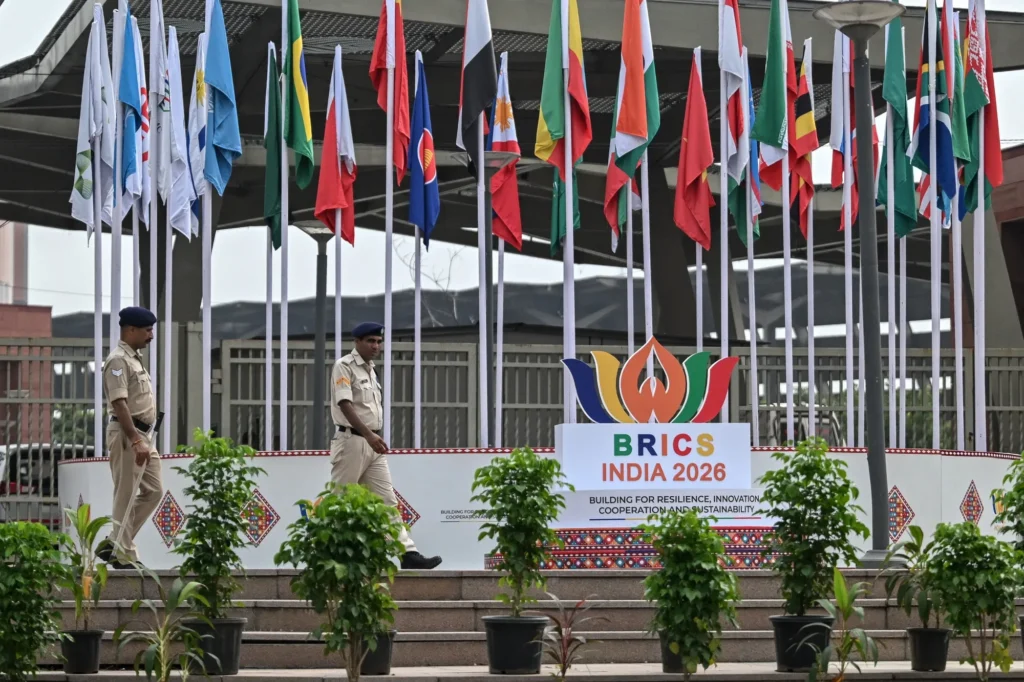
Finance ministers and central bank governors of the BRICS grouping have issued a unified demand for sweeping reform of the International Monetary Fund and the World Bank, warning that post-war multilateral financial architecture no longer reflects the realities of a reordered global economy.
The joint statement, released on the eve of the 18th BRICS Leaders’ Summit in New Delhi, represents the bloc’s most coordinated institutional push to date.
The finance chiefs called for a stronger voice for emerging market economies within global developmental financial institutions, arguing that existing governance structures have failed to keep pace with shifts in the balance of global economic power.
Their statement was unambiguous on the political stakes: “With the growing share of emerging market and developing economies in global output and growth, reform of global economic governance remains a consistent BRICS priority.”
The Bretton Woods institutions, created in the aftermath of World War II, should better reflect those shifts, the finance chiefs said in their joint statement, calling for increased IMF quota and voting shares for emerging and developing countries. They also backed greater representation of those economies in the leadership of the IMF and World Bank.
The bloc pressed for faster implementation of IMF quota reforms agreed under the 16th General Review, and for progress on a 17th review that would further realign voting shares toward developing nations.
It also endorsed the 2025 World Bank Shareholding Review as a mechanism to correct what it described as the historic underrepresentation of developing countries.
The financial chiefs did not confine their critique to institutional representation. “We continue to have serious concerns with the unilateral imposition of trade and finance-related actions, including the raising of tariffs and non-tariff measures, which distort trade and are inconsistent with World Trade Organization rules,” the statement said.
The declaration comes amid sustained pressure on emerging economies from elevated oil prices — exacerbated by geopolitical conflict — and volatility in American trade policy.
On cross-border payments, the statement called for practical, low-cost interoperability: “We encourage the BRICS Payment Task Force to continue discussions, building on the ongoing work, to facilitate practical solutions for cross-border payments among BRICS countries, which are fast, low-cost, more accessible, efficient, transparent, and safe.”
India will host the BRICS Leaders’ Summit this weekend, with leaders from Russia, China and Iran among those due to attend.
The gathering in New Delhi is widely seen as a test of the enlarged bloc’s cohesion — and its capacity to translate shared institutional grievances into a credible reform agenda before the world’s major multilateral bodies.