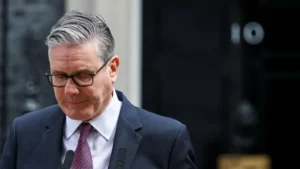
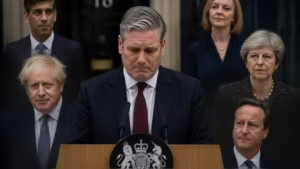
The resignation of Keir Starmer as leader of the Labour Party and Prime Minister marks yet another dramatic turn in Britain’s increasingly volatile political landscape. In less than two years since a landslide electoral victory, a leader once hailed as the architect of “national renewal” has been forced out by his own party, an outcome that is becoming disturbingly familiar in Westminster politics.
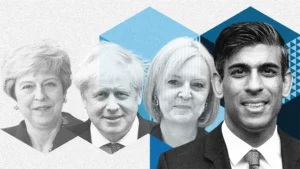
It raises a question that is no longer theoretical but urgent, why does UK seem unable to keep a Prime Minister in office long enough to govern effectively? Ironically, the country has indeed experienced an unprecedented period of political volatility, cycling through six Prime Ministers in just one decade.
On paper, the UK’s parliamentary system is designed for stability. Unlike presidential systems, where leaders are fixed for a term, a Prime Minister governs as long as they maintain the confidence of Parliament and their party. In theory, this ensures accountability and flexibility.
In practice, however, the balance has tilted sharply toward internal party politics, often at the expense of national governance. Recent years have seen an unusually high turnover in Downing Street. From Conservative infighting during the Brexit era to rapid leadership changes across parties, Britain has entered a “permanent leadership election cycle.”
Even the historic strength of the two-party system, anchored by the Labour Party and the Conservative Party, has been eroded by fragmentation, declining trust, and the rise of insurgent forces such as Reform UK, which has capitalized on voter anger and institutional fatigue.
Starmer’s downfall, as described by critics within the Labour Party, reflects more than personal failure. It highlights the structural pressures that now define British governance. His administration entered office promising stability after years of turbulence. Instead, it inherited a deeply strained economy, industrial unrest, and escalating geopolitical pressures linked to conflicts in Europe and the Middle East. Policy reversals, internal dissent, and falling approval ratings quickly followed.
Read More: UK PM Starmer Resigns Amid Mounting Political Pressure
The result was a familiar Westminster pattern: a leader weakened not just by opposition parties, but by their own parliamentary colleagues. Once that internal confidence begins to erode, Prime Ministers in the UK system rarely survive for long.
A major question is being raised, is parliamentary democracy failing? To find the answer, we have to look deep inside as to describe the situation as a failure of parliamentary democracy would be too simplistic. The Westminster system remains one of the most influential governance models in the world, exported and adapted across continents. But it is under strain now.
Modern party leadership structures are far more centralized than in the past. MPs often face intense pressure from party whips, while leadership contests can be triggered rapidly when internal factions shift.
The 24-hour news cycle and social media amplify mistakes and controversies, compressing political time. A policy misstep that might once have been absorbed over months can now become a crisis within hours.
While traditional party loyalty has also weakened. New political movements and shifting alliances mean governments often lack a stable, long-term mandate, even after winning large electoral victories.
Britain is not alone. Across other parliamentary democracies, similar tensions are emerging. In countries like Italy, frequent government changes have long been the norm. Israel has also experienced repeated elections and fragile coalition governments. Even historically stable systems such as Canada and Australia have seen increasing leadership churn and tighter internal party discipline.
The common thread is clear, parliamentary systems are becoming more sensitive to internal party instability and external public volatility. But does this mean the system is broken? Not necessarily. Parliamentary democracy still offers key advantages such as the ability to remove ineffective leaders without a full national election, stronger legislative-executive integration, and greater responsiveness to political shifts.
Read More: Political Crisis Mounts for UK’s Starmer After Health Secretary Exit
But those strengths can become weaknesses when party cohesion collapses. What is changing is not the constitutional design itself, but the political environment in which it operates. Trust in institutions is lower, media pressure is higher, and ideological divisions are sharper than at any point in recent decades.
So what is the road ahead? The UK now faces a choice, not between parliamentary and presidential systems, but between adaptation and gradual erosion of political stability. Reforms being quietly debated include strengthening internal party selection processes, limiting leadership challenges during parliamentary terms, and reconsidering the balance between party authority and MP independence.
Yet deeper questions remain unresolved, can modern politics still sustain long-term leadership? Or are democratic systems destined to produce shorter, more turbulent cycles of power? Keir Starmer’s resignation may be remembered not as an isolated political downfall, but as another sign of a system struggling to adjust to a faster, more fragmented world. The Westminster model is not collapsing, but it is clearly being tested like never before.

Farkhund Yousafzai is a seasoned journalist and analyst with over a decade of experience in the media industry. He specializes in national politics and international relations and regularly contributes as an analyst to national and international media outlets.