Two bridges, long delayed, are now preparing to open, and together they constitute something larger than a bilateral connectivity project.
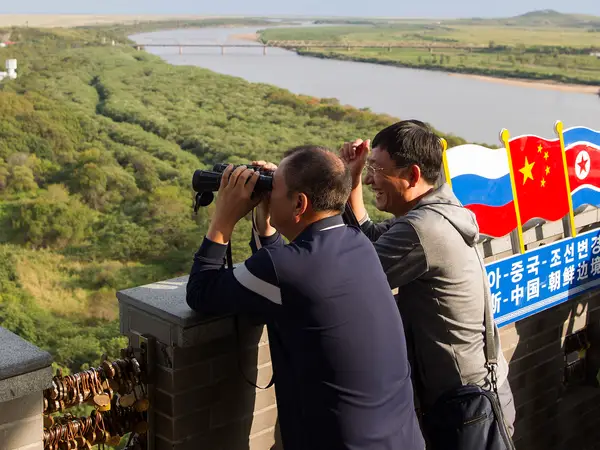
The Tumen River Bridge, linking North Korea’s northeastern city of Rason with Russia’s Khasan, was designed to handle up to 300 vehicles and 2,850 people daily.
Satellite imagery shows that construction on the Russian side accelerated sharply in August, with the main cargo road paved and parking and inspection areas for trucks nearing completion.
The Khasan district head confirmed in July that the bridge was already “ready for operation” and that officials planned to open it in early September.
Meanwhile, a structurally separate but politically inseparable project has accelerated on the opposite end of the peninsula. The New Yalu River Bridge, connecting Sinuiju with China’s Dandong, was completed twelve years ago but left unused because the two sides could not agree on financing the remaining infrastructure.
Satellite imagery from August 30 shows paving on the connecting road and customs compound nearly finished, with a new gate installed and exterior walls nearing completion.
These two openings are not coincidental. Pyongyang appears to be seeking to open both bridges simultaneously, establishing dual land routes to Russia and China and maximizing the economic benefits of its ties with both. Read together, they are a geopolitical declaration.
The Constellation: What September 2026 Inherits
To understand the bridges, one must read the chain of events that preceded them. The architecture of the Pyongyang–Moscow–Beijing triangle was not assembled overnight, it accumulated through a sequence of substantive, verifiable moves across eighteen months.
In September 2025, for the first time in sixty-six years, the leaders of the DPRK, Russia, and China stood together at a military parade; Kim Jong-un, Vladimir Putin, and Xi Jinping attended China’s commemoration of the 80th anniversary of the end of World War II in Beijing, the first such trilateral gathering since 1959.
Kim and Putin held bilateral talks on the margins, with Kim reaffirming Pyongyang’s commitment to prioritizing and deepening ties with Moscow. That gathering was not a diplomatic ceremony. It was a photograph of the emerging order.
By April 2026, the military dimension of the Russia–DPRK relationship was being institutionalized. Russian Defence Minister Andrey Belousov travelled to Pyongyang, and his words at the meeting with Kim Jong-un were unambiguous.
Belousov said, “We have reached an agreement with the DPRK Defense Ministry to place our military cooperation on a sustainable, long-term footing. We are prepared to sign a Russian–Korean military cooperation plan for the 2027–2031 period this year.”
Belousov also, in the same visit, awarded North Korean troops and officers the Order of Courage for their role in the Kursk operations; recognition that carries bilateral weight beyond ceremony. Russia’s Defense Ministry described ties between the countries as “unprecedentedly high.”
May 9, 2026, added another layer. North Korean troops marched in Russia’s Victory Day military parade at Moscow’s Red Square for the first time, carrying the DPRK national flag and a Victory Day banner; Putin personally met with the North Korean column commander to express his appreciation.
Brandishing silver-adorned weapons, the North Korean troops and generals who fought in Kursk intended to send a message not only to Ukraine and its allies, but also to Washington, Seoul, and Tokyo, that the alliance between Pyongyang and Moscow will last and expand.
Kim, in his congratulatory message to Putin that day, reaffirmed “the stand of the government of the DPRK to give top priority to and steadily develop the alliance-like comprehensive strategic partnership between our two countries,” pledging to “always faithfully fulfil the obligations under the inter-state treaty.”
Then came Beijing’s response. In June 2026, for the first time in seven years, Xi Jinping visited Pyongyang — making it his only foreign trip of 2026. The timing, the symbolism, and the sequencing all speak.
Xi had hosted Trump in Beijing in mid-May and Putin in late May before flying to Pyongyang. He came not as a patron dispensing benevolence, but as a peer recalibrating a relationship that had been quietly tilting eastward — toward Moscow — for three years.
The June meeting was timed to mark the 65th anniversary of the China–DPRK Treaty of Friendship, Cooperation, and Mutual Assistance. Xi proposed exchanges covering “diplomacy, law enforcement, military affairs, and others;” the first-time military affairs appeared in a public summit readout between Beijing and Pyongyang.
Kim called the DPRK–China relationship “the foremost strategic undertaking of the state” and described Xi as “the most respected guest of the DPRK people.” Chinese Defense Minister Dong Jun accompanied Xi and met with his North Korean counterpart, the first such bilateral military meeting since 1992.
Beijing, per CSIS analysts Victor Cha, Bonny Lin, Truly Tinsley, and Andy Lim, also appears to have de facto dropped any mention of denuclearization from its public readouts, a notable departure from China’s stated position as recently as 2023, when China’s Permanent Representative to the UN reiterated the commitment to “the denuclearization of the peninsula.” The silence is its own signal.
On the economic dimension, China–DPRK two-way goods trade reached $2.7 billion in 2025, the highest since the border closure in January 2020, and the first six months of 2026 ran 19 percent ahead of the same period the prior year.
Direct flights between Beijing and Pyongyang resumed in 2026. Passenger train service between the two capitals was revived. Tourism packages to the DPRK were placed on sale by Chinese travel agencies following Xi’s visit, though visa issuance remains pending.
The Inter-East Balance: China Moves to Match Russia
The Yalu bridge’s acceleration is best understood not as bilateral goodwill but as strategic counter-movement. Former senior North Korean official Ri Jong Ho, now based in Virginia, told Radio Free Asia that “Chinese alarm at the pace of Tumen River bridge progress may have contributed to the recent push to complete the Yalu crossing,” that Xi may have “pressed Kim to open it, particularly as construction on the Russia–DPRK bridge rapidly advanced while the Yalu project had stalled for over twelve years.”
This is the logic of intra-coalition balancing. Pyongyang is not a passive object of great power competition, it is the active orchestrator of it.
CSIS analysts note that since the start of the Ukraine war, Russia–DPRK high-level exchanges have “significantly dwarfed” those between North Korea and China; a historically unprecedented fact.
Beijing, watching its neighbor tilt toward Moscow at the level of troops, weapons, joint parades, and institutional military planning, moved to restore equilibrium. The result is that Kim Jong-un now holds real leverage over both partners simultaneously.
Professor Im Eul-chul of the Institute for Far Eastern Studies at Kyungnam University captured this succinctly: “Now, through these two bridges, North Korea is gaining access to China and Russia as vast economic and logistical backyards. This can also be interpreted as a message to the United States that North Korea has less reason to denuclearize or make major concessions simply to secure economic benefits through negotiations with Washington.”
Beijing’s motivations also extend to counterbalancing Japan’s military buildup, hedging against an unpredictable United States, and strengthening its military options regarding Taiwan. If US forces were tied up in a Korean Peninsula contingency, Beijing’s calculus shifts.
There is also the Tumen River access question, which sits quietly underneath all of this. Russia and North Korea control the last fifteen kilometers of the Tumen River, which empties into the Sea of Japan.
The joint statement from Putin and Xi’s May 2026 summit highlighted the issue of Chinese access to this stretch, with both sides reaffirming “their commitment to continuing trilateral consultations with North Korea” on the matter.
If Pyongyang eventually grants China access, Beijing’s northeastern provinces gain a maritime shipping route and the PLA gains proximity to the Sea of Japan. The decision is Pyongyang’s to make, and Pyongyang knows it.
The Military Exchange: What Has Already Crossed
The DPRK–Russia military relationship has moved from transactional to structural. What began as artillery shells and ballistic missile transfers in 2023 became, by late 2024, the deployment of approximately 15,000 combat troops to Russia’s Kursk operation; a decision that made two nuclear-armed states active military co-belligerents in a European land war for the first time since the Cold War.
The proposed 2027–2031 military cooperation plan covers arms transfers, technology sharing, joint training, and personnel exchanges, the building blocks of an institutionalized alliance rather than a transactional emergency arrangement.
Pyongyang has supplied at least 150 KN-23 and KN-24 ballistic missiles, with an additional 120 promised. Millions of artillery shells have crossed the border, filling gaps in Russian ammunition production that Russia’s own defense-industrial base could not cover at the pace the war demanded.
The flow is not one-directional. North Korea could use the Tumen bridge as a route for importing Russian military supplies once it opens, including support for missiles and nuclear-powered submarines, through channels that would face less international scrutiny than sea or rail shipments.
On the Chinese side, the military dimension, while newer and less operationalized, has distinct momentum. On July 3, 2026, just days before China and Russia’s joint maritime exercises off Qingdao, North Korea showcased its new 5,000-ton destroyer, the Kang Kon, with Kim personally observing it launch twelve cruise missiles from a vertical launch system.
The timing, three countries displaying naval capabilities in approximate simultaneity, was not lost on analysts. Russia has also expressed support for North Korea joining China–Russia military exercises to enable trilateral activities.
Infrastructure, when stripped of its diplomatic framing, is logistics. The bridges are not merely symbolic, they are the physical precondition for sustained exchange across every domain: goods, personnel, military supplies, technology, and intelligence.
The Khasan district head noted that even though the Tumen bridge connects North Korea and Russia, Chinese cargo would eventually traverse it, given that the three countries’ borders converge near the bridge and China’s Hunchun Border Economic Cooperation Zone lies just across from Rason and Khasan. One bridge, in other words, is already anticipated to serve three parties.
The economic opening encompasses resumed passenger trains between Beijing and Pyongyang, direct civil aviation, and North Korean officials conducting site visits to Chinese rail, port, and industrial facilities, reflecting alignment with DPRK developmental priorities. These are not courtesy tours. They are reconnaissance for reconstruction.
Trump–Kim Possibility: Negotiating from Strength
The strategic purpose of all of the above converges on a single outcome: the erosion of Washington’s primary instrument of pressure.
The sanctions architecture that the United States has spent decades constructing, and that reached its most muscular form after Pyongyang’s 2017 nuclear and missile tests, rested on Pyongyang’s economic isolation.
China controlled approximately 97 percent of DPRK external trade even after those sanctions. The chokehold existed because there was only one throat.
That condition no longer holds. Russia was the first to openly violate UN sanctions on North Korea, needing allies as it faced increased isolation following its 2022 invasion of Ukraine.
China followed; not through a formal declaration, but through the steady normalization of trade, aviation, tourism infrastructure, and high-level engagement that renders the sanctions framework a legal fiction rather than an operational reality.
Two functioning land corridors to two major powers mean that Pyongyang has, for the first time, a genuinely diversified economic and military hinterland.
Joung Eunlee, director of the Korea Institute for National Unification, frames the completed bridge connections as capable of serving as “a symbolic demonstration of a closer relationship among North Korea, China and Russia, while enhancing Pyongyang’s negotiation leverage and strategic standing in the region.”
It is precisely in this context that the South Korean National Intelligence Service assessment, disclosed to the National Assembly Intelligence Committee on September 1, 2026, becomes analytically significant.
The NIS assessed that a summit between Trump and Kim could take place “at any time,” with signs pointing toward dialogue even in the absence of confirmed direct contact between Washington and Pyongyang.
The assessment arrived after Trump publicly pushed to revive his personal diplomacy with Kim while scaling back US military exercises with South Korea. The NIS also disclosed that it was discussing possible ways to support a summit.
Trump expressed willingness to extend his Asia trip to meet Kim, and former National Security Adviser John Bolton, in a notably candid assessment, characterized the purpose of a potential Pyongyang visit as primarily about publicity rather than substantive diplomacy.
Whatever Trump’s motivations, the structural reality of any such meeting has changed. A Trump–Kim summit in 2026 would not be the Hanoi summit of 2019; where Kim came as a sanctioned, isolated leader seeking economic relief and left empty-handed.
The failed 2019 Hanoi summit stands as the symbolic contrast against which Pyongyang’s current diplomatic standing is measured. The bridges are part of that contrast.
Kim would arrive at any future negotiation having already secured two functioning land corridors to the world’s largest continental economies, a five-year military cooperation framework with Russia, the de facto acquiescence of China on nuclear status, and the active participation of his troops in a European land war.
Im Eul-chul noted that the bridges and the broader strategic reconfiguration “can be interpreted as a message to the United States that North Korea has less reason to denuclearize or make major concessions simply to secure economic benefits through negotiations with Washington.”
Any diplomacy conducted under these conditions is not Washington managing Pyongyang’s reintegration into the international order. It is Pyongyang deciding, on its own terms and timeline, whether to engage at all.
What the Tumen and Yalu bridges represent, taken together, is the material consolidation of a doctrine Pyongyang has pursued for decades: multipolarity as survival strategy. The DPRK was always too small and too sanctioned to survive in a unipolar world where Washington set the terms.
The emergence of a genuinely competitive multipolar order has given Pyongyang the conditions it required. It has used them with deliberate precision.
The bridges are the infrastructure of that doctrine made literal; steel and asphalt running east to Russia and west to China, simultaneously, as Kim Jong-un prepares to receive, or decline, a call from Washington.

Muhammad Mahad Samija
Muhammad Mahad Samija is a student of Political Science at Government College University, Lahore. He can be reached at [email protected]