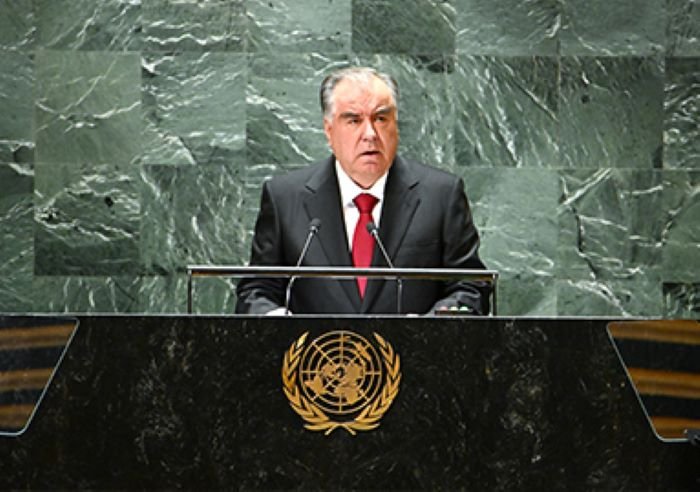
The participation of the President of Tajikistan Emomali Rahmon, in the 80th Session of the United Nations General Assembly (UNGA) in New York represents a significant stage in strengthening the country’s international standing and advancing its integration into global governance, security, and sustainable development processes. Amid intensifying geopolitical rivalries, challenges to climate and energy security, as well as complex economic and social conditions, Tajikistan’s diplomatic engagement demonstrates a pragmatic and multi-layered approach to promoting national interests within the context of global challenges.
Diplomatic mission of Rahmon combines elements of both multilateral and bilateral diplomacy, enabling Tajikistan to participate in shaping an international order grounded in the principles of multilateralism in global governance, while also employing instruments of soft power through initiatives in sustainable development, water management, and climate policy.
The working visit to the United States, undertaken on 21 September, marked the starting point of the President’s participation in the UNGA session. At the international level, this visit signaled Tajikistan’s readiness for active multilateral engagement and reflected a systematic approach to the development of diplomatic relations. The official delegation included senior members of the government among them the Prime Minister of the Republic of Tajikistan, the Minister of Foreign Affairs, the Presidential Assistant for Foreign Relations, the Minister of Health and Social Protection of the Population, and other high-ranking officials underscoring the strategic importance of the mission.
On 22 September, he met with United Nations Secretary-General António Guterres, President of Portugal Marcelo Rebelo de Sousa, and Vietnamese Lương Cường, each reflecting distinct dimensions of Tajikistan’s foreign policy orientation.
During the meeting with the UN Secretary-General, discussions addressed the prospects for multifaceted cooperation, including the implementation of the 2030 Agenda for Sustainable Development, the UN 2.0 initiative, the reform program of the contemporary UN system, and the Early Warnings for All (EW4All) project. President Rahmon also raised issues related to the preservation of water resources and glaciers, as well as the fight against terrorism and extremism, thereby underscoring the integration of national priorities into global agendas.
Read More: Tajikistan’s UN Diplomacy: From Water Security to Global Peace Initiatives
The meeting with the President of Portugal emphasized the bilateral dimension of Tajikistan’s diplomacy. The talks focused on opportunities for expanding political dialogue, strengthening the legal and contractual framework, and enhancing trade, economic, and investment cooperation. Particular attention was given to the potential for combining Tajikistan’s natural resources with Portugal’s technological expertise in the fields of energy, industry, and the green economy, as well as to humanitarian issues, including education, healthcare, culture, and tourism.
The meeting with President Lương Cường of Vietnam highlighted the Asian vector of Tajikistan’s foreign policy strategy. Despite geographical distance, the two countries maintain longstanding traditions of friendship and joint efforts in promoting peace, stability, and sustainable development. Both sides emphasized the importance of expanding inter-parliamentary and inter-agency cooperation, increasing trade turnover, and fostering collaboration in light industry, agriculture, and exchanges in education, healthcare, culture, and tourism.
Tajikistan’s engagement at the UNGA session illustrates the comprehensive application of the principles of multilateralism, whereby multilateral platforms serve as instruments for strengthening the country’s position within global governance. The meeting with the Secretary-General demonstrated Tajikistan’s capacity for strategic interaction within the framework of global initiatives, including UN reform and the integration of advanced digital technologies such as artificial intelligence into the implementation of the Sustainable Development Goals.
The exercise of soft power is evident in initiatives related to climate action, the preservation of water resources and glaciers, as well as the promotion of peace and security across various regions of the world. Under the leadership of President Rahmon, Tajikistan’s diplomatic activity contributes to shaping the country’s image as a responsible and constructive partner in the global agenda.
Read More: Scandinavian Social System and Possibilities of Its Adaptation in Tajikistan
The bilateral meetings with the leaders of Portugal and Vietnam highlight the pragmatic orientation of Tajikistan’s foreign policy strategy: combining national resources, technological capacity, and human potential with the opportunities of its partners for mutual development. The emphasis on green energy, industry, and humanitarian spheres reflects a comprehensive understanding of national interests through the lens of sustainable development and international cooperation.
Furthermore, the dialogue with Vietnam illustrates Tajikistan’s strategy of consolidating regional ties and leveraging interregional platforms, including the SCO and the United Nations, to advance its interests in Asia. This dimension underscores the importance of integrating global and regional approaches in international politics, in line with contemporary concepts of global governance.
Finally, the diplomatic mission underscores the practical significance of interstate cooperation in addressing global challenges. Discussions on countering terrorism, extremism, and conflicts in different regions demonstrate Tajikistan’s aspiration to act as an active participant in the international security system and in political conflict resolution, thereby contributing to the formation of a multi-level international order.
In conclusion, the participation of President Rahmon in the 80th Session of the United Nations General Assembly represents a vivid example of comprehensive diplomacy that combines both multilateral and bilateral dimensions.
First, at the multilateral level, Tajikistan demonstrates active engagement in global initiatives, including UN reform, the implementation of the Sustainable Development Goals, climate and water-related programs, as well as cooperation in the field of security. These activities contribute to strengthening the country’s international image and its standing as a constructive partner.
Second, the bilateral meetings with the leaders of Portugal and Vietnam reveal a pragmatic use of national potential to expand political, economic, technological, and humanitarian cooperation, thereby fostering sustainable development at both national and regional levels.
Read More: How OSCE Ensures Central Asian Security: The Case of Tajikistan
Third, the diplomatic activity under the leadership of the Head of the Nation illustrates the integration of national priorities into global agendas and affirms Tajikistan’s capacity for strategic, multi-tiered engagement in international politics, consistent with contemporary theories and concepts.
Thus, President Rahmon’s participation in the 80th Session of the UNGA session demonstrates Tajikistan’s systematic, strategic, and pragmatic approach to international diplomacy, strengthening the country’s role on the global stage and establishing a platform for advancing national interests through effective multilateral and bilateral cooperation.

Faridun M. Yusufjonov
Faridun M. Yusufjonov, Candidate of Political Science, is a Senior Researcher in the USA and Canada Department at the Asia and Europe Research Institute, National Academy of Sciences of Tajikistan.