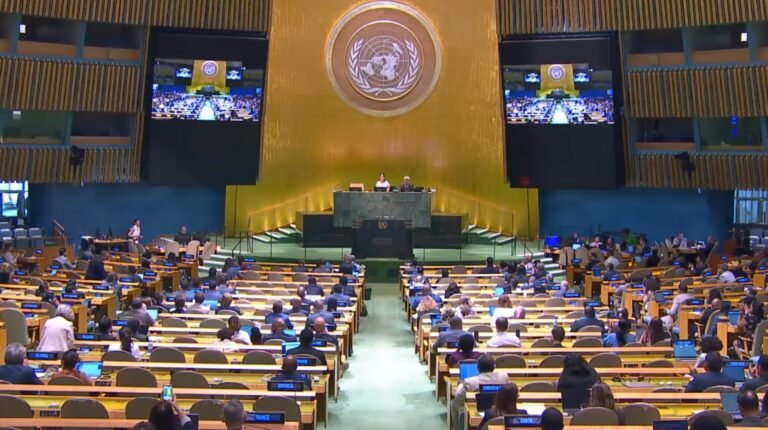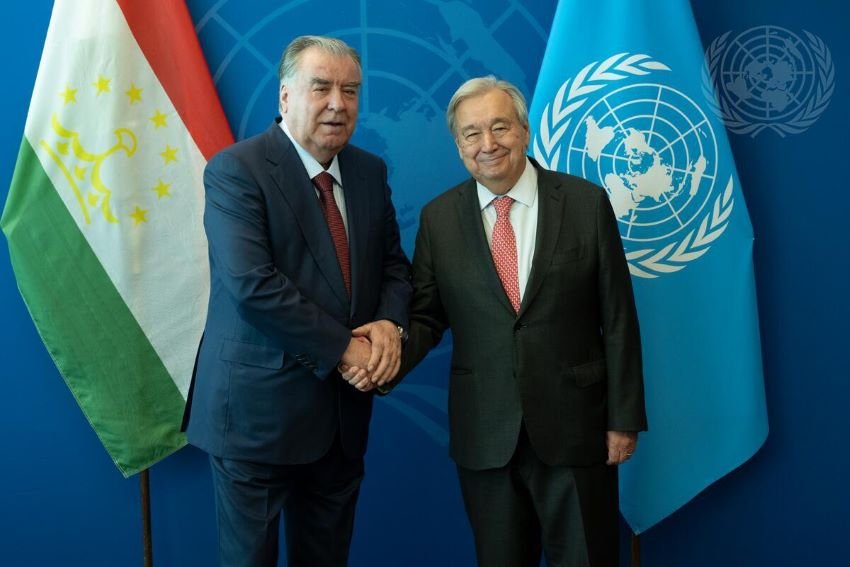
On September 21, President Emomali Rahmon of Tajikistan arrived in New York City to attend the 80th session of the United Nations General Assembly. The following day, he met with UN Secretary-General António Guterres to discuss key global and regional challenges, including institutional reforms, climate change, terrorism, and developments in Central Asia and Afghanistan. Continuing his long-standing commitment to global peace and security, President Rahmon delivered a speech on September 23 at the UN Future Summit, where he proposed the adoption of a landmark resolution, the “Decade of Peacebuilding for Future Generations”, underscoring Tajikistan’s vision for a safer and more sustainable world.
The Secretary-General praised Tajikistan’s leadership on water and glacier preservation, highlighted Tajikistan’s positive role in resolving border issues and promoting regional cooperation in Central Asia.
The United Nations Organization is one of the most influential international organizations that was established in 1945 with the aim of strengthening international peace and promoting cooperation between states. The organization title “United Nations” used in the United Nations Declaration signed on January 1, 1942 accordingly.
On January 29, 1992, during the session of the UN Security Council, a resolution was adopted on admission Tajikistan to the UN as an equal member. Tajikistan became member of the UN on March 2, 1992 and laid a solid foundation for the development of its cooperation with the institutes, agencies and specialized organizations of the UN system.
Read More: Tajikistan in the New Regional Order of Central Asia
Presently, Tajikistan actively cooperates with the UN in various fields, including ensuring universal peace and stability, combating modern threats and challenges to security, protecting the environment, sustainable development of society and water management.
According to Ministry of Foreign Affairs of Tajikistan, for a short period of its historical membership in the UN, the country has passed certain stages of relations with the United Nations and the priority was cooperation aiming to achieve peace and stability in the country. For this purpose, the first UN office – the United Nations Mission of Observers in Tajikistan (UNMOT) opened in Dushanbe on February 1, 1993 to ensure the advancement of the peace process in Tajikistan, assisting in peacekeeping efforts and providing urgent humanitarian assistance.
With the implementation of the General Agreement on the Establishment of Peace and National Accord, in May 2000, the United Nations Tajikistan Office of Peace-building (UNTOP) established accordingly and finally, in August 2007, the organization successfully completed its activities and the Tajik model of national reconciliation, with the assistance of the UN and guarantor countries, served as an example of preventive diplomacy for countries with internal conflicts.
As we know that initially the concept of human security was conveyed in 1994 under Human Development Report named as “New Dimensions of Human Security”. The report introduced a new concept of human security, which equates security with people rather than territories, with development rather than arms. The report also accepted that calculating income is simply not enough to measure the welfare of people.
Asia is known for its fertile and attractive land and history. Each state in the continent is full of natural wealth and capitals. It is the region of historians, scientists, scholars and Sufis or dervishes. It is the area where all its communities consist of distinctive body having full of soils and waters as Doctor Muhammad Iqbal pointed out in his poem, “Osiyo yak paikari obu gil ast”…and all its inhabitants can use all these treasures and live in peace and good life and prevent the region and the humanities of the world from all kinds of evils and violence consequently.
Read More: Kazakhstan, Tajikistan, Uzbekistan Agree on Bahri Tojik Water Sharing
Tajikistan is located in Asia and having countless of histories and customs and traditions. It is the region of plenty of eye-catching land and natural scenes. The country became a sovereign and an independence state on 9th September 1992. After transitory periods of times the country changed its policy and initiated its developmental and strategic plans and programs to promote and save its citizens life and health. Contemporary Tajikistan is now one of the active members of UN mission and other regional and world organizations.
As a result, the country contributed in many projects and assignments of the UN programs to promote human development, peace and security in the region and the world. It shares and backs all humanities programs and put its portions effectively and efficiently. The all UN related summits especially CICA in the capital of Tajikistan is one of the country human security contributions.
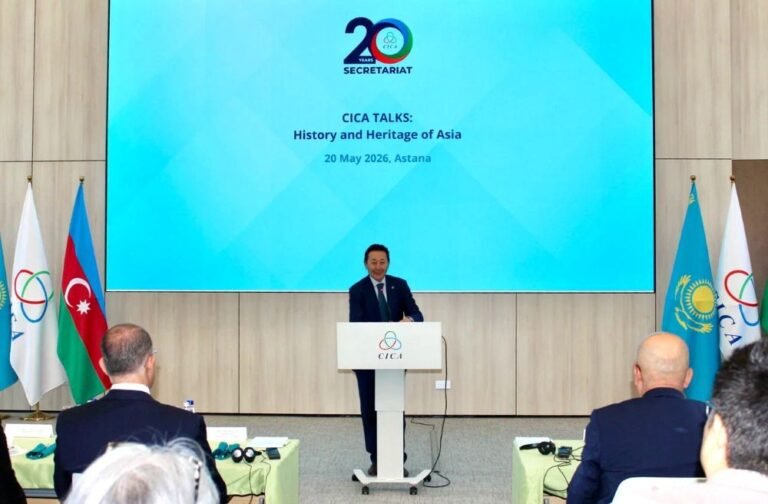
It is to be mentioned that CICA forum was initiated by Kazakhstan and acknowledged and accepted by UN mission. It has 27 members and its main office is located in Kazakhstan and was chaired by China till 2018. During Dushanbe summit Tajikistan became its Chairmanship for the years 2018 and 2020 accordingly.
Tajikistan during transitory period confronted many challenges leading the state towards ups and downs or uncertain stages. But under the visionary leadership of its selected president Emomali Rahmon, the country could save its people and boosted its diplomatic links with all over the world and became one of the peaceable and stable regions hereafter.
Diplomatic enhancement and introduction of Tajikistan to the people of the globe as an independent and sovereign state was very difficult in the earlier transitory period. By use of wisdom and fruitful consultancy Emamali Rahmon participated in UN Assembly during 29 September 1993 and had speech on significance of peace and security and ripens of communication and diplomatic relations among the people of the globe.
By focusing on human development and security programs, the country attained its mission accordingly and saved its sovereignty and rights meritoriously. The president contributed in many UN programs associated to human security and development. Preventing violence, terrorism, extremism and human trafficking and smuggling are the main objects of the country human development program strategies.
Moreover, Tajikistan always initiated the ecological and environmental programs and projects for safety and security of humanity. For such purpose, Dushanbe hosted international seminar in 2019, gathering many specialists and experts from all over the world to discuss the burning issue of climate change.
Many of us are well aware that water resources are key component of socio-economic development and environmental recreation of the world and especially Central Asian region. Therefore, we must know how to use them effectively. It is sure that only by ensuring judicious use of water resources, reducing their loss and preserving them for future generations we can achieve our sustainable development goals in the region. Based on this, Tajikistan’s recommendation on appropriate use of world waters adopted in UN GA Resolution on International Decade for Action “Water for Sustainable Development” in December 2016.
Considering all main human necessities and demands, Tajikistan proactively promotes global water agenda and proposes its fruitful and productive suggestions as “the International Year of Fresh water”, “the International Decade for Action”, “Water for Life” (2005-2015) and “the International Year of Water Cooperation 2018-2028” to the UN General Assembly. These are four main strategic recommendations of Tajikistan on water and its advantageous use to UN and other international organizations desiring to save the life of humanity around the world and help them to live happily and honestly.
Read More: How OSCE Ensures Central Asian Security: The Case of Tajikistan
The country also adopted policy of “open doors” to forge strong relations among all counties and communities across the world. By adopting such policy, Tajikistan wants to boost its relationship with its neighboring regions and promote their peace and security.
As we know that peace and security are the valuable items, but regrettably many countries of the world do not enable by such wealth. All of them try and struggle to have peace and stability, but they failed because of miscommunications and internal mistrust. It is great mercy for Tajikistan and its people that by appropriate guidance of its leader and his wisdom, the country achieved its peace accord on June 27, 1997 and became stable and secure region.
Its reconciliation agreement confidently adopted as valuable model under UN mission peace projects and programs. All struggles and attempts of Tajikistan are to boost peace and security around the world specially, Asia and to use its natural resources and bring delights and rapture to its people and communities. It is definite that by proper use of the natural resources, all states of Asia can boost their economic and trade projects and plans and develop peace and secure ties among each other’s efficiently and effectively.
New and progressive Tajikistan is a peaceful and stable state in the Asia and chairmanship of CICA during 2018-2020 produced more human security expansion projects and programs used in the development of the region and the world meritoriously. Tajikistan and its Chairmanship of CICA facilitated promotion of cooperation on peace, security, tourism and improvement of interaction between the countries in Asia. In this context, the country planned activities to broadly introduce representatives from CICA member states to cultural and historic heritage and abundant natural resources of Tajikistan and create a platform to seek for new ways of cooperation in this sphere accordingly.
Finally, we believe and hope that the UN congregation will make it possible for its members sharing experience accumulated during the years of interaction within the states and identify main directions of joint activities on confidence building, security, socio-politics, economy, tourism and further cooperation.
It is good to mention that Dushanbe UN multiprogram summits play as the source of providing supplementary impetus to achievement of common objectives and strengthening of mechanisms of multidimensional cooperation and greater interaction in addressing hot issues of Asia and the world commendably.
To sum up, it is recommended for the war-hit countries to learn from the peace, friendship, and neighborliness of Tajikistan in the frameworks of UN and its organizations, avoiding war, hostility, and separation which causes the suffering and poverty, and contribute to the people’s peace, and prosperity around the world.

Mirsaid Rahmonov
The writer is a senior researcher in the South and Central Asia Department, Institute of Asian and European Studies, Tajikistan.