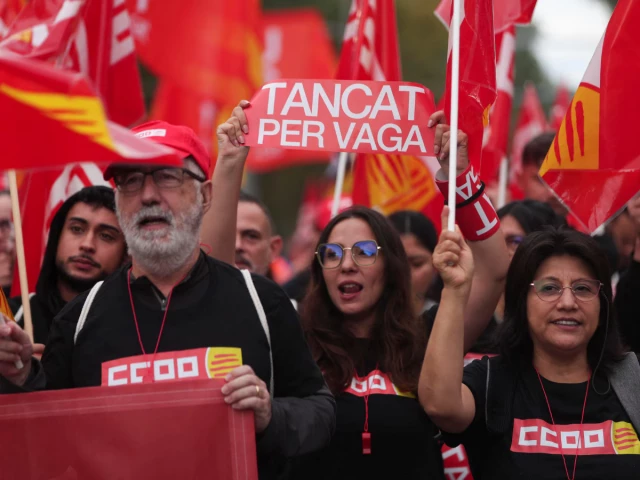
Madrid (TDI): Workers across Spain staged the country’s first general strike in 14 years jointly backed by its two largest trade unions on Wednesday, protesting rising rents and unaffordable housing less than three weeks before a snap general election.
The nationwide action was organized by the General Union of Workers (UGT), the Workers’ Commissions (CCOO), other labour organizations and tenants’ associations. Despite stormy weather, workers established picket lines and disrupted activity across several sectors.
The strike reflects growing public frustration over Spain’s housing affordability crisis, which has made it increasingly difficult for young people and lower-income households to secure independent accommodation.
Prime Minister Pedro Sanchez is seeking to make housing a central issue in the November 29 election, potentially shifting public attention away from corruption cases involving members of his inner circle and a deadly train crash last month. However, his Socialist Party continues to trail in opinion polls.
According to Spain’s central bank, the country faces a housing deficit of approximately 750,000 homes, a figure projected to exceed one million by 2028.
The shortage has pushed more people into the rental market, contributing to rising prices and intensifying competition for available properties.
Read More: France Braces for Fresh Protests as Yellow Vests Call for ‘Mass Disobedience’
The average monthly rent of €1,176 ($1,315) is equivalent to around 98.7 per cent of the average monthly salary of a young person in Spain, according to the Youth Council of Spain.
The unions reported particularly strong participation in coastal regions, including the Cantabrian coast, Catalonia, Andalusia and parts of the Mediterranean, where housing pressures have been especially acute.
UGT and CCOO said early participation reached 90 per cent in ports and the automotive sector, with complete stoppages reported at several factories, including Volkswagen’s plant in Navarre and SEAT’s facility in Barcelona.
They estimated participation at 85 per cent in the meat industry, 82 per cent in waste collection and 75 per cent in the energy sector.
Read More: France Puts 70,000 Police on Alert as Protests Over Living Costs Continue
Turnout was comparatively lower in healthcare and social services, at 38 per cent, and in the postal service, at 35 per cent.
The unions also reported a 10 per cent decline in electricity demand, which they cited as evidence of disruption across energy-intensive industries. They said significant parts of the petrochemical, steel-processing, food-processing and transport sectors had suspended operations, apart from activities covered by minimum service requirements.
However, participation varied across the country and industries, according to union statements.