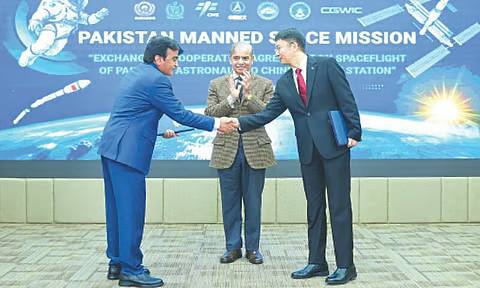
Following the completion of the first selection process for foreign astronauts under China’s manned space program, the two Pakistani candidates who were selected have now begun training in Beijing.
Once they finish the courses and meet all standards, one of them will join a Chinese crew as a payload specialist on a mission to the Tiangong space station, becoming the first foreign astronaut to enter the Chinese space station.
That flight would place the first Pakistani national in orbit and mark the first time any foreign astronaut lives and works aboard China’s orbital outpost. It shows that a partnership once defined by geography and security has entered a phase where technology and knowledge shape its direction.
Strategic Upgrade: Cooperation Enters a New Phase of Technology and Knowledge Sharing
This development lands at a pointed moment. The year 2026 marks the 75th anniversary of diplomatic relations between China and Pakistan, which began in 1951. Events across both capitals have already highlighted the depth of the partnership through cultural programs, student exchanges, and high-level visits.
The astronaut selection adds a layer that few could have imagined at the start of formal ties. It moves the relationship beyond roads, ports, and energy projects into the domain of human spaceflight. Officials from both sides describe the step as concrete proof that the all-weather strategic partnership now extends to the final frontier.
For Pakistan, the stakes feel immediate. The country has long remained on the margins of space activity. It has launched satellites with Chinese assistance, including PRSS-1, these projects were useful but limited in scope. They did not create a domestic ecosystem of research and innovation. Human spaceflight changes the equation.
Read More: Two Pakistani Astronauts Selected to Train for China’s Tiangong Space Mission
The selected candidate will not pilot the spacecraft but will handle scientific payloads. That role still demands the same physical and mental standards as any crew member. The training will expose Pakistani personnel to systems and procedures that SUPARCO has never handled at this scale. Knowledge gained in orbit can feed back into domestic programs, from satellite design to remote sensing.
The mission will likely occur toward the end of 2026, giving engineers time to integrate the payload specialist into the workflow. CMSA (China Manned Space Agency) has repeated that the station remains available for joint experiments and training from any country ready to cooperate.
The Pakistani case sets a practical precedent. It shows that international participation does not require the complex multinational bureaucracy seen in other programs. A bilateral framework, built on trust, delivers results faster.
Dual Value: Transforming from Participant to Contributor
Pakistan’s inclusion serves a dual purpose. It deepens bilateral ties while also demonstrating that China’s offer of cooperation is credible. For Islamabad, this translates into diplomatic capital. Being part of a major space mission alters perception. It allows Pakistan to present itself as a participant in advanced scientific work. In multilateral forums, this matters. It shifts the narrative from dependency to contribution.
Future Prospects: A New Journey After 75 Years
The 75th anniversary provides a natural vantage point to assess the trajectory. Relations have survived shifts in global politics, leadership changes, and economic pressures. The astronaut selection does illustrate a pattern: when both governments identify a shared objective, they find ways to pursue it. The candidates will train alongside Chinese colleagues for months. That shared experience will create personal bonds stronger than any official statement.
Nowadays, China and Pakistan stand at a point where the nature of their cooperation is being redefined. The move into space is not an isolated development. It is part of a broader shift toward high-value sectors that will shape the future global order. It shows that the partnership is capable of adapting to new realities.
As the candidates prepare to leave for China, the story of cooperation carries on for a generation of Pakistanis who see science as a path forward. It tells Chinese engineers that their work now supports partners across borders. The relationship between China and Pakistan continues to find new expressions even after 75 years.
The sky above Tiangong, once the exclusive domain of Chinese crews, will soon include a voice from Islamabad. That small step carries the accumulated trust of decades and points toward possibilities still unfolding.
Originally obtained by The Sichuan International Communication Center, China.
The Center invited Muhammad Asif Noor to analyze the collaboration between China and Pakistan, as two Pakistani astronauts arrived in Beijing to train for the Chinese space mission scheduled to take flight by year’s end.

Muhammad Asif Noor
The writer is Director, the Institute of Peace and Diplomatic Studies