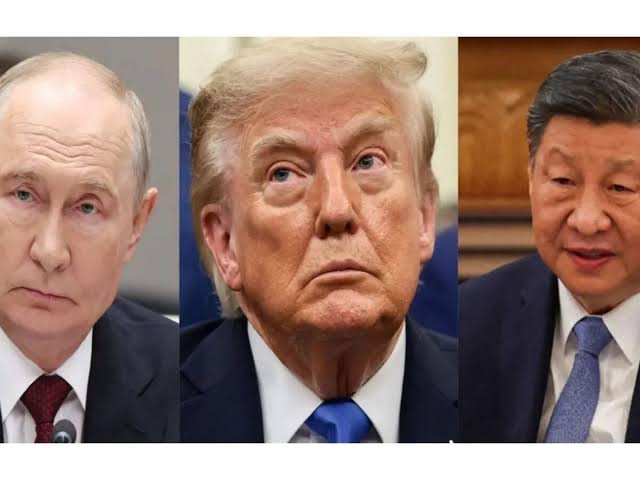
The Kremlin has signaled openness to an unprecedented three-way leaders’ summit between Russia, the United States, and China, but insists any such gathering must yield concrete, verifiable results.
Speaking from Bishkek, Kyrgyzstan, where Putin and Xi had just attended a gathering of the Shanghai Cooperation Organization, Kremlin aide Yuri Ushakov confirmed on September 1 that the possibility of a trilateral meeting at the APEC leaders’ summit in Shenzhen had been discussed.
Asked about the format on Russian state television, Ushakov said: “This issue was discussed, yes,” adding that if all three leaders attend as expected, “then the three of them will be able to have a meeting.” The APEC leaders’ summit is scheduled for November 18 and 19 in Shenzhen, southern China, hosted by Xi Jinping.
Five days later, on September 6, Russia’s Deputy Foreign Minister Sergei Ryabkov sharpened the condition, telling TASS that while Moscow had not ruled out a trilateral meeting of the three presidents, the agenda must be defined before any actual preparations begin.
“Here, the main question boils down to how the substance of the meeting will be formulated, and what we can expect as a result,” Ryabkov said.
Read More: Trump Praises Xi, Voices Hope for Stronger US-China Relations
He acknowledged that this three-party format involving Russia, China, and the United States “has not been practiced so far,” while declining to rule it out.
On the same day, Ushakov added that while such a meeting “would not be without merit,” its organization was the prerogative of the summit’s hosts; Beijing, not Moscow.
The timing of this diplomatic signal is not accidental. Putin confirmed in May his intention to attend the APEC meeting, though Trump has not yet done so.
White House spokeswoman Anna Kelly stated that “at this moment there are no announcements regarding President Trump’s attendance at APEC.” The asymmetry is telling: Moscow is constructing diplomatic architecture Washington has yet to enter.
The backdrop against which this offer is extended is one of measurable American strategic fatigue. The federal government is already projected to run a $1.853 trillion deficit in fiscal year 2026, with increased spending associated with the war against Iran almost certainly financed through additional borrowing.
The operational cost of that war has been staggering: Kent Smetters, faculty director of the Penn Wharton Budget Model, forecasted the daily war expenditure at roughly $800 million, with other estimates placing it at $1 billion per day.
Interest costs on America’s debt are now exceeding federal spending on national defense; a mathematical certainty that no amount of supplemental appropriations can reverse.
The munitions picture is equally sober. The US military has exhausted nearly 80% of its interceptors for the THAAD system, with senior US military commanders warning that the Pentagon’s munitions stockpile is “dangerously low.”
Patriot inventories fell from 2,330 in February to as low as 759 by July, while THAAD interceptors dropped from 452 to as low as 234 over the same period. CSIS estimates it would take three or more years to rebuild inventories to pre-war levels.
Read More: Trump Says Putin Won’t Attack NATO, Denies CIA Warning to Russia
Against this landscape, Russia and China have been consolidating an alternative architecture. At their Bishkek bilateral, Xi told Putin that ties between Beijing and Moscow have grown “more solid,” and must continue despite “uncertainty and unpredictability in the international order.”
The Bishkek Declaration jointly adopted at the SCO summit affirmed member states’ “position condemning military strikes on the territory of the Islamic Republic of Iran, which have resulted in numerous civilian casualties and significant damage to the country’s economy.”
For strategic analysts, the contours of what Moscow envisions are coming into focus: a settlement architecture across multiple theatres – Ukraine, Iran, the broader Middle East – negotiated from a position of relative Russian and Chinese advantage, presented to a Washington whose fiscal and military elasticity has visibly contracted.
The Shenzhen proposal, floated from Bishkek immediately after a display of Russia–China solidarity, is less an invitation than a test of whether the United States is ready to transact.
To float a three-way meeting with Trump from that particular stage, immediately after a display of Russia–China solidarity, was a “piece of choreography,” that carried its own message: that Moscow sees itself as a pivot able to convene both Beijing and Washington.

Muhammad Mahad Samija
Muhammad Mahad Samija is a student of Political Science at Government College University, Lahore. He can be reached at [email protected]