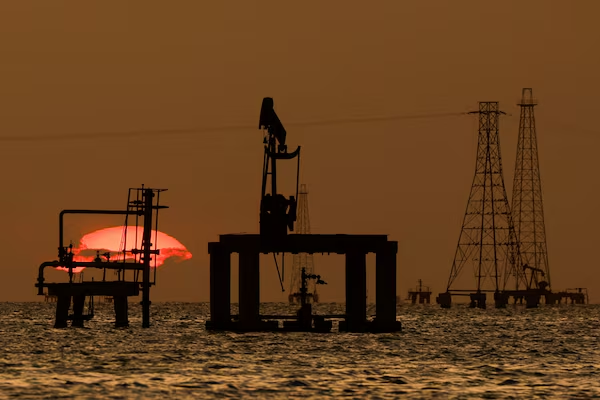
Amid the negative global atmosphere created by the forced war against Iran, United States President Donald Trump announced the construction of a new oil refinery in Brownsville, marking the first such refinery to be built in the United States in 50 years.
The most notable aspect for India is that under the “America First” framework, India’s Reliance Industries will invest in this $300 billion (around ₹28 lakh crore) project. According to Trump, the project will help the United States maintain its dominance in the energy production sector, generate thousands of jobs, and strengthen national security.
Meanwhile, Reliance is already a major name in the oil refining sector, and this deal effectively transforms it from a purely Indian company into a “global energy giant.”
This agreement is not merely a commercial deal. For Trump, it is a strategic move with both domestic and global political advantages, while for Mukesh Ambani it is a “business masterstroke,” along with an opportunity to secure a kind of “political shield” by establishing a direct relationship with the world’s most powerful leader.
However, while this deal appears to be a win–win for Trump and Reliance, will India’s interests be affected? Yes, certainly. Is this deal as massive as it appears at first glance? Not exactly. Let us examine the many dimensions of this agreement whose consequences could be far-reaching.
The Huge $300 Billion Figure
Since news of the deal emerged, a misconception has developed in some quarters that Reliance will immediately invest such an enormous sum. People have begun asking whether Reliance even possesses that much money. Some commentators have written that $300 billion is larger than the GDP of several small countries—can such a huge refinery really be built?
In reality, the $300 billion figure represents the total economic value of a 20-year agreement with “America First Refining.” It is an offtake value, not merely the construction cost.
Read More: Opposition Alleges Modi Compromised National Interest in US Deal
The deal includes an agreement to purchase 1.2 billion barrels of U.S. shale oil, valued at about $125 billion, while the remaining $175 billion reflects the value of the refined products that will be produced.
To actually build the refinery, Reliance would need to raise only about $1.2 billion, which could easily come through international debt, equity routes, or other financing methods. Companies belonging to Asia’s richest man already have cash reserves exceeding this amount.
A Boost for U.S. Economy, a Massive Boost for Trump’s Politics
For Donald Trump, this $300 billion agreement with Reliance is not merely a commercial deal but a key component of his political and economic strategy. Trump is presenting the deal as a major victory for his “America First” policy.
For the first time in 50 years, a major new refinery will be built in the United States—something he claims demonstrates that his policies, such as tax cuts and simplified permitting processes, are bringing foreign investment back to America. He also portrays the project as strengthening America’s Energy Dominance, part of his larger ambition to make the United States the world’s largest energy producer and exporter.
The refinery is specifically designed to process U.S. shale oil, reducing America’s dependence on foreign oil—especially from the Middle East—and thereby strengthening national security. Trump has highlighted the creation of thousands of potential jobs for American workers and the people of South Texas, calling it a “historic victory” for them. This narrative also strengthens his political base and vote bank.
Under this deal, India (through Reliance) will purchase billions of dollars’ worth of American oil, which could reduce the U.S. trade deficit. Trump has also claimed that the facility will be the “cleanest refinery in the world,” helping him respond to critics who argue that his support for fossil fuels is environmentally harmful.
Geopolitically as well, the refinery offers advantages for both the United States and Trump. Amid the ongoing Iran-Israel tensions and instability in the Middle East, increasing domestic refining capacity helps the U.S. reduce vulnerability to international pressure. It also strengthens America’s ability to influence global oil prices and expand exports.
In short, the deal helps Trump present himself as a leader who is “bringing jobs back,” “securing American energy,” and “attracting foreign investment.”
Read More: Modi Govt Faces Backlash After US Grants Temporary Waiver for Russian Oil Purchases
Mukesh Ambani’s Ascent
This $300 billion deal could have profound and long-term implications for Reliance Industries and for Mukesh Ambani personally. Reliance already operates the world’s largest refining complex in Jamnagar. Investing in the highly developed and tightly regulated U.S. energy market signals that the company is no longer merely a domestic giant but is moving into the league of global players such as ExxonMobil, Shell plc, and Saudi Aramco.
Securing crude supply for 20 years strengthens Reliance’s energy and retail portfolio. Analysts closely track the company’s Gross Refining Margin (GRM)—the profit earned from refining a barrel of crude oil. U.S. shale oil is often cheaper, and selling refined products such as jet fuel and diesel in premium markets in the U.S. and Europe could significantly boost Reliance’s profits.
Following the deal, global rating agencies such as Moody’s and S&P Global may upgrade Reliance’s credit rating. This would enable the company to raise funds from international markets at lower interest rates—positive news for shareholders.
Reliance is already India’s most valuable company. Establishing a physical presence in the United States could make it even more attractive to global investors, potentially multiplying its market capitalization. By-products from refining are also used in Reliance’s petrochemicals and plastics businesses.
The abundance of natural gas and raw materials in the United States could make this segment more globally competitive. In effect, Reliance will not only purchase American oil but become part of the U.S. energy infrastructure, providing insulation from geopolitical instability in the Middle East.
However, Ambani’s motives are not purely economic. The deal could also provide strategic, political, and global influence advantages. Reliance will gain direct access to U.S. political and business networks, potentially benefiting from lobbying opportunities, future energy policy decisions, and strategic partnerships.
The biggest advantage may be the political protection that comes with proximity to the world’s most powerful leader. Trump’s influence can even be seen affecting policy debates in India. Being in the “good books” of the White House could therefore carry weight domestically and bring certain privileges.
India’s Concerns on the Deal
While the deal is widely seen as a major victory for Reliance and Trump, at the national level it could pose certain challenges and risks for India. The first concern is foreign exchange outflow. Payments for crude oil are made in U.S. dollars. India is already grappling with a trade deficit and a weakening rupee. If Reliance purchases hundreds of billions of dollars’ worth of American oil, it could put pressure on India’s foreign exchange reserves and weaken the rupee further against the dollar.
A second concern is the potential impact on relations with Russia. In recent years, India has purchased large quantities of discounted Russian oil, which has provided significant economic relief. If India tilts too heavily toward the United States through Reliance, its strategic and energy relations with Russia could be affected.
The deal also raises the question of “Make in India” versus “Make in America.” Prime Minister Narendra Modi has declared his ambition to turn India into a global refining hub. When India’s largest company builds a new refinery in the United States, investment, business, and employment are effectively shifting to America rather than India.
There is also the risk that future political changes in the U.S.—such as sanctions or tariffs—could place India’s energy security under new forms of American pressure. The United States has often used energy supply as a diplomatic tool.
Another issue is the potential impact on domestic fuel prices. There is no guarantee that refined products from this refinery will be cheaper for Indian consumers, as pricing will depend on international market dynamics and shipping costs.
Read More: Trump Administration Engages US Oil Firms for Venezuela Plans
Currently, along with Reliance, Indian public sector companies such as Indian Oil Corporation, Bharat Petroleum, and Hindustan Petroleum, as well as private refiners like Nayara Energy, export large volumes of diesel and petrol to Europe and Africa.
Since Reliance will now have a refinery inside the United States, it could sell products directly into global markets with lower shipping costs, potentially reducing the export margins of other Indian companies. Another significant concern is that if U.S. refining capacity expands substantially, global competition in fuel markets will increase, placing pressure on India’s own refining export capacity.
For Reliance, the deal is undoubtedly a business masterstroke, but for the Indian government it represents a delicate balancing act. New Delhi will need to ensure that strengthening ties with the United States does not alienate long-standing partners such as Russia and Middle Eastern countries.
At the same time, it must ensure that while capital flows abroad, sufficient investment continues to flow into India as well. Maintaining a favorable balance of trade will also be crucial so that the rupee does not depreciate further.
Ultimately, this refinery deal is not merely about energy trade—it represents a complex interplay of power, capital, and global strategy. It could elevate Reliance Industries and Mukesh Ambani to new heights in the global energy landscape, while also delivering immediate political gains for Donald Trump.
But the real question remains: Should such deals be viewed only as corporate and political victories, or should they also be measured against the yardstick of national interest, energy security, and India’s long-term strategic autonomy?
*The views presented in this article are the author’s own and do not necessarily reflect the views of The Diplomatic Insight.

Aalok Bajpai
Aalok Bajpai is a senior journalist, columnist and multidisciplinary cultural commentator based in Indore, India. He is a research scholar in economics and writes on democracy, political economy, development and environmental issues. He can be reached at aalokbajpai@yahoo.com