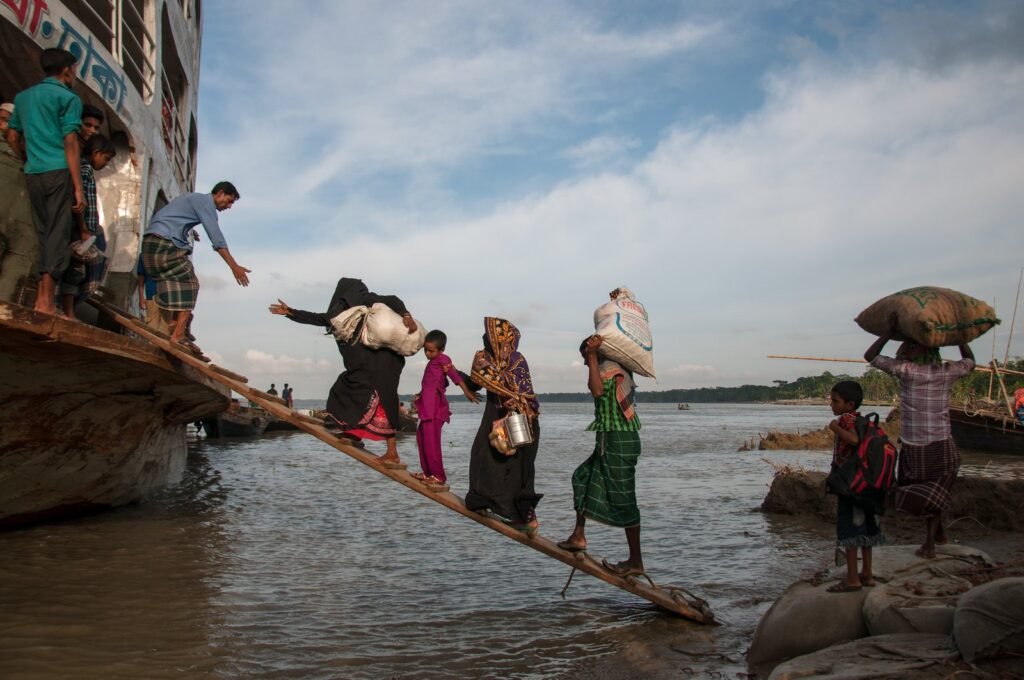
Bangladesh, a frontline country in the climate crisis, has long been in a vulnerable place. This country, with a dense population, extensive river system, and a low-lying deltaic geography, faces recurrent floods, rising sea levels, cyclones, and salinity intrusion that threaten livelihood, food security, and overall national development. The World Bank (2022) reported that if urgent action is not taken, over 40 million Bangladeshis will fall at risk from climate-induced displacement by 2050.
Despite its vulnerability, Bangladesh remains inconsistent and fragmented in accessing predictable and adequate climate finance. This problem is as much diplomatic as it is financial. Only shifts in strategy can bridge this gap. Need a shift from dependence on centralized finding mechanisms into a polycentric governance approach, which would leverage multiple, overlapping centers of authority and collaboration across local, national, regional, and global levels.
The challenge of traditional climate finance
Conventionally, multilateral channels such as the Green Climate Fund (GCF), the Global Environment Facility (GEF), and bilateral aid from major industrialized countries have been funded over the years. While they are essential, they have significant limitations. Financial flows are slow, conditional, and influenced by the political priorities of donor nations.
In this way, Bangladesh remains vulnerable to external fluctuations, delays, and bureaucratic complexities. While the GCF, for example, pledges significant funding for adaptation projects in Bangladesh, only a fraction is realized each year, leaving urgent local needs unmet.
Overdependence on these traditional finding mechanisms also leads Bangladesh to remain vulnerable and powerless in negotiations. When a single source dominates funding, recipients are forced to adhere to donor-determined parameters, limiting local priorities and innovative approaches. Recent geopolitical tensions and the COVID-19 pandemic have already highlighted the fragility. Economic slowdown in donor countries slowed climate finance flows. This reveals how competing global crises can shift attention away from frontline climate-vulnerable nations.
Read More: Beyond Pledges & Paternalism: Dismantling Climate Colonialism in Global Governance
Polycentric governance: A strategic alternative
Polycentric governance provides a practical and strategic alternative that works in a way of multiple, overlapping nodes of authorities and action, including national ministries, local governments, private sector actors, civil society organizations, regional coalitions, and global institutions. If any country overly relies on a single or centralized channel for climate finance, it would be difficult to cultivate a networked approach that can provide diverse sources and mechanisms to create redundancy, resilience, and strategic leverage. What would be the practical implications for a country like Bangladesh?
- As Bangladesh has already received climate-related support from Japan, Germany, and the European Union, there is an opportunity to further diversify its bilateral and plurilateral engagements. The polytechnic governance framework emphasizes expanding and deepening these partnerships strategically. For instance, instead of traditional UNFCCC channels, Bangladesh can negotiate plurilateral agreements focusing on targeted adaptation and mitigation projects, such as mangrove restoration, flood-resilient agriculture, and urban climate resilience initiatives. Through these engagements from national ministries to the regional office, Bangladesh can optimize project design, amplify the dynamic of fund utilization, and reduce the misalignment with the national priorities.
- Bangladesh can enhance multilateral funding channels or institutions, including the World Bank, Asian Development Bank (ADB), and the Asian Infrastructure Investment Bank (AIIB). These can complement bilateral finance flows by providing project-based assistance. For that reason, Bangladesh needs to coordinate national climate strategies with multilateral priorities. Consequently, Bangladesh can leverage co-financing arrangements, attracting additional funding while maintaining a degree of autonomy over project implementation. Polycentric governance can be the path to creating dedicated actors within ministries to negotiate, monitor, and align funding streams across these diverse actors, who would minimize duplication and ensure accountability.
- Instead of traditional financial mechanisms, polycentric governance offers innovative financial instruments, such as green bonds, climate risk insurance, public-private partnerships, and city-to-city (C2C) collaboration. These would help subnational actors to access global funds directly, for example, Dhaka, Chittagong, and Khulna could engage in climate adaptation exchanges with other delta cities worldwide in which they would secure technical support and financial resources independently of national or multinational bottlenecks. These small-scale projects funded through innovative mechanisms can be seen as experiments that would provide valuable insights and inform about best practices in national-level policy making.
- If Bangladesh desires to create regional climate finance consortia, Bangladesh’s leadership (cooperation and knowledge sharing) in regional platforms like SAARC, BIMSTEC, and the Bay of Bengal Initiative will be the milestones. Sharing technical expertise, designing projects jointly, and pooling resources would enhance member states’ bargaining power. Bangladesh, here, can coordinate such initiatives, positioning itself not just as a recipient but as a strategic broker that bridges national, regional, and global actors.
- Practically, the strategic values and real benefits of a polycentric governance framework are profound. It can reduce dependency on a single source if the donor fluctuates financially and shifts geopolitically. It can enhance accountability and transparency, as multiple actors automatically create natural checks and balances, which ensure efficiency and equity of funding. It strengthens negotiation power, which would leverage Bangladesh during the discussion about loans, grants, technical assistance, etc. It facilitates decentralized experiments with different mechanisms, since successful initiatives need multiple experiments and learnings at multiple stages. Through polycentric governance, Bangladesh can elevate its diplomatic position as a frontline nation at the COP meetings and other global forums by coordinating multiple actors.
Read More: Reimagining South-South Climate Cooperation: From Rhetoric to Structural Justice
What would be the policy implications of operationalizing polycentric governance in Bangladesh’s climate diplomacy? Several steps are essential: first of all, Bangladesh should map its institutional catalog and identify all potential actors along with their roles in climate finance. Secondly, it should establish dedicated units within the Ministry of Environment, Forest, and Climate Change for strategic coordination across these nodes, ensuring alignment with national climate plans.
Thirdly, train government officials, local governments, and civil society actors to engage effectively with international and regional funding mechanisms. If the state can build a strong capacity, the path for innovative partnership will be developed, like encouraging subnational actors, universities, and private enterprises to co-develop and co-finance climate projects with international partners. And finally, last but not least, to hold accountability and transparency, a separate and powerful mechanism must be created to evaluate the effectiveness of various funding streams, allowing for continuous learning and adaptation.
The era of singular, centralized climate finance no longer exists. Even slow, conditional, and fragmented funding cannot alone meet Bangladesh’s climate vulnerability. Polycentric governance provides a strategic, actionable framework that allows Bangladesh to diversify its funding sources, strengthen its negotiating position, and experiment with innovative climate finance solutions. By embracing this model, Bangladesh can transform its climate diplomacy from reactive to a proactive one where Bangladesh would simultaneously act as a recipient, innovator, and strategic negotiator.
Ahead of COP30, the stakes could not be higher. The world is watching whether frontline nations like Bangladesh can secure the resources necessary to protect millions of citizens from climate-induced disasters. Polycentric governance offers a path not just to survival, but to leadership. Bangladesh’s future, and the resilience of its most vulnerable communities, relies on its ability to turn the challenges of climate finance into opportunities for strategic, multilevel engagement that other nations may soon follow.
*The views expressed in this article are the author’s own and do not necessarily reflect the editorial policy of TDI.

Akash Ali
Akash Ali is an independent researcher specializing in climate diplomacy, global politics, and IR. He is currently associated with the University of Rajshahi, Bangladesh. He can be reached at akashali2000.ru@gmail.com