Pakistan’s textile industry is often assessed through cotton production and export earnings. Both are important, but neither fully captures whether the sector is becoming more resilient to climate change, more efficient in its use of natural resources, or better prepared for international markets.
The more important question is how much economic value Pakistan can generate from its available cotton, water, energy, and industrial capacity.
Climate change is exposing vulnerabilities across Pakistan’s agricultural and manufacturing systems. Heat stress, irregular rainfall, water shortages, rising energy costs, and changing international market expectations are placing pressure on the textile value chain.
At the same time, global buyers increasingly expect credible environmental information, responsible production, and greater supply-chain transparency. Pakistan must, therefore, reconsider its textile strategy.
Rather than focusing exclusively on increasing cotton production and export volumes, it should prioritize resource productivity, climate resilience, cleaner manufacturing, and higher-value production.
Cotton remains a critical agricultural input for Pakistan’s textile industry, but farmers make cultivation decisions according to profitability, production costs, water availability, pest risks, and the returns offered by competing crops. Industrial demand alone cannot guarantee that cotton remains an attractive option for farmers.
Climate-related pressures further complicate these decisions. Rising temperatures, irregular rainfall, water stress, and pest outbreaks can affect yields and fiber quality. These challenges, combined with input costs, seed quality, and limited access to agricultural finance, create uncertainty throughout the supply chain.
The consequences extend beyond agriculture. Unreliable domestic cotton supplies can increase manufacturers’ dependence on imported raw materials, raise production costs, and complicate industrial planning.
Pakistan should, therefore, connect agricultural adaptation with industrial competitiveness. Agricultural research and extension services should prioritize heat-tolerant varieties, water-efficient cultivation, improved irrigation practices, and stronger pest management.
Farmers also need reliable information about crop profitability so they can make informed decisions about cotton and competing crops. The objective should not simply be to grow more cotton, but to generate better economic returns from available land and water while protecting farmers against climate-related risks.
Measuring Resource Productivity, Not Just Production
Pakistan needs a practical farm-to-factory productivity framework that evaluates environmental performance alongside economic outcomes.
At the farm level, indicators should include farmer income, yield stability, fiber quality, and water productivity. At the factory level, businesses should measure energy consumption, freshwater use, wastewater management, and material losses.
At the export level, attention should shift toward value addition, product diversification, and the ability to meet international sustainability and traceability expectations.
Local research demonstrates that resource efficiency can produce measurable industrial benefits. A 2025 peer-reviewed study by Hassaan Noor and Irfan Ahmed Shaikh, published in Discover Sustainability, examined water conservation interventions in two denim mills in Lahore.
The researchers reported reductions of 28.3 percent and 29.7 percent in specific water consumption at the respective mills between 2022 and 2023. Total water consumption also declined by 14.5 percent and 23.6 percent. One mill increased production by 19 percent compared with its baseline year. Measures included wastewater reuse, machinery modifications, steam condensate recycling, and improved management practices.
Although the findings cannot automatically be generalized across the textile industry, they demonstrate that cleaner production can deliver measurable operational and environmental improvements under actual industrial conditions.
Pakistan should use such evidence to establish practical resource-efficiency benchmarks for different manufacturing processes. Better measurement would help businesses identify avoidable costs, prioritize investments, and assess progress through verifiable production data.
Cleaner Manufacturing Needs Financial Support
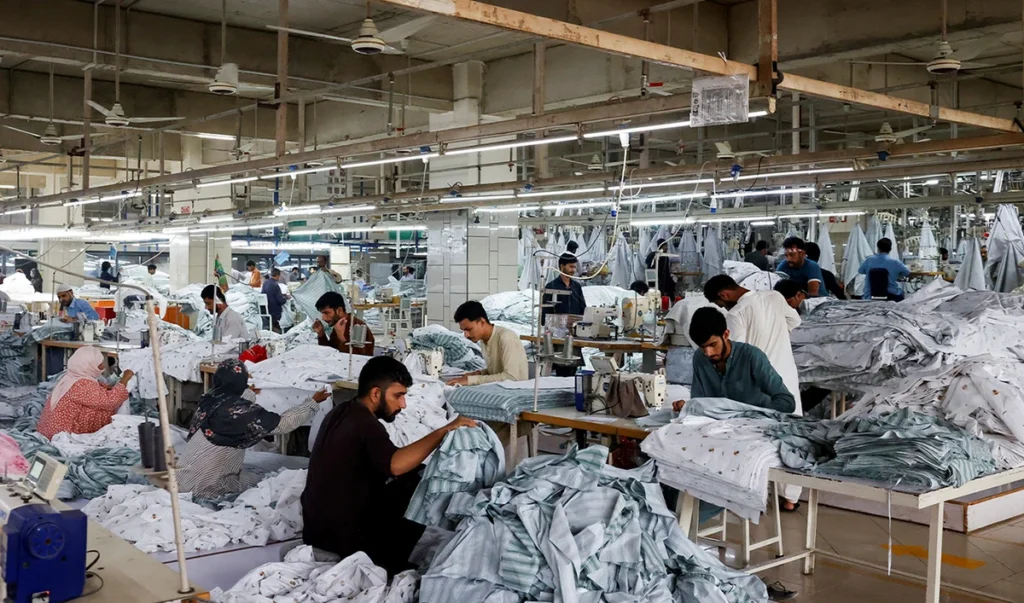
Textile manufacturing processes, including spinning, dyeing, washing, finishing, and garment production, consume substantial energy, water, and chemicals. Inefficient machinery, heat losses, inadequate process controls, and poorly managed wastewater can increase operating expenses and environmental damage.
Manufacturers should establish reliable resource-consumption baselines and identify opportunities for improvement. Energy-efficient machinery, renewable energy, heat recovery, water recycling, and effective wastewater treatment can reduce operating costs while improving environmental performance.
However, financing remains a significant obstacle, particularly for small and medium-sized enterprises. Smaller suppliers may struggle to afford modernization even when investments could generate long-term savings.
Pakistan should consider establishing a dedicated industrial resource-efficiency financing facility for textile manufacturers. This could combine concessional lending, technical assessments, and performance-based incentives for investments that demonstrate reductions in energy consumption, freshwater use, and material losses.
Large exporters, commercial banks, development-finance institutions, and international buyers should also contribute through technical assistance, affordable financing, and longer-term purchasing arrangements. International climate finance and technology partnerships could further support industrial modernization.
These partnerships should help Pakistani manufacturers access appropriate technologies and technical expertise without making environmental improvements financially inaccessible to smaller suppliers.
Textile waste also deserves greater attention. Cutting residues, rejected fabric, yarn remnants, and other production waste can contain recoverable materials. Better sorting, collection, recycling, and waste prevention can reduce disposal costs and create additional industrial value. Universities, manufacturers, and technology providers should collaborate to identify commercially viable recovery opportunities.
International textile markets are increasingly influenced by environmental performance, circularity, and supply-chain accountability. Competitiveness will depend not only on production costs and product quality but also on manufacturers’ ability to demonstrate where materials originate and how resources are used throughout production.
The European Union’s Ecodesign for Sustainable Products Regulation (ESPR) is an important development. Textiles and apparel have been identified as priority product groups for future Ecodesign requirements and Digital Product Passports.
According to the European Commission’s indicative planning, textile-specific delegated rules are scheduled for planned adoption in the fourth quarter of 2027. Their precise requirements and implementation arrangements are still under development and may evolve.
Digital Product Passports are intended to improve access to relevant product information, including material composition, origin, and information supporting repair, reuse, and recycling. For Pakistani exporters, preparation should begin before these requirements become operational.
Manufacturers need better production records, reliable sourcing information, and environmental data systems. Pakistan should initially test these capabilities through practical traceability pilots involving selected cotton-growing districts, ginners, spinning mills, and exporters. Such pilots should establish whether cotton batches can be tracked through successive production stages, what information international buyers require, and how much compliance would cost participating businesses.
Importantly, traceability must also create fairer commercial relationships. Farmers and smaller suppliers who invest in improved environmental practices should have an opportunity to benefit when those improvements are verified and commercially valued.
Otherwise, sustainability requirements risk transferring additional costs to weaker participants in the supply chain while financial benefits accumulate elsewhere.
COP31 Offers an Opportunity for International Cooperation
The 31st Conference of the Parties to the United Nations Framework Convention on Climate Change (COP31), taking place in Antalya, Türkiye, from November 9 to 20, 2026, provides an important international context for Pakistan’s industrial transition. The United Nations Climate Change COP31 information and Action Agenda priorities emphasize implementation and measurable climate action.
For Pakistan, climate policy should become an instrument of economic modernization rather than a separate environmental obligation. Cooperation on climate finance, technology transfer, renewable energy, and industrial efficiency can help manufacturers improve productivity while reducing environmental pressure.
However, international commitments will have limited economic impact if smaller businesses cannot afford the investments required to meet changing expectations. Financial and technical support must therefore accompany the transition.
Pakistan should begin with a focused five-year program built around five priorities:
- Climate-resilient cotton cultivation: Strengthen agricultural research, extension services, suitable seed access, and water-efficient farming practices in selected cotton-growing districts.
- Industrial resource efficiency: Establish comparable energy, water, wastewater, and material-use benchmarks for participating textile factories.
- Supply-chain traceability: Launch pilot projects connecting farmers, ginners, spinning mills, and exporters to test practical and affordable tracking systems.
- Accessible industrial finance: Mobilize public finance, commercial banks, development partners, and international buyers to support cleaner technologies and factory modernization.
- Transparent monitoring: Publish periodic assessments through a publicly accessible textile resource-productivity dashboard, supported by reliable data and independent verification.
Progress should be measured through both environmental improvements and commercial outcomes. A technically successful intervention that imposes unsustainable costs on a small supplier will be difficult to expand. Programs should ,therefore, demonstrate that resource efficiency can improve profitability, strengthen resilience, and create economic opportunities throughout the value chain.
Pakistan should not abandon cotton. It should abandon the assumption that higher cotton production alone can secure the future of its textile industry.
The country’s textile competitiveness will increasingly depend on how efficiently raw materials are processed, how responsibly water and energy are used, how much production waste is recovered, and how effectively manufacturers respond to international market expectations.
Climate resilience must become an economic strategy rather than remain a separate environmental objective. This requires coordinated agricultural and industrial policies, predictable investment conditions, accessible financing, cleaner technologies, and stronger supply-chain information.
Ultimately, Pakistan’s textile future will depend not simply on how much cotton it grows or how many textile products it exports, but on how much economic and social value it creates from its available resources.
The question is no longer simply how much cotton Pakistan can produce. It is whether the country can create greater and more sustainable prosperity from every bale, every drop, and every unit of energy.
*The views presented in this article are the authors’ own and do not necessarily reflect the views of The Diplomatic Insight.*

Noreen Raza
Noreen Raza is Assistant Director (Technical) at the Sindh Environmental Protection Agency (SEPA), a climate advocate, and environmental governance professional. She serves as a YSP Global Ambassador, Climate Ambassador with the Climate Diplomacy Network, and member of IUCN’s Commission on Ecosystem Management (CEESP). A former Forest Officer, she advocates for climate resilience, biodiversity conservation, ESG integration, and sustainable development. She is an alumna of UNITAR and PFI and contributes to environmental policy discourse as a writer and speaker.