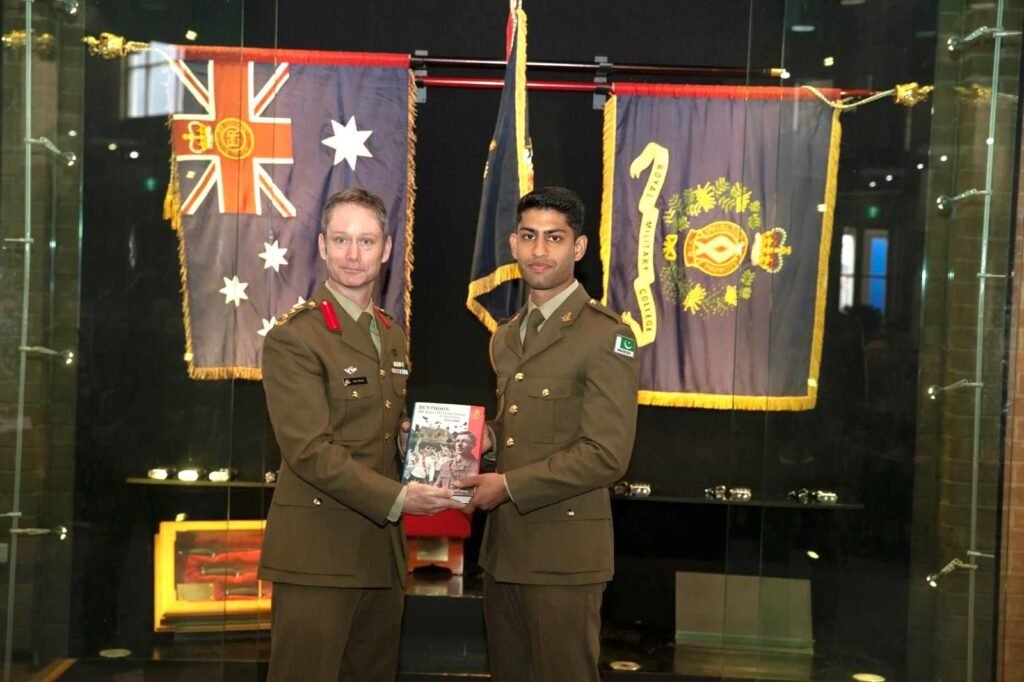
Islamabad (TDI): The Inter-Services Public Relations (ISPR) confirmed that Cadet Sardar Arsam Abbas, from the 152nd Long Course of the Pakistan Military Academy, received the top international distinction after securing leading positions across academic, physical, and tactical training components.
The commissioning parade was reviewed by Chief of Army of Australia, Simon Stuart, along with Pakistan’s High Commissioner to Australia, Irfan Shaukat, and was also attended by diplomats and senior military officials.
The High Commissioner of Australia to Pakistan, Timothy Kane, praised Abbas for his performance at the Royal Military College Duntroon in Canberra.
Kane said the achievement reflects the “excellence and leadership” underpinning ongoing defense cooperation between the two countries.
Congratulations to Pakistani Army Cadet Sardar Arsam Abbas on being named the Overall Best Foreign Military Cadet at Australia’s Royal Military College, Duntroon! A proud achievement that reflects excellence and leadership, and the enduring Australia–Pakistan partnership. ???????????????????? pic.twitter.com/JCVDvLnRXb
— Timothy Kane (@AusHCPak) May 6, 2026
ISPR noted that this marks the 14th occasion on which a Pakistani cadet has received the “Overall Best Foreign Military Cadet” award at the institution during a graduation parade, underscoring ongoing performance standards among Pakistan’s officer trainees.
It further highlighted that defense ties between the two countries remain structured and ongoing, with seven Pakistan Army officers having served on the RMC faculty as platoon commanders since 2013 and a total of 46 Pakistani cadets graduating from Duntroon since 2009.
The record of Pakistani cadets at RMC Duntroon also includes past recipient Nasir Hussain Khalid Selhria (Shaheed), whose name remains recorded on the academy’s memorial following his death in 2020.
Officials indicated that the latest recognition reflects the training standards of Pakistan’s military institutions and contributes to continued professional engagement between the armed forces of Australia and Pakistan.
The recognition also highlights the broader role of international military training exchanges in building professional capacity and mutual understanding.
Such programs are often viewed as important avenues for strengthening institutional ties, fostering interoperability and promoting shared standards of leadership and discipline among partner countries.

Muhammad Usman Hashmi is a researcher in International Relations, focusing on climate diplomacy, global governance, and political economy in the Global South. He has contributed to policy dialogues with the Foreign Policy Community of Indonesia and serves as a Senior Research Fellow at the International Council on Human Rights, Peace and Politics. He is also associated with Rethinking Economics Islamabad, contributing to research on development and sustainability.