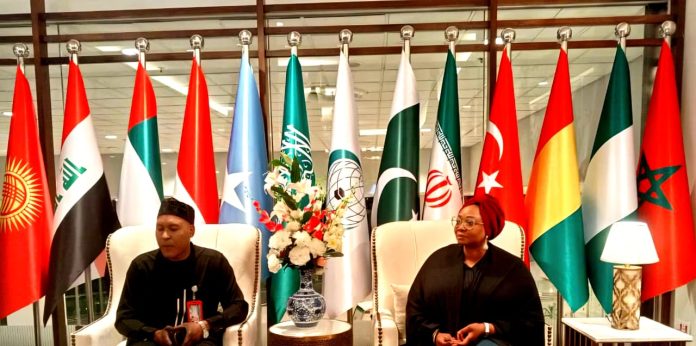
Pakistan opens the ninth Organization of Islamic Cooperation (OIC) Ministerial Conference on Women in Islamabad on Sunday, with delegations from member states already arriving in the capital ahead of the two-day gathering.
Delegates began landing at Islamabad International Airport on Saturday, where they were welcomed by Minister of State for Law and Justice Barrister Aqeel Malik, Parliamentary Secretary on Human Rights Saba Sadiq, Parliamentary Secretary on Law and Justice Farah Naz Akbar, and senior officials from the ministries of Human Rights and Foreign Affairs.
The conference, hosted by the Government of Pakistan under the Ministry of Human Rights, carries the theme “Socio-Economic and Political Empowerment of Women in the OIC Countries: Challenges and Way Forward.”
Warm welcome to all delegates arriving for the 9th OIC Ministerial Conference on Women in Islamabad. We wish you productive discussions & a memorable stay in Islamabad. pic.twitter.com/LpkSKrhHrq
— Ishaq Dar (@MIshaqDar50) July 11, 2026
Minister for Law, Justice and Human Rights Senator Azam Nazeer Tarar will formally assume the conference chair on Pakistan’s behalf, leading proceedings as the country works with fellow OIC states to build consensus on advancing women’s empowerment across the Muslim world.
According to Pakistani state media, around 190 delegates from the OIC’s 57 member countries are expected to attend.
The event will bring together ministers responsible for women and family affairs alongside senior officials, representatives of OIC institutions, international organizations and development partners.
Held roughly every three to four years, the ministerial conference is designed to let member states review progress on women’s rights, exchange national policies and adopt joint frameworks.
Read More: OIC-COMSTECH Trained 5,000 Scientists Across 54 Countries in 2025
Organizers say the goal is to create conditions that let women in OIC countries fully realize their potential to contribute to social and economic development, while boosting their political and professional participation and their access to economic resources and financial systems.
This year’s edition will also examine how to close gender gaps in technology and digital participation. Previous ministerial meetings have tackled themes including women’s economic empowerment, combating gender-based violence, and expanding access to education and health care.
The last such conference was held in Cairo in 2021, focusing on empowerment, protection frameworks and socio-economic participation.
By taking the chair, Pakistan positions itself at the center of a multilateral push to coordinate women’s rights policy across the 57-nation bloc, a role Islamabad says it intends to use to foster dialogue and build consensus among OIC members in the months ahead.