The Treaty on the Non-Proliferation of Nuclear Weapons (NPT) is the heart of the international nuclear non-proliferation framework, which distinguishes between the recognized nuclear-weapon states and non-nuclear-weapon states and makes access to nuclear technology contingent on adherence to the NPT’s obligations.
Theoretically, this should have been to ensure restraint and equal treatment among states. But if India’s trajectory is examined on the ground, it leaves one with uncomfortable questions about whether these rules are still equally applicable.
India is not a signatory to the NPT but is a nuclear-armed country that is increasingly playing a part in international nuclear governance. Over the last two decades, India has gradually been incorporated into important export control regimes such as the Australia Group, the Missile Technology Control Regime and the Wassenaar Arrangement. The most significant was the waiver extended by the Nuclear Suppliers Group (NSG) in 2008, which enabled India to continue in the civilian nuclear business even as it was not a nuclear power signatory to the NSG.
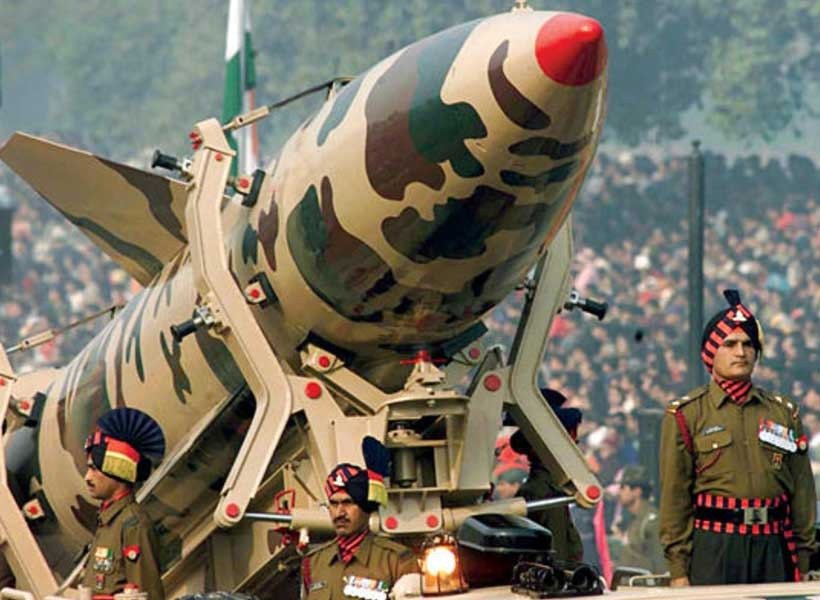
Regardless, India is expanding its missile technologies and its ranges, such as MIRV technology and the Agni series. The combination of the formal denial of treaty status and the functional incorporation into treaty benefits has led to what can only be called “strategic exceptionalism.”
Read More: India Set for Record $2bn Drone Procurement to Boost Defense Capabilities
The deeper worry is structural: the world’s non-proliferation regime seems to be ready to violate its own principles when they are in strategic interest of the US. The NSG waiver is a clear example. The initial intention behind the NSG was to limit nuclear cooperation with non-comprehensive safeguards states, to support the rationale that nuclear cooperation should be subject to strict and explicit safeguard requirements.
Whereas India exempted itself from that principle. Instead of applying the criteria, the member states negotiated an exception for a state outside the NPT. It wasn’t just a policy change; it was a change in the way the rules are applied.
This is important because international regimes rely on both the enforcement of measures and their credibility. The legitimacy of the whole system is undermined if it is seen as less flexible in some states and more in others. The obvious question is: if the exception can be granted to India for strategic reasons, why not to other states that are not part of the treaty?
If there are no such cases, it has a negative impact. This may be a more fundamental change in geopolitics. India’s growth has come at a time when the world is becoming more competitive, with China and the US vying for dominance. India is not only seen as a non-proliferation-compliant country but also as an important partner in balancing strategies. Having this dual role – a non-NPT nuclear power and a strategic counterweight in Asia – has enabled India to enjoy flexibility in global rules.
The tension is clearly seen here. A universal non-proliferation regime is being designed, but its application is getting strategic. The claim that India is behaving responsibly and aligned with international standards to be a member of sensitive technology regimes is often used as justification, despite being far from the reality.
But this is not quite satisfactory in explaining why such flexibility is not given to other non-NPT countries which could show similar technical safeguards. This makes an emerging hierarchy in the nuclear order that is no longer only based on treaty status, but geopolitical value.
There are more opportunities for compromise in states that are important to big powers, and less in others that are subject to stronger formal constraints. This ‘double-track’ system adds confusion to the otherwise transparent rules.
Read More: India’s Exceptionalism and Sanctity of IAEA Safeguards
The Australia Group and Wassenaar Arrangement are export-control regimes that complicate this situation. India’s membership in these institutions is seen as successful integration in responsible global governance. However, these memberships do not solve the issue of contradiction that India is not a member of the NPT, which constitutes the legitimacy of the nuclear order. Participation is thus not the same as ‘normal’ inclusion.
The wider impact will be a gradual disintegration of the non-proliferation regime. It is based on the assumption of uniform application of the rules. The assumption is undermined when exceptions begin to show and become politically motivated.
This can lead to a reduction in trust in the system’s neutrality over time and increase the likelihood of strategic calculation over institutional norms. It is not only about treaty discipline anymore; the nuclear order is also evolving in a way more determined by adaptation to geopolitical realities.
The India exception is, in fact, a reflection of another structural dynamic in the global governance system, namely, universal rules versus strategic flexibility. With major powers still toying with what is supposed to be a system of equal obligations and what is geopolitically in their best interests, the non-proliferation regime may increasingly become a façade for power politics in legal disguise.
*The views presented in this article are the authors’ own and do not necessarily reflect the views of The Diplomatic Insight.

Nomeen Kassi
Nomeen Kassi is a Research Assistant at Balochistan Think Tank Network (BTTN), Quetta. She is also doing her Masters in International Relations, with keen interest in emerging technologies, AI and South Asian politics. She can be reached at nomeen.kassi.nk@gmail.com