In the complex arena of international politics, the relationship between religion and statecraft has often produced both powerful motivations and dangerous outcomes. The ongoing Israeli-US war on Iran offers one of the most visible examples of this dynamic, particularly in the relationship between the United States and Israel. While strategic interests have long defined foreign policy, religious and moral arguments have also played a significant role.
When nationalism collides with the confluence of politics and faith, history shows that the results can be unpredictable and sometimes perilous. The United States’ relationship with Israel has evolved through different phases, shaped by both geopolitical calculations and ideological considerations. During the Cold War, American policy makers often framed their support for Israel primarily in strategic terms. Yet even then, moral and religious arguments were present.
In the early 1970s, former U.S. president Richard Nixon reportedly remarked that Israel held limited direct strategic value for the United States but carried immense moral and theological importance. This observation reflected a deeper cultural sentiment within American society, where biblical narratives and Judeo-Christian traditions have historically influenced public opinion and political discourse.
Following the establishment of the modern state of Israel in 1948, the United States gradually became its most important ally. Strategic concerns—particularly during the Cold War rivalry with the Soviet Union—played a role in strengthening this alliance.
However, religious sympathy among segments of American society, especially evangelical Christian communities, also contributed to the perception that Israel’s existence fulfilled biblical prophecy. This blending of faith and geopolitics created a unique political environment where foreign policy could sometimes be interpreted through theological lenses.
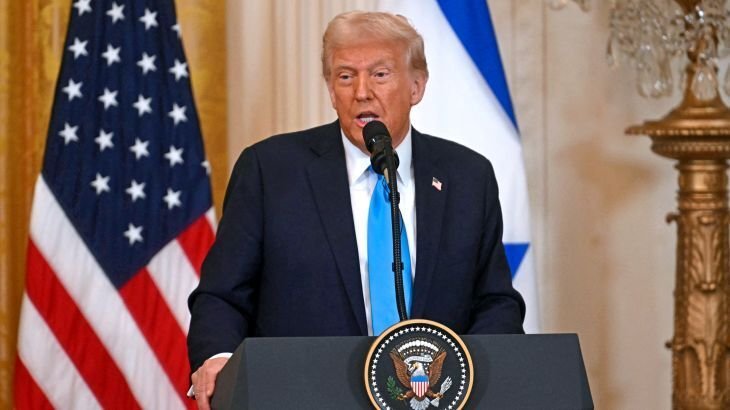
The role of religious symbolism in American politics became especially visible during the presidency of Donald Trump. His administration adopted policies strongly supportive of Israel, including the recognition of Jerusalem as Israel’s capital in 2017 and the relocation of the U.S. embassy there in 2018.
Read More: Faith, Fear, and the Far-Right: Australia’s Next Challenge in Countering Extremism
While these decisions were justified politically as acknowledgments of geopolitical realities, they also resonated deeply with evangelical voters who viewed them as steps toward fulfilling biblical expectations. Critics argued that such policies suggested a shift in American political rhetoric—from presenting the United States purely as a secular democracy toward portraying it as a nation guided by religious duty. The idea that biblical narratives can influence modern territorial claims has also appeared in diplomatic rhetoric.
Recently US ambassador to Israel Mike Huckabee invoked ancient scriptural descriptions to describe the historical extent of Israel. For instance, references to a land stretching “from the Nile to the Euphrates” echo passages from the Hebrew Bible that describe the territory promised to the ancient Israelites. Supporters of this interpretation sometimes associate it with the biblical kingdom of Solomon, who according to scripture ruled a vast domain during the tenth century BCE.
Critics, however, warn that invoking ancient religious texts to justify modern political borders can inflame tensions and complicate diplomatic solutions. Religious symbolism has also appeared within American military culture. Public discussions about figures such as Pete Hegseth—who has been associated with imagery such as the crusader cross—illustrate how historical religious symbols can resurface in contemporary political narratives.
While many individuals view such symbols as expressions of cultural identity, others interpret them as reminders of historical conflicts between religious civilizations. As reported by the British newspaper ‘The guardian’ before operation epic fury religious rhetoric was invoked to motivate troops which reinforced the perception that some conflicts are framed in moral or even spiritual terms rather than purely strategic ones.
Historically, relations between religious civilizations have often been conceptualized through ideological frameworks. In classical Islamic political thought, scholars used terms such as Dar al-Islam, Dar al-Harb, and Dar al-Aman to categorize relations between Muslim and non-Muslim territories. These concepts reflected a medieval world divided largely along religious lines. Although modern international law no longer operates within these frameworks, echoes of such divisions still influence political discourse in some regions.
The emergence of an expansionist or highly ideological nationalist movement—whether religious or secular—can therefore revive old narratives of civilizational conflict. The Israeli-US war on Iran illustrates how religion, nationalism, and historical memory can become deeply intertwined. Jewish historical connections to the land, Islamic and Christian attachments to sacred sites, and modern nationalist aspirations have all shaped the dispute.
Read More: Mojtaba Khamenei: Iran’s New Hardline Supreme Leader
For Jews, Israel represents both a homeland and the fulfillment of a long historical struggle for self-determination following centuries of persecution, culminating in the tragedy of the Holocaust during World War II. For Palestinians, the same territory represents their ancestral home and the center of their own national aspirations. When religious narratives are layered upon these political claims, compromise becomes increasingly difficult.
This raises a broader philosophical question: in an age where humanity has achieved extraordinary scientific progress by reaching the moon and vivisection of the atom should ancient scriptures guide modern political decisions?
Religion has undoubtedly shaped human civilization, providing ethical frameworks and cultural identity for billions of people. Yet modern governance generally attempts to balance religious traditions with secular principles such as international law, diplomacy, and democratic accountability. Ultimately, history suggests that the fusion of intense nationalism with religious conviction can produce both unity and conflict. When political objectives are framed as divine mandates, negotiation and compromise often become more difficult because the stakes appear absolute.
As the French writer Jean-Baptiste Alphonse Karr famously remarked, “the more things change, the more they remain the same.” Despite humanity’s technological and scientific advances, the enduring power of faith and identity continues to shape global politics. Understanding this dynamic is essential for navigating the conflicts of the twenty-first century.
Recognizing the historical, religious, and political dimensions of disputes may not resolve them immediately, but it can encourage more nuanced dialogue. In a world striving for peace while still deeply influenced by ancient beliefs, the challenge lies in balancing respect for faith with the pragmatic realities of modern diplomacy.
*The views presented in this article are the author’s own and do not necessarily reflect the views of The Diplomatic Insight.

Idrees Khan
Idrees Khan holds a BS(Hons) degree in Government and Public Policy and is an alumnus of the SUSI exchange program at the University of Massachusetts Amherst. Currently, he is serving as Azerbaijan Youth ministry representative.