Beijing’s latest countermeasures arrive precisely as Washington’s drone arsenal faces its worst wartime attrition in a generation; raising the question of whether China is intervening in the Iran conflict by other means.
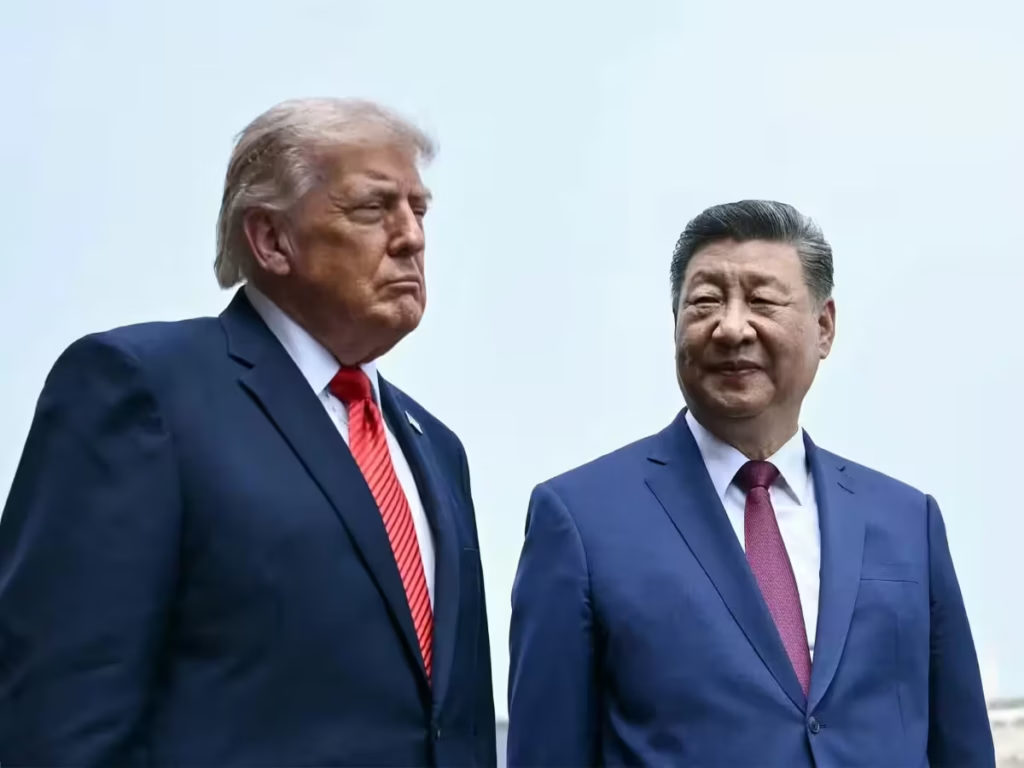
The Chinese Ministry of Commerce on Wednesday announced a broad range of countermeasures against the United States, imposing new export restrictions on the drone supply chain and approving sanctions on a new list of US entities.
China now has to review case by case exports of UAVs, their principal components and related technologies which are all considered “dual-use” under China’s existing export-control system; and they no longer get to the export license conveniences that they have enjoyed in the past.
While it is not a full ban on drone exports, the measure will make it harder to ship drones to the United States, and could impact American drone manufacturers and customers that rely on components and technology made in China.
The commerce ministry also put six US companies on its countermeasures list, which is intended to prevent China’s entities and individuals from engaging in cooperation with those in the United States, for allegedly helping the US with sanctions targeting China’s Xinjiang region.
Read More: China’s Foreign Affairs Blue Book Warns of a Turbulent World Ahead
Compliance Testing LLC was also sanctioned for helping the FCC implement policies that Beijing said are “threatening China’s sovereignty.” The ministry said its measures were a response to actions that “seriously violate the important consensus reached by the two heads of state” and “severely damage China’s legitimate rights and interests,” warning of further countermeasures should Washington introduce new restrictions.
The timing is not coincidental; it comes at the exact time the US drone arsenal is under severe strain in its recent history. Since the beginning of the war, Iran has shot down over two dozen MQ-9 drones used by the US, a loss of almost $1 billion, accounting for about 20% of the Pentagon’s pre-war stockpile of the hard-to-replace platform.
The Air Force says that the number of operational MQ-9s has dropped to about 135, down from more than 280 at the start of the war, and well below the 189-aircraft minimum required to maintain worldwide operations. While lawmakers were beginning to work on a move to end all divestments and to build up the fleet by 2028, Air Force Chief of Staff Gen. Kenneth S. Wilsbach declared the MQ-9 the “most valuable player” of Operation Epic Fury.
The high end ISR layer is also overworked. The Navy confirmed in April the loss of an MQ-4C Triton reconnaissance drone in the Persian Gulf, one of some 20 in service, each worth about $238 million. The loss was determined to be a Class A mishap, and open-source flight tracking data revealed the aircraft was on a descent from 52,000 feet over the Strait of Hormuz when its transponder went dark.
Read More: The Long War Between China and the United States
The Triton program had already been cut from the original acquisition of 68–70 aircraft down to 27, where a loss of one aircraft would mean the loss of about 5% — a level that has real operational implications for continuous surveillance over the Gulf and elsewhere.
It is in this context that the United States has been increasingly relying on the LUCAS, the Low-Cost Unmanned Combat Attack System. On February 28, 2026, LUCAS made its combat debut when the United States conducted airstrikes on Iran, which were comprised of LUCAS drones, reverse-engineered from Iran’s own Shahed-136 one-way attack drones.
The irony is that the world’s foremost military power, the United States, was imitating Iranian drone technology, reflecting the desperate need for scalable, expendable strike power. LUCAS production is still low in comparison to operational needs and the rest of the US counter-drone and drone-strike system only received $4.7 billion in fiscal year 2026 budget.
Read More: China’s Shrinking Export Buffer Could Have Global Spillovers
China’s decision to close the supply route to drone parts at this very moment presents a sharp strategic dilemma: is Beijing really coming to the Iran war without a declaration? The answer, analytically, is unlikely to be through formal coordination with Tehran; but structurally the outcome is the same.
As analysts have observed, nations such as Russia and China are taking note of the experiences of the Iran war, especially in the area of the limits of American war-fighting capabilities posted by the backlash of stockpile depletion.
At the very moment when it is most in need of scalable and affordable UAS, restricting drone component flows to Washington, while its high dollar ISR platforms, like the MQ-9 and MQ-4C, bleed over Iran, is coercive leverage done via trade law and deniable in form and exact timing.
It may have been coincidence or a message from Beijing, but the impact is the same: The United States is now in the midst of its largest drone deployment in a single war in history, and the world’s premier drone maker has put a bureaucratic spike in the supply line. That’s not a non-threatening action. It’s another way of intervening.

Muhammad Mahad Samija
Muhammad Mahad Samija is a student of Political Science at Government College University, Lahore. He can be reached at [email protected]