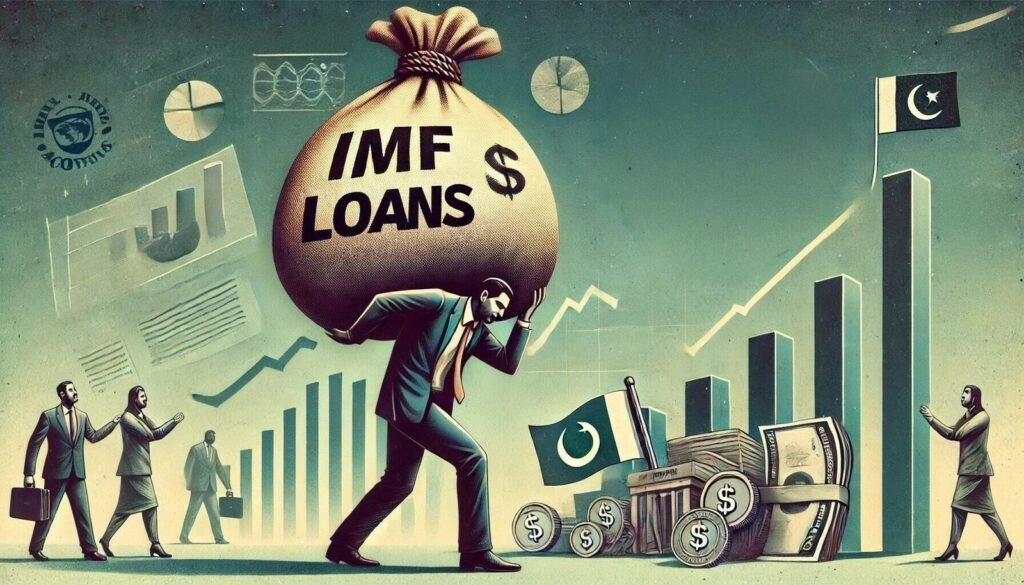
Pakistan’s economy is still caught in a vicious cycle of bailouts and disasters. The IMF’s 24th program since independence, a 37-month Extended Fund Facility (EFF) for roughly $7 billion, was approved in September 2024 . This scheme was implemented in the midst of a major balance-of-payments crisis and political unrest in 2023, following a stop-gap SBA. Although recent data indicates some improvement inflation has returned to single digits and GDP growth recovered to roughly 2.5% in FY2024 structural issues still exist.
According to the World Bank, persistent deficits, an unsustainable energy sector, and a small tax base have “remained largely unaddressed,” impeding development and slowing growth . Pakistan needs to change its economic model in a practical, multi-year plan that includes boosting revenues, reducing subsidies, diversifying exports, deepening finance, and reforming institutions in order to end the IMF cycle.
One of the main structural issues of Pakistan is its ongoing budget deficit. In FY2024, total spending was approximately 20% of GDP, but revenue was only 12%. Despite recent changes, the budget deficit is still close to 6–7% of GDP (the World Bank estimates 6.7% for FY2025), with significant interest payments using up public funds. The tax base is incredibly small; according to OECD data, Pakistan’s tax-to-GDP ratio was just roughly 10.5% in 2023 , significantly lower than that of its peers in the Asia-Pacific area (≈19%).
The government is dependent on debt and outside assistance due to poor revenue mobilization. The IMF points out that unless the tax base is expanded and spending is restrained, “fiscal sustainability” is in jeopardy. Pakistan committed to eliminating significant tax exemptions and bringing industries including retail, agriculture, and exports into the tax system in 2024 as part of its IMF program; these actions would generate an additional 3% of GDP in revenue . However, execution will put political will to the test because history demonstrates that fiscal deficits recur in the absence of ongoing tax measures.
The energy industry continues to be a major drag. Expensive electricity production, widespread subsidies, and “circular debt” (arrears) have depleted state coffers and warped prices. The circular debt in power reached approximately Rs. 2.4 trillion (€$8.6 billion) by March 2025. The government also announced a three-year “Roshan Maeeshat” electricity plan in late 2025 to boost industry, charging farmers and industries merely Rs. 22.98/kWh (far less than cost). This goes against IMF-mandated tariff revision even if it seeks to increase output and exports.
Read More: IMF Is Not the Enemy, Pakistan’s Internal Economic Architecture Is
The Fund has encouraged Pakistan on several occasions to phase out untargeted subsidies and match rates with actual costs. In reality, it will be politically delicate to restore cost recovery (increasing rates, reducing losses). In the meantime, state-owned businesses and public utilities that are losing money keep losing money. The “outsized role of the state” and poor corporate governance have hindered investment, according to the 2024 IMF report. A crucial but challenging component of any exit strategy is resolving the energy pinch through increasing efficiency, focusing help, and reducing subsidies.
For a long time, exports have been excessively limited and weak. Pakistan’s export basket is still dominated by agricultural and textile goods, and its export growth has lagged behind that of its neighbors in the region. Pakistan’s numerous import and export restrictions “have consistently placed [it] around the 90th percentile” of international limitations, limiting market access, according to an IMF report . Pakistan will find it difficult to generate sufficient foreign exchange unless higher-value sectors emerge. The current account has been largely in deficit due to this deterioration.
Due to high remittances, Pakistan only had a little surplus in FY2024 (about 0.1% of GDP). Importantly, remittances have been a lifesaver. In FY2025, Pakistan received a record $38.3 billion in remittances (up 27% year over year), boosting reserves and driving the current account toward its first surplus in more than ten years. Although hopeful, this windfall is unpredictable because it depends on foreign labor markets. Foreign direct investment is still low in the interim. FDI inflows increased to just $1.9 billion in FY2024, with a large portion of that amount going into resource and electricity projects. FDI is hampered by low investor confidence, which is partially caused by macro instability.
To put it briefly, important economic ratios are bad: growth per capita has hardly kept up with population growth, government debt above 70% of GDP, and reserves once fell to dangerously low levels. According to the WB, “Pakistan’s economy is recovering from the recent crisis” as a result of policy changes; nonetheless, growth is expected to remain moderate (~2.6% in FY2025) in the absence of other significant reforms.
Crucially, foreign reserves have grown and inflation seems to be under control. The IMF confirmed in late 2025 that Pakistan’s economy was “on track,” citing reduced risk spreads, better buffers, and controllable inflation . These encouraging developments could aid Pakistan’s return to the capital markets: officials have declared ambitions to issue a $1 billion bond and a Chinese-yuan “panda” bond by 2026 , which would signify a tentative departure from emergency finance.
Read More: IMF Board to Approve $1.2bn for Pakistan on December 8
In order to prevent further IMF rescues, the economy’s weak points must be addressed gradually. Similar pillars are outlined by analysts and institutions:
Expand the base, close loopholes, and improve tax administration. Revenues can be progressively increased toward a target of approximately 15–18% of GDP by taking little initiatives, such as taxing property, agriculture, and unorganized services. An overhaul of fiscal federalism is also necessary; as Pakistan has agreed upon in response to IMF advise, province budgets should be coordinated under a legally binding fiscal agreement. Concurrently, it is necessary to streamline non-development expenses, particularly those related to subsidies and loss-making organizations. Reducing debt pressures by bringing the budget deficit down to 4–5% of GDP in the medium run is the top aim.
Finish the shift to gas and electricity cost-recovery rates while focusing on helping the underprivileged. This entails lowering line losses, standardizing billing, and progressively doing away with blanket subsidies that cost the government almost 2% of GDP annually. Pakistan is being pressured by the IMF to “phase out untargeted energy subsidies and restore cost recovery in the power sector”. If this is accomplished, state spending will be reduced and private investment in energy infrastructure will be encouraged.
Promote sectors like engineering goods, pharmaceuticals, and IT services to overcome the dominance of cotton textiles. This calls for trade barrier reduction, technical assistance for value-added production, and investment incentives for exporters. In order to draw in export-linked FDI, regulatory reform is also essential given Pakistan’s difficult business environment. It is encouraging that in order to integrate into supply chains, governments now want to loosen import restrictions and adhere to international norms. Increased trade openness and competitiveness would boost Pakistan’s growth, as the IMF points out.
Reforms in the banking industry are necessary to expand credit. Strengthening business lending and financial inclusion is crucial because private credit accounts for only 10% of GDP, which is among the lowest in the world. Improving risk assessments, growing microfinance, and boosting capital market financing for companies are a few possible actions. Although the recent rise in lending (backed by low interest rates) is encouraging , credit expansion will require ongoing monetary stability. By enabling entrepreneurs to invest, deepening finance will increase the tax base and create jobs.
Read More: Aurangzeb Reaffirms Reform Commitment to IMF Chief
Without solid institutions and backing from both parties, none of the aforementioned improvements can be sustained. Pakistan has to protect its economic policies against periodic changes in the political landscape. Confidence will be increased by anti-corruption initiatives, judicial and regulatory independence, and openness in public contracts. A World Bank-backed initiative that emphasizes steady, long-term investments has been introduced by the new administration along with an economic “transformation plan”. Such efforts must endure beyond election cycles. Policy coherence will also be improved by increased provincial coordination (the previously mentioned fiscal agreement).
The foundation for medium-term restructuring (energy reform, financial sector strengthening) and long-term growth (export diversification, human capital) should be laid by short-term stabilization (e.g., fiscal consolidation, inflation control). International partners can offer financial buffers during adjustment whenever feasible. In fact, Pakistan obtained $1 billion from Middle Eastern banks in the middle of 2025 to reduce its debt related to the energy sector.
Realistically, it will take several years to exit the IMF cycle. Pakistan might need to carry some external buffers (via new bond issuances or development finance) through the late 2020s even if execution is effective. For instance, Pakistan intends to issue yuan-denominated bonds and Eurobonds around 2026, indicating anticipated market confidence. Pakistan may try to cover its funding needs through regular routes when the EFF finishes on time in late 2027 and reforms continue. This could entail using its own reserves to fund imports for three to six months and retiring IMF support as the principal backup.
In the end, the IMF itself emphasizes that institutions that are resilient to shocks and “a favorable environment for private-led growth” are necessary for sustained growth. One-time programs and piecemeal remedies are insufficient, as the present cycle has demonstrated. Pakistan’s economy, which was formerly heavily dependent on borrowing and subsidies, has to change to focus more on exports, investment-friendly policies, and fiscal restraint. The nation has “an opportunity to durably take another course,” according to the World Bank, but only if reforms are “duly implemented and sustained”.
In conclusion, institutionalizing reforms and putting aside short-term politics are critical to Pakistan’s departure from IMF dependency. It will necessitate years of stable administration and difficult decisions, some of which are unpopular. However, the cycle can be broken with a well-defined plan and reasonable standards. Pakistan can progressively restore its fiscal health and regain policy room by expanding the tax base, simplifying energy policy, increasing exports, and deepening finance. In this sense, the nation would finance development through its own expanding economy the ultimate test of economic sovereignty instead of relying on outside rescues.
*The views expressed in this article are the authors’ own and do not represent TDI. The contributor is responsible for the originality of this piece.

Talha Zaib
Talha Zaib is a student of International Relations and can be reached at talhazaib969@gmail.com