Public debates about extremism in Australia often default to a familiar assumption: that violent extremism is primarily a religious problem. This framing has shaped counter-terrorism laws, media narratives, and public perceptions for more than two decades.
Yet it no longer captures the reality of extremist violence facing liberal democracies. Extremism today is as likely to emerge from secular, racial, and ideological worldviews as it is from religious belief.
Understanding the distinction between religiously motivated and non-religious (ideological) extremism is crucial if Australia is to respond effectively to contemporary threats without deepening social division.
Religiously motivated extremism in Australia has largely been associated with jihadist movements inspired by groups such as Islamic State and Al-Qaeda. These actors frame violence as divinely sanctioned, drawing selectively on religious texts to justify attacks against civilians and the state.
Read More: Bondi Beach Shooting: How an Australian Father and Son Became Radicalized
Although the number of Australians involved in such movements has always been small, their actions have had a disproportionate political impact.
In response, Australian counter-terrorism policy has expanded dramatically since the mid-2000s. Surveillance powers increased, preventive detention laws were introduced, and Muslim communities became central targets of “counter-radicalization” initiatives.
While these measures were justified in the name of security, they also contributed to the securitization of Muslim identity, blurring the line between faith, politics, and suspicion.
Crucially, religion itself does not cause violence. Rather, it is instrumentalist, which means it is used as a moral language that frames violence as sacred, necessary, and heroic. This distinction matters, because focusing narrowly on religion risks mistaking the symbol for the source.
Extremism Without God
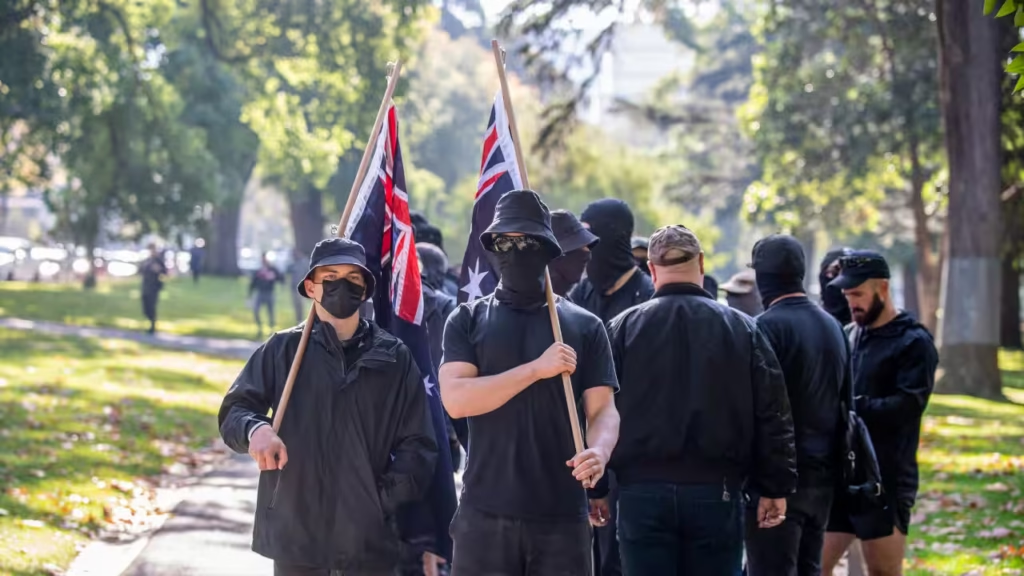
Far less attention has been paid to the rise of non-religious extremism—particularly far-right, white supremacist, and ethno-nationalist ideologies. These movements explicitly reject organized religion, yet they exhibit the same absolutism, de-humanization, and moral certainty found in religious extremism.
The clearest illustration of this dynamic is the Christchurch mosque attacks carried out by Brenton Harrison Tarrant, an Australian national. Although the attack occurred in New Zealand, its ideological roots were deeply connected to transnational far-right networks in which Australians are active participants.
Tarrant did not claim divine inspiration. Instead, he framed violence as a defensive necessity to protect “Western civilization” from demographic and cultural “replacement.” Race, not religion, was sacralized. Violence was portrayed as tragic but essential—a moral duty owed to the nation and future generations.
This form of extremism exposes a dangerous misconception: that secular societies are somehow immune to ideological violence. In reality, ideology can function like religion, providing totalizing explanations of the world, defining enemies, and legitimizing extreme acts.
| Dimension | Religiously Motivated Extremism | Non-Religious (Secular/Ideological) Extremism | Similarity / Outcome |
| Worldview | Binary: believers vs. non-believers | Binary: patriots vs. invaders, us vs. them | Both construct the world in absolute, doctrine terms |
| Justification for Violence | Invokes divine authority; martyrdom glorified | Invokes race, history, or civilization; violence framed as moral duty | Violence portrayed as justified, virtuous, and necessary |
| Legitimacy / Authority Source | God or religious texts | Ideology, race, nation, or historical narrative | Provides moral certainty and authority for extreme actions |
| Narrative Framework | Religious grievance, persecution of co-religions | Cultural or civilization grievance, perceived societal threat | Both rely on grievance narratives to transform fear and resentment into moral certainty |
| Targets | Out-groups, “apostates,” or states seen as hostile | Ethnic/religious minorities, political opponents, or “civilisational threats” | Civilians and symbolic targets become legitimate in both cases |
Rethinking Prevention in Australia
Australia is one of the world’s most multicultural societies, with declining religious affiliation and growing ideological diversity. In this context, reducing extremism to a religious problem is not only analytically flawed—it is socially dangerous. It risks stigmatizing entire communities while leaving other forms of radicalization under-examined.
A more effective approach would focus on how extremist ideas operate, not where they claim authority. This means paying attention to online ecosystems, grievance politics, and identity narratives that cut across religious and secular divides. It also means recognizing that radicalization is less about belief systems than about belonging, meaning, and perceived injustice.
If extremism is understood as a mode of meaning-making rather than a religious pathology, prevention strategies must change. Community engagement cannot be limited to faith groups, and counter-narratives cannot rely solely on theological rebuttals.
Instead, Australia needs a broader civic approach that addresses social alienation, digital radicalization, and the political exploitation of fear. This shift would also help depoliticize religion itself, allowing faith to be recognized as a social resource rather than a security risk.
Beyond the Religion Trap
The Australian experience demonstrates a simple but uncomfortable truth: extremism does not need God to be deadly. Whether sanctified by scripture or justified by ideology, violence emerges from the same human impulses—fear, identity, and the search for meaning in times of uncertainty.
Until public debate moves beyond the religion–violence trap, Australia risks fighting yesterday’s threats while misunderstanding today’s. Recognizing the shared logic of religious and non-religious extremism is not an academic exercise; it is a necessary step toward a safer and more cohesive society.
Australia now faces a critical choice. It can continue to treat extremism primarily as a religious security problem, or it can adapt to the evolving reality in which ideology, identity, and grievance—religious or secular—drive violence in similar ways.
Read More: Bondi Beach Shooter Visited Philippines as Indian National
Counter-extremism frameworks must become ideologically inclusive, giving the same analytical attention to non-religious threats, including far-right and ethno-nationalist movements, as to jihadist actors. Lone-actor violence should be understood as part of broader ideological ecosystems, while online radicalization—through forums, encrypted messaging apps, and algorithm-driven platforms—must become a central focus of prevention efforts.
Effective strategies will prioritize radicalization pathways, grievance amplification, identity reinforcement, and social isolation rather than merely policing belief content.
At the same time, Australia must avoid over-securitizing particular communities, as singling out religious minorities undermines trust and weakens intelligence and prevention efforts. Long-term resilience requires education, civic literacy, and inclusive national narratives that counter both religious absolutism and racialized fear politics.
The public conversation must move beyond simplistic labels to ask why violent ideologies resonate, whether religious or secular. Ultimately, the future threat landscape will be shaped not by religion alone, but by how effectively Australia understands extremism as a problem of meaning, identity, and power, and whether it responds with insight, foresight, and societal cohesion rather than fear.
*The views presented in this article are the author’s own and do not necessarily reflect the views of The Diplomatic Insight.

Usman Anwar
Usman Anwar is a prospective M.Phil. scholar in Politics and International Relations. His research interests include security studies, maritime affairs, comparative politics, human rights, and climate change. His academic portfolio includes 7 published articles in reputable journals (Category Q-2 and Y) and a book review (Category Q-3). He can be reached at usmananwar2023@gmail.com