Canberra meeting produces agreements on hypersonic missile ranges, directed-energy systems, and a decade-long defense production partnership; a signal that the Indo-Pacific’s middle powers are accelerating self-reliance.
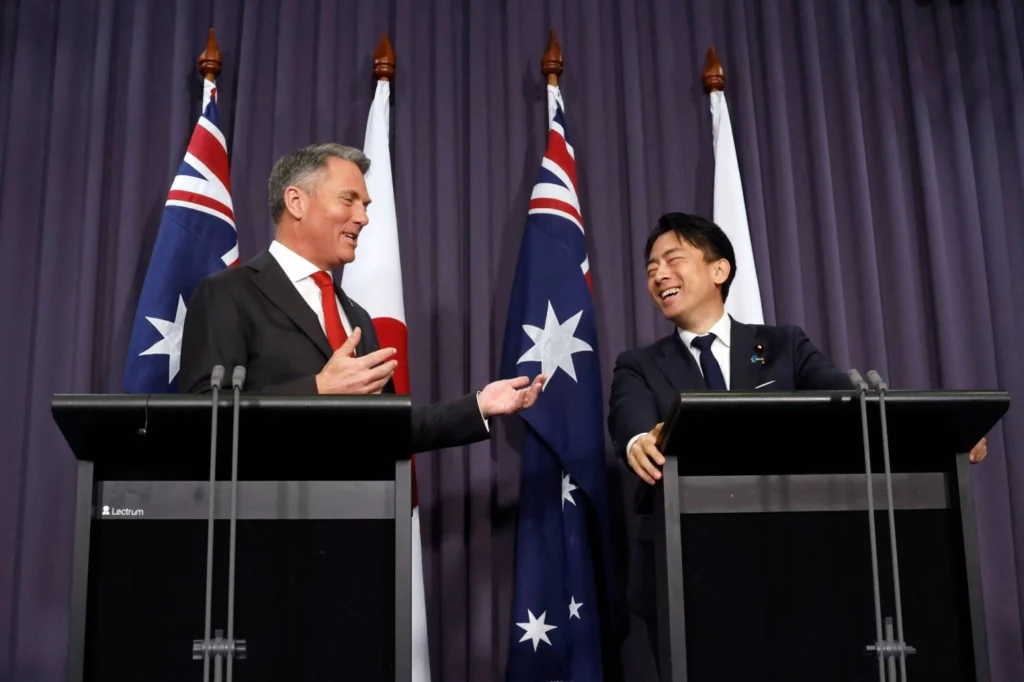
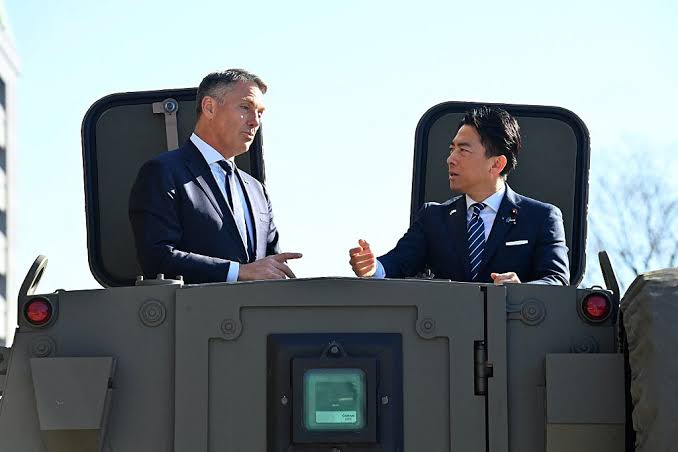
In what marks a further institutional deepening of the Australia–Japan defense relationship, Defense Minister Richard Marles and his Japanese counterpart Shinjiro Koizumi held talks in Canberra on Tuesday, producing agreements on hypersonic missile testing, a jointly developed laser detection system, and an expanded framework for bilateral military training and technology transfer over the next decade.
Marles said after meeting Koizumi that they had agreed to an enhanced deal for Japan to conduct missile launches at Australian firing ranges over the next decade.
Koizumi noted it would be the second time Japan establishes a missile range arrangement with any ally, the first being with the United States.
“If the Japan Self Defense Forces are able to conduct test launches of stand-off missiles, such as hypersonic missiles in Australia,” Koizumi said, “it would be a groundbreaking development.”
Read More: Australia, Japan Push Back Against US on Deploying Ships to Hormuz
Beyond the missile range deal, the two ministers announced a new jointly developed defense cooperation project called Boobook – named for an Australian owl that sees in the dark – featuring a co-developed laser system to detect incoming threats.
The project includes enhanced laser capability deployable on land combat and littoral platforms. Koizumi and Marles described successful field trials of the high-energy laser as a “significant milestone” in bilateral defense collaboration.
The timing of this acceleration is inseparable from America’s current strategic condition. The Iran war, now well into its sixth month, has consumed naval, munitions, and human bandwidth at a pace Washington did not plan for. The United States entered this conflict with inventories already strained from years of high operational tempo and insufficient industrial replenishment.
According to a CSIS report, the Pentagon is currently receiving roughly 15 new Tomahawks and 20 new Patriot missiles per month, with no THAAD deliveries forecast in 2026 at all; and rebuilding depleted stocks to pre-war levels will take three or more years.
The human cost is equally visible. Sixteen US service members have been killed and more than 430 wounded since the conflict began, with Iranian strikes hitting American bases across Kuwait, Jordan, Saudi Arabia, Bahrain, and the UAE.
And the naval gap in the Pacific is now literal; the USS George Washington is departing the Pacific to replace the USS Abraham Lincoln in the Middle East, leaving the western Pacific without an American aircraft carrier, amid growing concerns about crew mental health and supply issues aboard the long-deployed Lincoln.
If two carriers remain in the Middle East, the Pacific presence could drop to zero for months at a time each year, with post-deployment maintenance further reducing carrier availability for years to come.
The carrier’s absence gives states in the region an opportunity to reinforce the narrative that the US “is not the big dog in the western Pacific anymore” and can no longer guarantee regional security.
That doubt is precisely the condition Canberra and Tokyo are responding to. Marles framed Australia’s strategic role explicitly, saying it can provide “strategic depth to Japan across a range of areas,” including through the use of Australian testing ranges.
The Boobook laser project, the decade-long missile range arrangement, and the accumulated architecture of the bilateral relationship – Mogami-class frigates, the Ghost Bat collaborative combat aircraft framework, embedded liaison officers in each other’s operational commands – together constitute not a substitute for the US alliance, but a substantive insurance policy against its episodic unavailability.
The diversion of American forces from the Western Pacific is a deliberate trade-off the Trump administration has accepted, with the expectation of eventual redeployment; though restoring depleted stockpiles to desired inventory levels will take many years regardless of when the Iran war concludes. What Australia and Japan signed in Canberra is, in structural terms, an answer to that uncertainty.

Muhammad Mahad Samija
Muhammad Mahad Samija is a student of Political Science at Government College University, Lahore. He can be reached at [email protected]