The relationship between Indonesia and Singapore is once again being tested by two distinct issues that have emerged within the same diplomatic climate, that is transboundary haze due to forest and land fires and the reduction of Indonesia’s natural gas supply to Singapore.
In October this year, both issues triggered strong public statements and concerns about bilateral stability. However, attributing the reduction of gas as retaliation against Singapore’s pressure regarding forest fires would go beyond the available evidence.
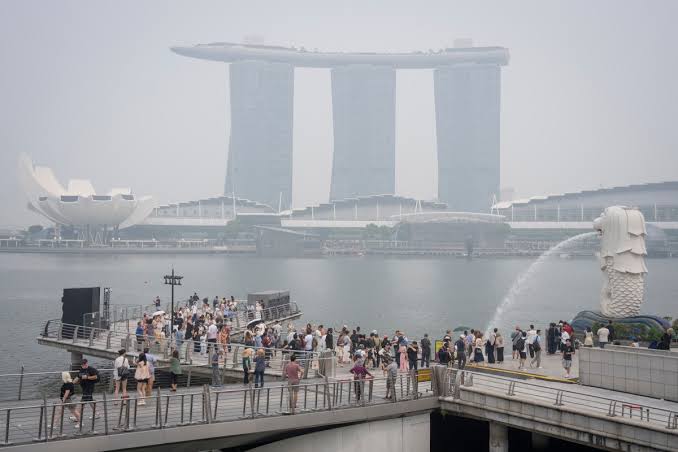
The tension between the two countries began when forest and land fires occurred in Kalimantan and Sumatra, crossing the borders of Indonesia, and reducing air quality in Singapore, Malaysia, and Timor-Leste. For Singapore, the impact poses a public health threat and disrupts social and economic activities, demanding a response from the government.
On October 16 and 19, the National Environment Agency (NEA) of Singapore sent Preventive Measure Notices to ten companies with concessions in Indonesia. The notice requested the companies to deploy fire-fighting personnel, stop burning, and submit fire prevention plans.
The measure is based on indications that smoke from the related concession land has moved to Singapore; the notice is not a verdict that the company has been proven guilty.
Singapore’s move places corporate responsibility and the reach of national law within bilateral relations. Singapore is interested in protecting its citizens and demanding accountability from companies suspected of contributing to cross-border pollution. On the other hand, Indonesia is interested in maintaining law enforcement authority over its territory.
Tensions escalated when President Prabowo Subianto on October 21 criticized countries deemed to have insulted Indonesia regarding forest fires and stated that the responsible companies would be revealed. He did not mention Singapore directly, but the statement came amid regional criticism.
Previously, Singaporean officials expressed disappointment over a comment by an Indonesian official implying that Singapore obtains oxygen from Indonesian forests when there is no haze.
Tensions took on a new dimension on October 24, when Indonesia reduced its pipeline gas supply to Singapore by 31 million standard cubic feet per day, 15 million from Natuna and 16 million from Sumatra. SKK Migas stated that the supply was redirected to maintain the reliability of domestic supply, especially for power plants in Batam, Bintan, and Sumatra.
On October 26, Minister of Energy and Mineral Resources Bahlil Lahadalia explained that the reduction of around 8 percent is still within the minimum contractual limits. He cited facility maintenance and increasing domestic demand as the reasons.
Singapore emphasizes compliance with commercial contracts. Prime Minister Lawrence Wong stated that all parties must fulfill their supply commitments, while Singapore’s gas importers will protect their rights under the contract. However, the direct impact of the reduction is relatively limited.
According to Singapore’s energy authority, the volume is less than two percent of the country’s daily gas needs. Singapore also has LNG terminals and diverse supply sources to mitigate the risk of disruptions.
This chronology does not prove that the gas reduction is a retaliation against Singapore. The Indonesian government bases its policy on domestic needs and maintenance, while also stating that the policy still meets the minimum contract requirements.
Therefore, it is more accurate to interpret the decision as an affirmation of the priority of domestic energy security, rather than as an energy sanction. Nevertheless, its emergence amid the tensions of forest fires makes that commercial decision have greater diplomatic implications.
Singapore’s Foreign Minister, Vivian Balakrishnan, stated on October 28 that neighboring countries will always be interdependent, despite unavoidable differences in priorities and approaches. His visit to Jakarta resulted in an agreement to form a Joint Task Force for information exchange and coordination in handling haze.
Both governments also emphasized the importance of high-level communication and respect for contracts. This development shows that tensions do not automatically escalate into confrontation; mutual interests encourage both parties to maintain channels of cooperation.
The relationship between the two countries reflects an interdependence that is not entirely symmetrical. Indonesia has gas resources and policy space to determine domestic allocation priorities. Singapore, with its limited natural resources, is very concerned about supply certainty.
However, Singapore’s dependence does not mean that Indonesia has unlimited bargaining power. The impact of this reduction is limited, contracts remain the reference, and LNG diversification provides Singapore with alternatives.
Indonesia is also interested in maintaining its reputation as a reliable supplier and preserving economic relations with one of its main investment and trading partners.

Iqbal Saputra
Iqbal Saputra is an International Relations graduate. His research focuses on Southeast Asia, ASEAN Security, and Indo-Pacific Studies.