Education systems rarely collapse overnight. They weaken slowly, year after year, through neglect, poor priorities, and the absence of strong political ownership. Khyber Pakhtunkhwa (KP), Pakistan’s third-largest province, is a clear example of how failures at the top directly shape lost opportunities at the bottom. Despite repeated promises and reform slogans, KP’s education indicators show a system struggling under administrative neglect and lack of direction.
One of the clearest signs of this failure is the absence of sustained Chief Minister–level focus on education. KP continues to have between 4.7 and 4.9 million out-of-school children. This number alone should have triggered an emergency response. Instead, it has become a routine statistic, quoted in reports, briefly discussed, and then ignored. For a province with one of the youngest populations in South Asia, this is not a minor policy gap. It is a long-term development failure.
Globally, regions with similar out-of-school numbers, such as northern Nigeria or parts of Ethiopia, are treated as education crisis zones. In KP, however, this crisis has unfolded openly, without consistent executive ownership. Education has remained scattered across departments and programs, with no single authority held clearly responsible for results.
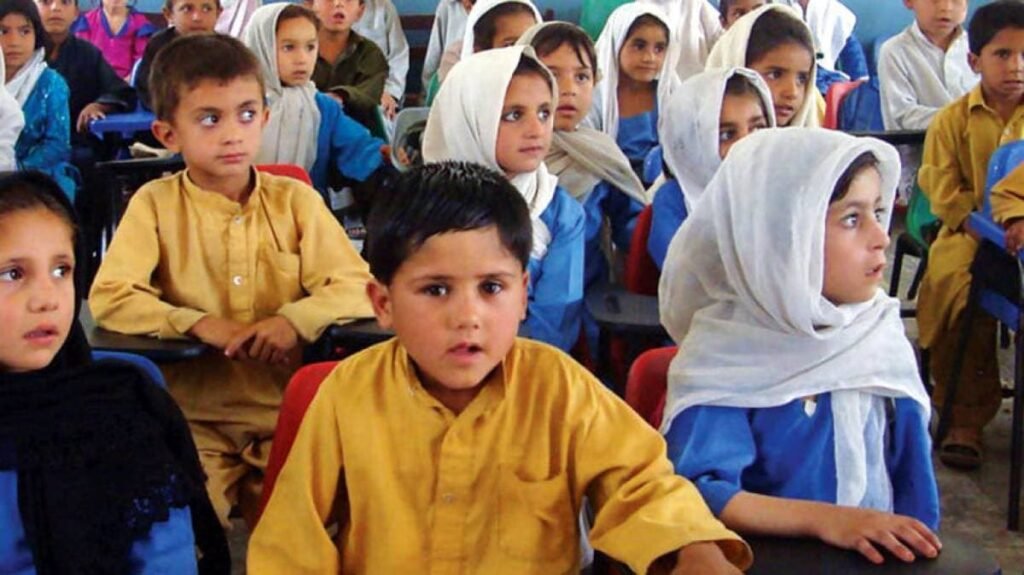
The impact of this neglect is visible inside classrooms across KP. Schools face overcrowding, teacher shortages, and safety concerns, all of which weaken learning and push children out of the system. Classrooms built for 30 students often hold 60 or more. In many rural and mountainous areas, one teacher is expected to handle several grades at the same time, an approach widely recognized as ineffective.
Teacher recruitment has not kept up with growing enrollment, while training and monitoring systems remain weak. These problems are not new or hidden. Provincial audits, education surveys, and civil society reports have highlighted them repeatedly. What has been missing is strong political action to fix these structural gaps.
Read More: US Envoy Highlights Role of American Businesses in KP’s Economic Growth
Girls carry the heaviest burden of this failure. In some districts of KP, as many as 74.4 percent of girls are out of school, placing the province among the worst-performing regions globally in female education access. Safety concerns, long travel distances, lack of female teachers, and poor school facilities all contribute to keeping girls out of classrooms. These barriers are well known, yet government responses have been slow and fragmented.
International evidence is clear: when girls are excluded from education, societies pay a lasting economic and social price. In KP, however, girls’ education has remained more of a talking point than a real priority.
Supporters of the KP government often cite perception surveys to defend education performance. Yet public satisfaction stands at only 62 percent, while literacy remains stuck at around 51 percent. This gap between perception and reality is important. People may see effort, but the outcomes show that effort has not produced real change.
Stagnant literacy is not a small issue. It reflects deeper problems in keeping children in school, ensuring learning, and helping students move from primary to secondary levels. Countries that have successfully raised literacy, such as Vietnam and Sri Lanka, treated education as a core governance priority. Their leaders closely monitored results and stepped in when targets were missed. KP has not applied this approach at scale.
Instead, education policy in the province has suffered from shifting priorities, weak monitoring, and limited accountability. Programs are announced, pilot projects launched, and enrollment drives promoted, but little is shared about why millions of children remain out of school year after year.
Read More: Education Malaysia Global Services Host Networking Event in Pakistan
At the heart of KP’s education crisis is a governance problem. Education has never been firmly owned at the highest provincial level. Without steady Chief Minister–level oversight, departments work in isolation, data is underused, and corrective action is delayed. Education reform requires more than funding. It needs urgency, coordination, and clear accountability from top leadership.
Internal differences within the province make this failure even clearer. Districts like Upper Chitral show that better outcomes are possible within the same system. Their relative success challenges the idea that geography or culture alone explains KP’s education problems. The real difference is governance quality, not fate.
KP is at a demographic turning point. Every year of delay adds hundreds of thousands of undereducated young people to an already strained job market. The long-term consequences are serious: lower productivity, higher unemployment, social instability, and weakened human capital. No amount of roads, buildings, or economic reforms can make up for a generation denied basic education.
From a global perspective, KP offers a clear warning. Education systems do not fail because solutions are unknown. They fail because leaders do not act decisively. The evidence from KP is unmistakable. Millions of children are out of school. Girls are disproportionately excluded. Literacy has stalled. Classrooms are overcrowded.
These outcomes are not accidental. They reflect choices made, or avoided, by those in power. If education continues to remain politically secondary in KP, the province risks trapping itself in a cycle of underdevelopment that will be far harder to break later. For a region rich in human potential, this would be a failure not of resources, but of leadership. It is a high time that global community and the local government should take serious actions against this crisis.
*The views presented in this article are the author’s own and do not necessarily reflect the views of The Diplomatic Insight.