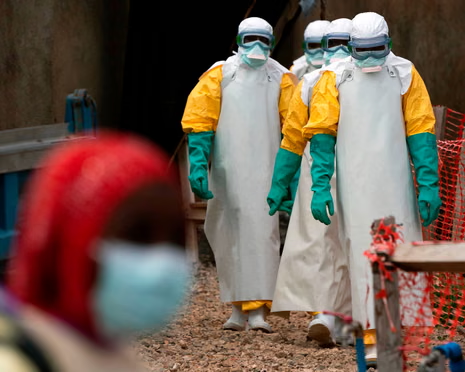
The World Health Organization (WHO) has declared a public health emergency of international concern after an Ebola outbreak driven by a rare viral strain spread from the Democratic Republic of Congo (DRC) into Uganda.
The declaration, issued by WHO Director-General Tedros Adhanom Ghebreyesus on Sunday, marks one of the agency’s highest levels of alarm, though officials were careful to note the situation does not yet meet the threshold of a pandemic emergency.
At the center of the crisis is the Bundibugyo virus, a lesser-known species of the Ebola family last seen in an outbreak in the DRC in 2012.
As of May 16, health authorities had recorded eight laboratory-confirmed cases, 246 suspected cases, and 80 suspected deaths concentrated in Ituri Province in eastern DRC, across at least three health zones including Bunia, Rwampara, and Mongbwalu.
Read More: WHO confirms Ebola outbreak in Uganda
Cases have since been confirmed in Kinshasa, the DRC’s capital, and in Kampala, Uganda’s capital, where two travelers arriving from the DRC were admitted to intensive care within 24 hours of each other.
What makes the outbreak especially worrying is the absence of any approved vaccine or treatment. Unlike the more well-known Ebola-Zaire strain, for which licensed vaccines exist, the Bundibugyo variant has no such countermeasures.
The fatality rate for the strain is estimated between 25% and 40%, according to Médecins Sans Frontières, which is scaling up its response in Ituri.
Health experts have raised concerns that the outbreak had already reached hundreds of suspected cases by the time it was formally reported on May 5, suggesting weeks of undetected spread.
Read More: Uganda extends quarantine at Ebola Outbreak Areas
Epidemiologist Jennifer Nuzzo speculated the delayed detection may be linked to cuts in global health funding. Ituri Province hosts roughly 273,000 displaced people amid an ongoing humanitarian crisis, creating conditions in which the virus can move quickly and quietly.
At least four healthcare workers have died, raising alarms about infection prevention failures in clinical settings. The DRC Ministry of Health officially declared the outbreak on May 15; the country’s 17th since Ebola was first identified.
One day later, the WHO elevated it to an international emergency. WHO is not recommending restrictions on international travel or trade, but is urging countries to heighten surveillance and emergency preparedness.
The United States separately invoked a public health law to limit entry from affected regions after a US national tested positive for the virus inside the DRC.