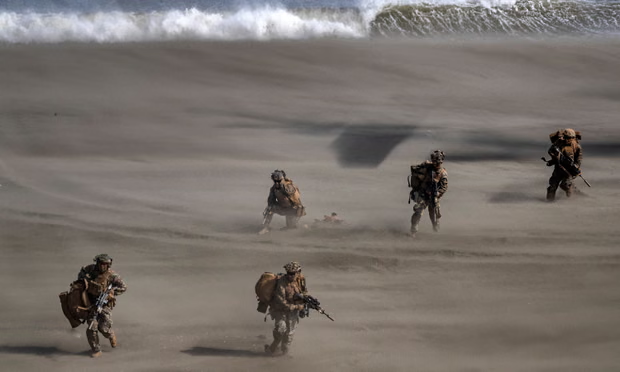
Amid escalating regional tensions in the Middle East, the United States and the Philippine military have begun their major annual drills in the Philippines, including areas close to the South China Sea and the Strait of Taiwan. The largest joint exercises, also involving Australia, Japan, Canada, France, and New Zealand, show the US`s continued interests in the region and its encirclement strategy vis-à-vis China.
The Philippines is an island country in the east of the South China Sea and south of Taiwan. For decades, the country has been central to the US Asia policy and is the US’s oldest treaty ally in the Asia-Pacific Region. The US and the Philippines have established a comprehensive relationship, including a bilateral security alliance, extensive military cooperation, and shared strategic and economic interests.
The US established its military bases under the Military Base Agreement signed in 1947. This was followed by the signing of the Mutual Defense Treaty in 1951. In 2023, Washington and Manila agreed to increase the number of Philippine military bases open to US forces. In the same year, the two sides established new bilateral defense guidelines to modernize the Philippines’ defense capabilities.
Reportedly, the US is also deploying advanced nuclear technologies to the Philippines, funding the country’s major power utility to evaluate US small modular reactor (SMR) designs and to develop a roadmap for Manila’s first SMR nuclear power plant. More recently, the US signed a deal with the Philippines to create a high-tech manufacturing zone in the Philippines, ostensibly an effort to lessen China`s leverage over global supply chains.
For decades, countries in the region have effectively navigated China as an indispensable economic partner, while relying on the US for their security needs. But as the gap between the US and China narrows rapidly, the equilibrium is crumpling.
Read More: Sino-Philippine dispute at South China Sea
For instance, Manila has moved decisively toward Washington and emerged as a key ally in the US Asia-Pacific posture. In recent years, rising tensions between China and the Philippines have posed serious and growing risks of a military confrontation, with the potential entanglement of the US.
The South China Sea is a region where the rivalry between the US and China is shaping the regional dynamics. The South China Sea is a decades-old dispute over competing claims among China, the Philippines, and other claimants. The regions hold economic and geo-strategic significance as a choke point for the flow of energy from the Middle East to East Asia, as well as the potential passageway for naval forces.
Given its growing significance, not only China and the ASEAN countries have claims, but also the US, Japan, the Republic of Korea, the UK, and the countries that comprise the European Union, have interests in the region. The South China Sea holds about 190 trillion cubic feet of natural gas and proven 11 billion barrels of oil in proved and probable reserves.
More importantly, roughly 30% of all maritime trade passes through the South China Sea en route to the busy ports of Southeast Asia. The Strait of Malacca, at the western entrance to the South China Sea, is one of the world’s most vital shipping lanes, with nearly 100,000 vessels passing through each year, including tankers transporting roughly 25% of all oil carried at sea.
Read More: China Conducts Joint Military Drills in South China Sea
Though the US position on the South China Sea comes from its treaty commitments to the Philippines and, in part, from its interest in maintaining freedom of navigation for both commercial vessels and the US Navy, containing China appears to be its main goal. The US’s increased engagement with regional countries may intensify China`s concerns. China has expressed concern over the current military drills and deems the introduction of external forces as division and confrontation in the region
China`s concern in the South China Sea stems from two main reasons: first, the security of its borders, which may be threatened by the US encirclement strategy. Second, China seeks regional stability to support its economic growth, as demand for energy resources has already increased.
Although China has an extensive coastline of about 18,000 km along the Pacific Ocean, bordering the Bohai Sea, the Yellow Sea, the East China Sea, and the South China Sea, a crisis at the crucial chokepoints may put China’s economy under great pressure. China has also stressed the normal passage through the Strait of Hormuz amid uncertainty on the key waterway following the US-Israel war on Iran.
The presence of the US and allies’ submarines, particularly in strategically important chokepoints such as the South China Sea, and the US’s perception of China`s efforts to expand nuclear-powered attack boats and integrate a large number of guided missile classes into its submarine force, indicate the region as a growing flashpoint of China-US strategic rivalry.
*The views presented in this article are the authors’ own and do not necessarily reflect the views of The Diplomatic Insight.

Sher Ali Kakar
Sher Ali Kakar is the Associate Director of Research at BTTN, at BUITEMS, Quetta. He can be reached at sheralikakar28@gmail.com