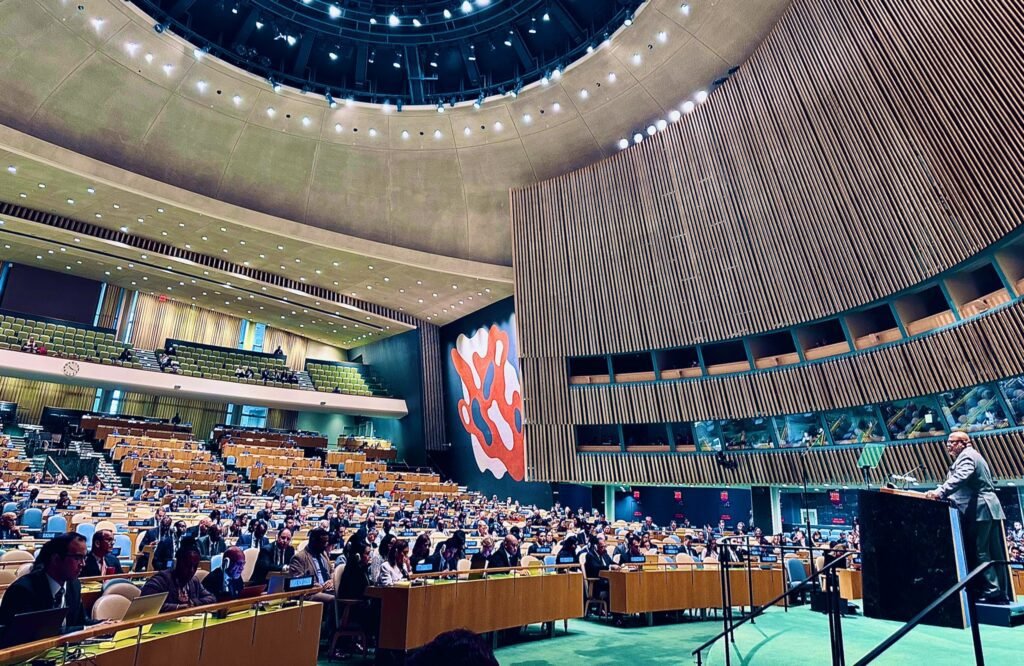
New York, 26 October 2023 (TDI): During the emergency meeting on the Gaza conflict, UN General Assembly (UNGA) President Francis emphasized that the foremost priority of the entire United Nations membership is to safeguard and preserve the lives of civilians.
He stressed that all parties involved in the conflict must adhere to international humanitarian law and promptly create the necessary conditions to establish a humanitarian corridor to the Gaza Strip.
I stood before the General Assembly, this morning – deeply disturbed and distraught.
We gather amidst the gravest escalation of violence and hostility in the Middle East in decades.
I urge the membership to use today’s session to unify our purpose and our actions to save lives… pic.twitter.com/bSXcxpzBFz
— Annalena Baerbock (@UN_PGA) October 26, 2023
The immediate delivery of life-saving aid to those in need is of utmost importance.
President Francis also commended the efforts of United Nations personnel in Gaza and offered his condolences to the families of the 35 UNRWA staff members who have lost their lives since the crisis began.
President of the General Assembly Dennis Francis officially commenced the session shortly after 10 a.m. in the Grand General Assembly Hall and delivered the opening address.
Also read: UNGA Session: Ambassador Mansour addresses Israel-Palestine Crisis
He reminded delegates that this emergency session was reconvened in response to requests from Member States, supported by letters signed by Jordan, Mauritania, Nicaragua, Russia, and Syria.
Francis, by general consensus, agreed to grant a waiver to members who have outstanding dues, enabling them to participate in the General Assembly meeting.
At this juncture, the most immediate step is clear – the violence must cease, and further bloodshed must be prevented.
I call for the prompt and unconditional release of all hostages, an immediate, unconditional humanitarian ceasefire, and the immediate, unconditional opening of… pic.twitter.com/xGALRrHnfT
— Annalena Baerbock (@UN_PGA) October 26, 2023
The tenth Emergency Special Session of the Assembly was scheduled to begin at 10 a.m. in New York, with 110 speakers currently registered.
Israel was to address Member States after the State of Palestine. The session was convened under the “Uniting for Peace” resolution of 1950, allowing the General Assembly to call an “emergency special session” within 24 hours if the Security Council fails to fulfill its primary responsibility for international peace and security.
The tenth Emergency Special Session was initially convened in April 1997 at the request of Qatar, following discussions in the Security Council and General Assembly regarding Israel’s decision to construct a major housing project in East Jerusalem.
The most recent session of the Emergency Special Session took place on June 13, 2018, to consider a draft resolution on the “Protection of the Palestinian civilian population.”
At the conclusion of that session, the UNGA decided to temporarily adjourn and authorized the President of the General Assembly to resume it upon request from Member States.
Today at 10 AM ET, the United Nations General Assembly convenes for the 10th Emergency Special Session (resumed) on the situation in the Middle East.
Watch Live ➡️ https://t.co/vVFP3a3wdf#UNGA #ESS10 pic.twitter.com/Fc0bb2qFEU
— Annalena Baerbock (@UN_PGA) October 26, 2023
Regarding the ongoing crisis, several UN agencies on the ground have reported a shortage of critical life-saving supplies, hospital fuel, and drinking water.
Furthermore, on Wednesday, the Security Council failed to pass two resolutions addressing the humanitarian crisis.
China and Russia both vetoed a draft resolution that the United States was leading, and a second Russian-backed resolution did not receive enough support.
These failures in the Security Council came after previous attempts to achieve unity on the matter.
Including the voting down of a Russian-led draft resolution calling for an “immediate humanitarian ceasefire” and the US vetoing a Brazilian-led text that urged “humanitarian pauses” for delivering aid to millions in the Gaza Strip.

Iffat Masood is Contributor and Content writer on THE DIPLOMATIC INSIGHT, and also Ambassador from IAMCR. She is perusing her PhD. from UAB Barcelona, Spain in Audio-Video Communications and Advertising.