United Nations (TDI): Developing countries are being pushed into a cycle of debt and stagnation as global borrowing costs rise and trade tensions intensify, a senior United Nations trade official has warned.
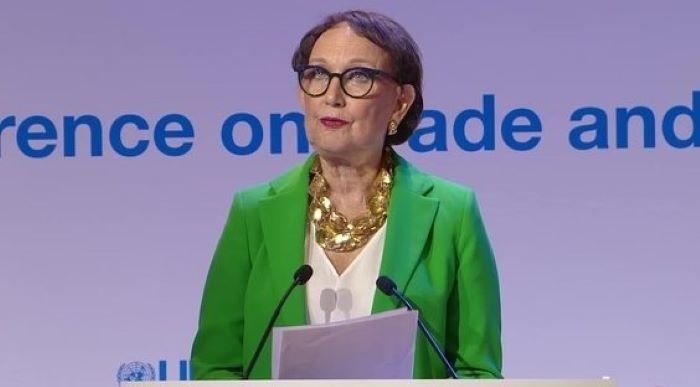
Speaking to the 195 Member States of the UN Conference on Trade and Development (UNCTAD) in Geneva, Rebeca Grynspan, the organization’s Secretary-General, said that global trade remains fragile despite most exchanges still operating under the World Trade Organization (WTO) framework.
“Seventy-two percent of global trade still moves under WTO rules,” Grynspan noted, crediting the resilience of multilateral cooperation for preventing a repeat of the trade wars that crippled the world economy in the 1930s.
“This didn’t happen by accident,” she said. “It happened because you kept negotiating when it seemed pointless, defending a rules-based system even when reform was overdue, and building bridges even after they fell.”
Her remarks come amid renewed concerns over global tariffs and rising public debt, especially among developing nations struggling to recover from economic shocks.
Read More: Pakistan Unveils Debt Overhaul Strategy Amid Record Rs 76 Trillion
Grynspan warned that many low-income countries are now forced to choose between repaying debt and funding development projects. “A debt and development crisis is still facing countries with impossible choices,” she said. “They must decide whether to default on their debt or on their development.”
According to UNCTAD, tariffs imposed by major economies, including the United States, have surged this year from an average of 2.8 percent to more than 20 percent, stifling trade and investment. “Uncertainty is the highest tariff possible,” Grynspan cautioned. “It discourages investors, slows growth, and makes trade as a path to development far more difficult.”
The UNCTAD chief also highlighted a worrying retreat in global investment flows for the second consecutive year, which she said was “eroding tomorrow’s growth.”
Read More: Pakistan Urges Debt Relief for Developing Countries
She pointed out that current investment patterns overwhelmingly favor advanced economies, making capital up to three times more expensive in Zambia than in Zurich. Similarly, freight costs have become “too volatile,” with landlocked and small island states paying transport fees up to three times the global average.
Grynspan also warned that while artificial intelligence (AI) could add trillions to global GDP, fewer than one in three developing countries have strategies in place to harness its benefits. An estimated 2.6 billion people remain offline, most of them women in poorer countries.
Echoing her concerns, Annalena Baerbock, President of the UN General Assembly, said developing nations’ debt hit $31 trillion last year, leaving governments with little fiscal space to invest in social welfare.
“Instead of building more schools or expanding healthcare facilities, many governments are spending scarce resources on debt repayments,” Baerbock said.
She added that trust in the international system is eroding, with half the global population seeing “little or no rise in their income for a generation,” despite a world economy now worth over $100 trillion annually.