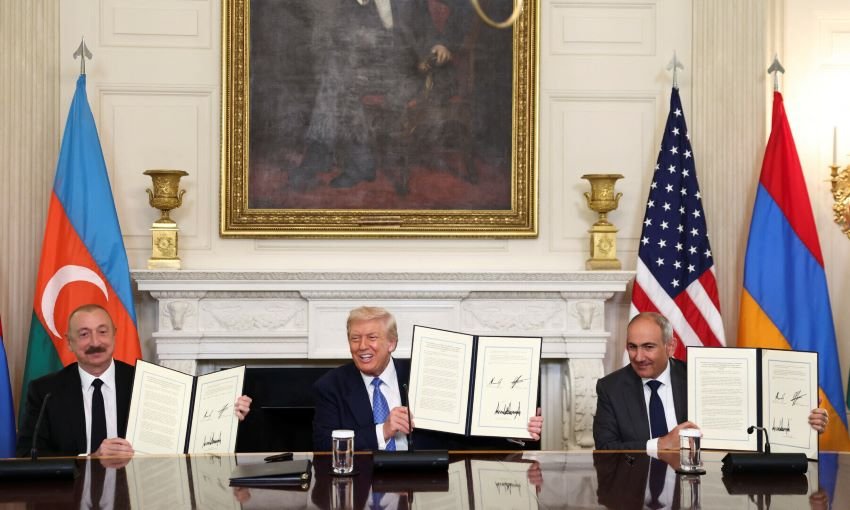
Washington (TDI): In a significant diplomatic breakthrough, Azerbaijan and Armenia have signed a preliminary peace framework at the White House under the mediation of US President Donald Trump, officials confirmed Friday.
The accord is intended to pave the way for stronger economic cooperation after decades of hostility between the two South Caucasus neighbors.
White House spokesperson Anna Kelly said President Trump also signed separate bilateral agreements with both governments covering a wide range of areas, including energy, technology, border security, infrastructure, and trade. Specific terms of the documents were not disclosed.
At the heart of the arrangement is a new strategic transit corridor across the region dubbed the ‘Trump Route for International Peace and Prosperity” (TRIPP), for which the United States has been granted exclusive development rights. According to US officials, the route is expected to serve as a key channel for energy exports and other trade, attracting considerable interest from American and international investors.
“This isn’t a handout,” a senior administration official remarked. “This is a commercially viable project with enormous potential. Several companies, including three from the US, have already shown serious interest.”
Read More: Kyrgyzstan Invites Armenia, Azerbaijan to Sign Peace Deal
The framework agreement is described as the first step toward full normalization between the two nations, whose relations have been strained since the late 1980s over the disputed Nagorno-Karabakh region.
That conflict, which flared after the collapse of the Soviet Union, saw Armenian-backed forces seize the territory. Azerbaijan regained full control of Nagorno-Karabakh in 2023 after a military operation that led to the departure of almost the entire ethnic Armenian population from the area.
Read More: FMs of Azerbaijan, Armenia Discuss Normalization of Relations at Antalya Forum
While Friday’s accord focuses on economic cooperation, it leaves unresolved the more sensitive political disputes, including border demarcation and Azerbaijani calls for constitutional changes in Armenia that reference a 1989 unification bid for Nagorno-Karabakh. Officials avoided direct discussion of these issues during the signing.
Under the TRIPP arrangement, the US will take the lead in developing and managing the corridor for an extended term. Negotiations on the commercial framework are set to begin next week.

Farkhund Yousafzai is an Associate Editor at The Diplomatic Insight.