Women constitute half the population of our global Anthropocene. Yet despite growing representation, they remain structurally underrepresented in formal political institutions worldwide. Within this framework, women’s parliamentary diplomacy presents a critical, multi-faceted avenue for statecraft.
This distinct mechanism relies on the active engagement of female legislators to promote inter-state cooperation, inter-faith dialogue, communal cohesion, and cross-cultural partnerships.
Despite its increasing strategic relevance, the subject remains significantly under-researched. Today, diplomacy led by women legislators is undergoing a profound structural transition, moving beyond informal advocacy to emerge as a visible, institutionalized mechanism within contemporary international governance.
Understanding its prospects and systemic limitations has become urgent in a global landscape increasingly shaped by health vulnerabilities, climate instability, cross-border displacement, and armed conflict.
Read More: Pakistan, UK Reaffirm Parliamentary Cooperation as High Commissioner Meets NA Speaker
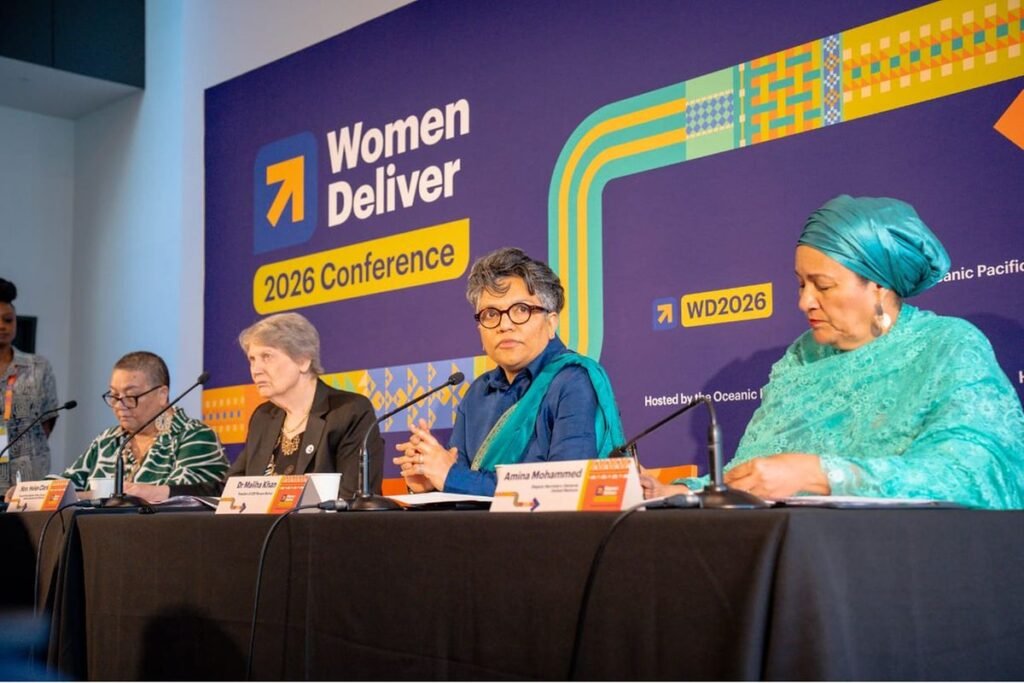
The Women Deliver 2026 Conference, held in Melbourne from 27–30 April under the theme “Change Calls Us Here,” offers a highly relevant case study. Hosted in the Oceania-Pacific region for the first time, the summit convened over 6,500 delegates, including parliamentarians, ministers, legislative staff, youth leaders, and civil society representatives.
The deliberations focused sharply on leadership, resilience, and community advocacy in response to a volatile global environment for gender equality.
A core operational component of the conference was the Ministerial and Parliamentary Forum held on 27 April. The forum deliberated on “Legislating Justice: Bold Parliamentary Action for Gender Equality and Sexual Reproductive Health (SRH).”
Jointly organized by the Asian Forum of Parliamentarians on Population and Development (AFPPD) and the Australian Parliamentary Friends of Population and Development (APGPD), the session brought together ministers and lawmakers from across the Asia-Pacific region to address a fundamental question: can women’s parliamentary diplomacy effectively resolve human security challenges that transcend national borders?
Traditional Track 1 statecraft is frequently paralyzed by geopolitical friction and rigid state-centric mandates. Parliamentary diplomacy, by contrast, functions effectively as a Track 1.5 dialogue mechanism.
Utilizing both formal and informal channels—most notably Parliamentary Friendship Groups (PFGs)—legislators can reinforce bilateral relationships, exchange legislative strategies, and cultivate institutional cooperation between nations. These networks frequently create vital diplomatic runways where formal state channels face operational deadlocks.
Yet, the strategic potential of women’s parliamentary diplomacy remains largely underutilized. Armed conflicts, territorial occupations, climate-induced migration, and maternal health crises continue to leave women and girls disproportionately vulnerable. Because these security threats are inherently transnational, they demand cooperative frameworks that extend beyond classical diplomatic structures.
In this context, women legislators serve as an essential alternative conduit. Shared institutional and societal experiences often allow them to navigate sensitive issues with a degree of pragmatic consensus that transcends partisan and national divisions.
This capacity is particularly vital for advancing inter-faith dialogue and stabilizing cross-border social challenges. Despite these distinct advantages, the field continues to receive insufficient academic and policy focus.
Substantive challenges, however, persist at the level of implementation. Legislative and statutory protections drafted in capital cities are only as effective as the domestic administrative machinery tasked with their delivery. Dr. Shaista Khan, a medical professional and member of Pakistan’s National Assembly, captured this structural bottleneck precisely during the forum: “A policy is only as strong as the clinic it reaches.”
This implementation gap is most pronounced in conflict zones and climate-vulnerable areas. Women parliamentarians are uniquely positioned to establish transnational monitoring networks to oversee gender-responsive aid, audit legal protections, and champion human security priorities alongside conventional hard-security agendas.
This logic applies directly to the evolving green economy. A tangible policy pathway involves linking frontline women—those directly managing natural resources and climate adaptation—to bilateral green funds, development partnerships, and trade initiatives.
Read More: Women in Diplomacy: From Catherine of Aragon to the 21st Century
The Melbourne conference explored this continuity during a Youth-Led Interactive Dialogue chaired by Senator Mehreen Faruqi, which bridged the gap between youth delegates and active parliamentarians to debate long-term governance continuity.
Nonetheless, persistent institutional barriers continue to constrain the operational effectiveness of female lawmakers. A significant proportion enter legislatures through reserved quotas. While many are highly qualified professionals and subject-matter experts, they frequently confront institutional resistance, restricted access to development funds, and systemic underrepresentation on influential parliamentary committees dealing with foreign affairs and national security.
These structural impediments do not diminish their capacity to contribute; rather, they expose the friction between nominal representation and actual institutional influence. As global crises become more deeply interconnected, women’s parliamentary diplomacy must be elevated from a niche area of study to a core component of mainstream foreign policy analysis.
The Melbourne forum underscored that regional stability, sustainable human development, and social cohesion are structurally linked to the inclusion of women in diplomatic and legislative processes. Moving forward, gender-responsive statecraft must be evaluated not merely through the lens of social welfare, but as an increasingly critical instrument of contemporary international relations.
*The views presented in this article are the authors’ own and do not necessarily reflect the views of The Diplomatic Insight.

Syed Rahim Shah
Syed Rahim Shah is the Deputy Director International Relations at National Assembly of Pakistan.