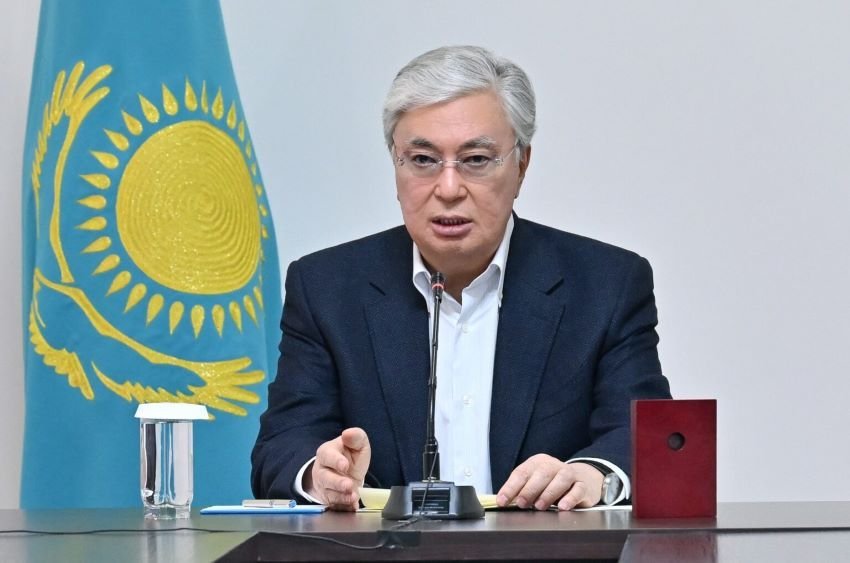
Astana (TDI): President Kassym-Jomart Tokayev delivered a major address at the National Kurultai in Kyzylorda on Tuesday, setting out a new stage in Kazakhstan’s political development and highlighting priorities in governance, foreign relations, and digital transformation.
The President presented a comprehensive package of constitutional and institutional reforms aimed at modernising the state system, clarifying governance structures, and strengthening long-term political stability. Key proposals include formalising presidential succession rules, establishing the role of Vice President, and moving toward a new constitutional framework through a national referendum.
Tokayev also addressed Kazakhstan’s approach to foreign policy in a shifting global landscape, emphasizing pragmatic diplomacy, economic integration, food security, and the strategic role of digitalisation and artificial intelligence in national competitiveness.
President Tokayev observed that global relations are increasingly complex, marked by declining trust, weakening international norms, and rising militarization. He stressed that Kazakhstan’s foreign policy should remain balanced, cautious, and guided by national interests. Diplomatic decisions, he noted, have long-term implications, and should prioritize compromise over confrontation, reinforcing Kazakhstan’s reputation as a responsible international actor.
The President reaffirmed Kazakhstan’s commitment to building a rule-of-law state, emphasizing that legal reforms must accompany efforts to foster civic responsibility and national consciousness. He highlighted the 2022 constitutional reforms, which established the Constitutional Court, introduced cassation courts, and granted constitutional status to the Human Rights Commissioner.
Reforms in administrative justice and judicial procedures have strengthened citizens’ and entrepreneurs’ ability to protect their lawful rights. Tokayev stressed that the principle of “Law and Order” applies equally to all, and reiterated the state’s duty to safeguard the rights, freedoms, dignity, and security of all citizens.
Read More: Kazakhstan’s President Tokayev Outlines Strategic Vision for Rural Development
Addressing matters of trade and regional cooperation, the President reaffirmed Kazakhstan’s support for economic integration while emphasizing protection of national interests amid global trade pressures. As chair of the Eurasian Economic Union in 2026, Kazakhstan plans to prioritize the removal of trade barriers, combat unjustified protectionism, and leverage artificial intelligence to enhance integration efficiency. Tokayev also raised concerns about subsidized imports affecting the agricultural processing sector, framing it as a national food security issue.
Kazakhstan aims to solidify its role as a regional transport and logistics hub connecting East–West and North–South corridors. Key infrastructure initiatives include accelerating the Beineu–Sekseuil highway and modernizing critical railway lines, alongside plans to expand cargo aviation with private-sector participation.
On energy and environmental matters, the President highlighted water security as a strategic priority and called for stronger regional cooperation. He announced that Kazakhstan will host the International Ecological Summit in Astana in April, focusing on the Aral Sea, and instructed the development of a national map of water and energy resources. Coal reserves and gas development were identified as strategic assets, with plans to combine state and private investment to modernize production and ensure environmental compliance.
Among proposed governance changes, Tokayev introduced the office of Vice President, appointed by the President with Parliament’s consent, to strengthen institutional coordination without diluting presidential authority. He also emphasized the need for clear constitutional rules governing presidential succession, ensuring that any early termination of office leads to elections within two months.
Read More: Nuclear Power Corrects Kazakhstan’s ‘Historical Absurdity’: Tokayev
The President signaled a broader transition from the 1995 constitution toward a new political system, subject to national referendum. This includes parliamentary reforms moving toward a unicameral legislature, now proposed as the “Kurultai,” with 145 deputies, simplified committee structures, and a proportional electoral system. A new People’s Council will take on advisory roles related to interethnic and interfaith matters, domestic policy recommendations, and state ideology promotion.
Tokayev stressed the centrality of digital transformation and artificial intelligence to national competitiveness, emphasizing that technology must be paired with strong governance. Initiatives include the establishment of high-capacity data centers, constitutional recognition of digital governance, and creation of a national digital heritage repository to preserve archival, scholarly, and artistic materials.
Cultural and spiritual development, the President noted, remains a strategic priority. Plans include modernizing museums, theaters, and libraries, promoting the creative industries, and highlighting Kazakhstan’s heritage on international platforms, including UNESCO. Tokayev emphasized the integration of cultural heritage into the global digital sphere as essential for maintaining national influence in the modern world.
Through these measures, President Tokayev outlined a vision of Kazakhstan that blends political modernization, strategic foreign engagement, and forward-looking economic and technological development, aiming to secure stability and competitiveness in the decades ahead.
Sohail Majeed
Sohail Majeed is a Special Correspondent at The Diplomatic Insight. He has twelve plus years of experience in journalism & reporting. He covers International Affairs, Diplomacy, UN, Sports, Climate Change, Economy, Technology, and Health.