Moscow (TDI): Russia has conducted large-scale nuclear drills involving missile launches and the deployment of nuclear-capable systems, as tensions with NATO continue to escalate over the Ukraine war and reported drone activity in the Baltic region.
The exercises, described by Russian officials as among the most extensive in recent years, reportedly involved around 64,000 personnel and focused on training forces in the preparation and potential use of nuclear weapons in the event of what Moscow calls external aggression.
President Vladimir Putin, addressing senior defense officials and Belarusian President Alexander Lukashenko, said Russia’s nuclear forces remain a “reliable guarantor” of the security and sovereignty of the Union State of Russia and Belarus, while stressing that nuclear weapons would only be used in extreme circumstances.
Putin also said Moscow does not seek to engage in an arms race, but would continue to modernize its strategic arsenal, including new missile systems and submarine-based capabilities, in response to rising global tensions.
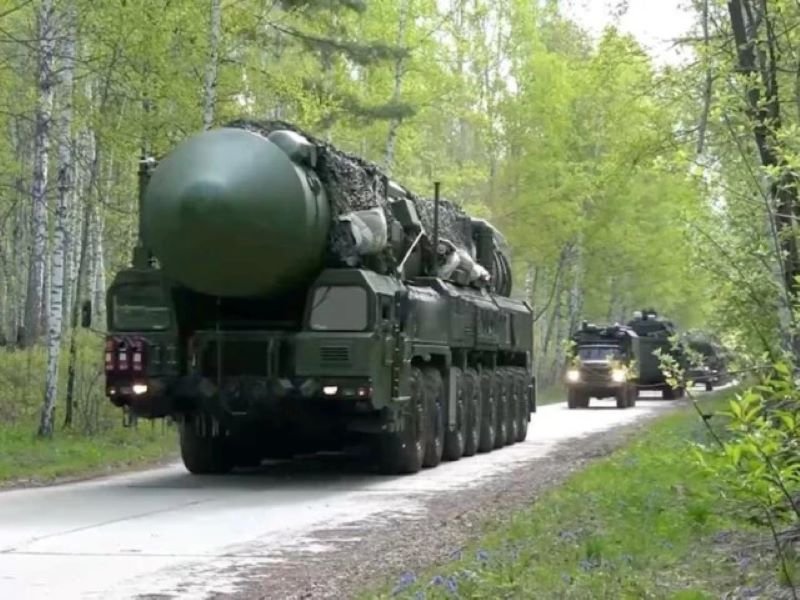
As part of the drills, Russia carried out test launches of nuclear-capable systems, including a Yars intercontinental ballistic missile from the Plesetsk Cosmodrome, a Zircon hypersonic missile from a frigate in the Barents Sea, and a Sineva submarine-launched ballistic missile, according to Reuters.
The Russian defense ministry said the exercises also included the deployment of strategic assets such as Borei-class nuclear submarines, Il-38 maritime patrol aircraft, and MiG-31 jets armed with Kinzhal hypersonic missiles.
Read More: Russia, Ukraine Exchange Heavy Strikes Despite Victory Day Truce
Officials said some units in both Russia and Belarus were temporarily assigned nuclear munitions during the drills, which are typically conducted using simulated warheads, according to previous practice.
The Kremlin framed the exercises as part of preparations for what it describes as a prolonged strategic confrontation with Western countries over the war in Ukraine.
Russia and Belarus have accused NATO states of contributing to escalation, while Ukraine and its allies have dismissed such claims as justification for continued military pressure and nuclear signalling.
Read More: Polish PM Questions US Commitment to NATO in Case of Russian Attack
The drills come amid heightened diplomatic friction in Europe, with Baltic states and NATO members expressing concern over increased military activity near their borders and in the broader Baltic region.
Moscow has accused NATO countries of enabling Ukrainian drone operations over Russian territory, a claim denied by the alliance, which maintains that it is not directly involved in such actions.