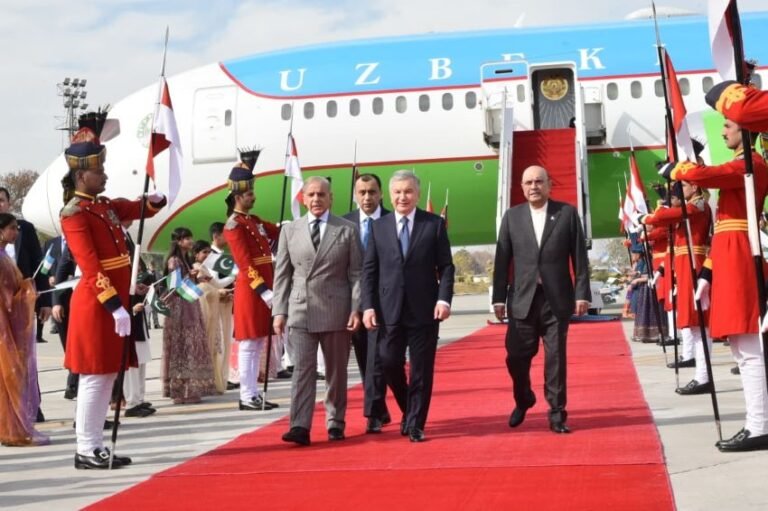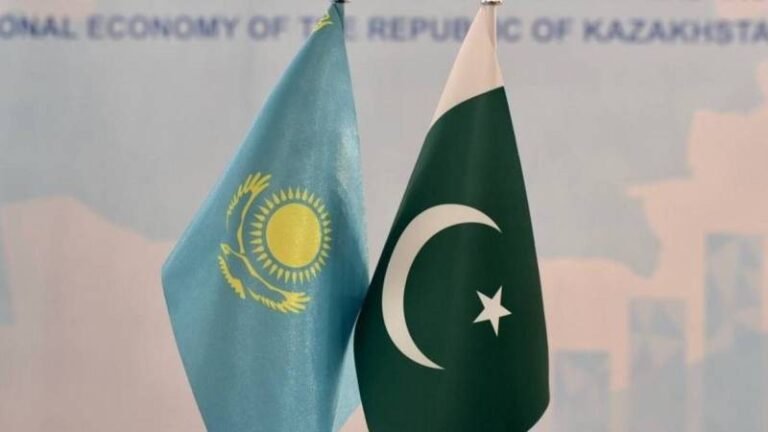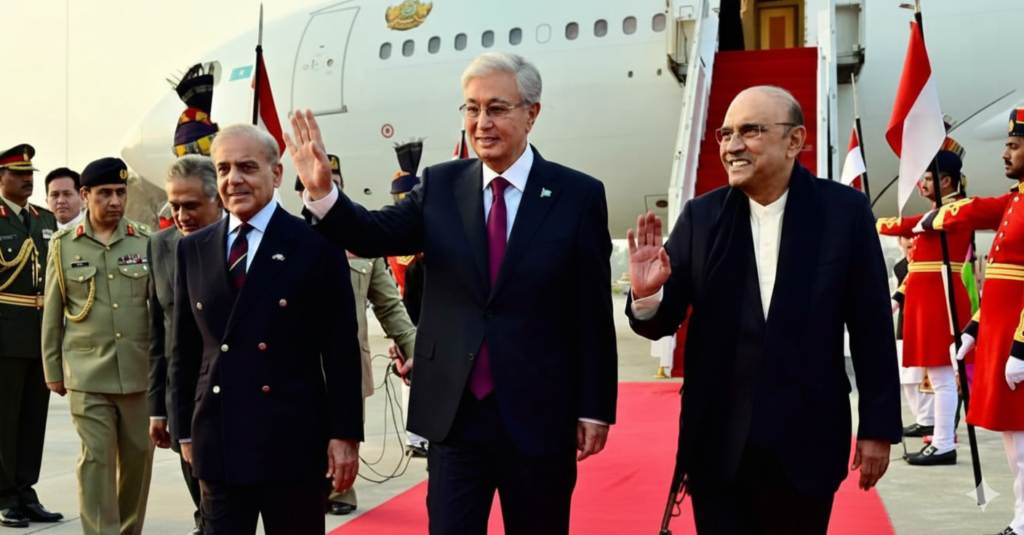
The President of the Republic of Kazakhstan, Kassym-Jomart Tokayev, successfully concluded a historic two-day state visit to Pakistan, concluded on February 4, 2026. This visit, undertaken at the invitation of Prime Minister Muhammad Shehbaz Sharif, stands as a milestone, being the first by a Kazakh head of state in over 23 years.
This engagement transitioned the bilateral relationship from a state of distant partnership to a project-oriented strategic alliance. During a special investiture ceremony held at Aiwan-e-Sadr, President Asif Ali Zardari conferred the Nishan-e-Pakistan, the nation’s highest civilian honor, upon President Tokayev. The award acknowledged his distinguished contributions to strengthening brotherly bonds.
The central outcome of this high-level engagement was the signing of the “Joint Declaration on Establishing Strategic Partnership,” a visionary document that elevates the traditionally cordial bilateral ties to a level of profound strategic cooperation.
During the visit, the two nations signed 37 Memoranda of Understanding (MoUs) and agreements across various sectors, including trade, defense, energy, and connectivity, effectively setting a new trajectory for South-Central Asian integration.
It is pertinent to note that the relationship between Pakistan and Kazakhstan is built upon a bedrock of shared history, common cultural values, and a mutual commitment to regional stability.
Pakistan was among the first countries to recognize Kazakhstan’s independence in 1991, and since the 1992 Declaration on the Principles of Relations, the two states have consistently sought to build a partnership based on sovereignty and territorial integrity.
For centuries, the Silk Road served as a bridge of knowledge and commerce between these regions, developing a deep spiritual and intellectual affinity that continues to resonate in the contemporary era.
The geopolitical landscape of Eurasia has undergone significant turbulence in recent years, most notably due to the Russia-Ukraine conflict and the resulting disruptions in traditional supply chains. This has created a strategic imperative for middle powers like Kazakhstan to seek alternative transit routes.
For Astana, diversifying access to maritime trade is no longer a commercial preference but a strategic necessity. Concurrently, Islamabad has articulated a geo-economic vision that leverages its unique position at the crossroads of South, Central, and West Asia.
The recent state visit confirms that Pakistan’s deep-sea ports in Karachi and Gwadar are now viewed as indispensable southern gateways for the landlocked Central Asian Republics (CARs).
Over the years, despite the geographic distance and the challenges of regional volatility, the two countries have maintained a steady diplomatic dialogue through the Shanghai Cooperation Organization (SCO), the Organization of Islamic Cooperation (OIC), and the United Nations.
However, the lack of direct connectivity had historically prevented these brotherly bonds from reaching their full economic potential.
Recent developments, particularly the activation of the Joint Intergovernmental Commission (IGC) and the signing of the Transit Trade Agreement, have provided the necessary institutional framework to bridge this gap and transform political goodwill into tangible economic dividends.
Moreover, the current state of relations is now characterized by a shift toward “Infrastructure Diplomacy.” A defining highlight of this visit was the formal commitment to the $7 billion rail connectivity project.
This ambitious initiative aims to connect Karachi and Gwadar ports to Kazakhstan via Afghanistan and Turkmenistan, effectively cutting transit times from weeks to just five days.
This proposed corridor aims to institutionalize and scale the successful overland trade already tested under the TIR convention. Through reducing transit times and logistics costs, the project seeks to transform Kazakhstan from landlocked to land-linked, while positioning Pakistan as the logistics hub of the region.
This rail link is a physical manifestation of the shift from political symbolism to a project-mode approach, characterized by concrete contracts and market access.
Both nations have signaled their intent to operationalize the “South-Central Asia Economic Corridor,” by signing this agreement. This will allow Kazakhstan, the largest economy in Central Asia, to bypass traditional landlocked constraints and access the “warm waters” of the Arabian Sea.
Furthermore, both leaders expressed satisfaction with the current trade volume but underscored the strong need to enhance it to $1 billion within the next two years.
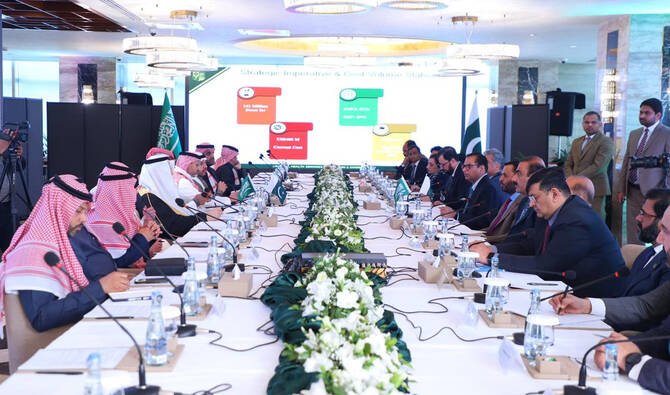
The visit also featured a high-level Business Forum where Kazakh business leaders, including several prominent entrepreneurs, engaged with their Pakistani counterparts to explore joint ventures in agriculture, textiles, pharmaceuticals, and defense production.
The agreement to consider re-launching direct flights in the near future is expected to further stimulate tourism and business-to-business (B2B) linkages, strengthening the fabric of people-to-people ties.
While a significant historical weakness in the bilateral trajectory has been the relatively low level of people-to-people ties, this state visit has catalyzed a profound shift toward institutionalized cultural and intellectual exchange.
Beyond the existing influx of Pakistani medical students to Kazakhstan, the recent high-level engagement saw the inauguration of three specialized academic centers at Pakistan’s premier universities.
These include the Al-Farabi Center at Quaid-i-Azam University (QAU), the Satbayev Center at the National University of Sciences and Technology (NUST), and the Khoja Akhmet Yassawi Center at the International Islamic University Islamabad (IIUI).
These centers are not merely symbolic; they are designed as modern hubs for collaborative research, faculty exchanges, and the convergence of Central Asian history with future-oriented fields like Artificial Intelligence.
Furthermore, the establishment of the “Dostyq” Sports Center in Islamabad, promoting traditional Kazakh sports such as Qazaq Kuresi alongside modern athletics, complements the eight educational MoUs signed to strengthen a two-way flow of talent and ideas.
While the agreement to explore the resumption of direct flights is a critical step, it is these sustainable educational bridges and institutional linkages that will provide the necessary bedrock for building long-term constituencies within both societies.
As the opportunities are immense, one must acknowledge the daunting challenges that lie ahead. The successful implementation of the $7 billion railway project requires a stable and secure Afghanistan, which serves as the primary transit hub.
Moreover, there is a strong need for “Corridor Governance,” ensuring that technical standards, customs digitalization, and border protocols are unified across all participating states. Addressing non-tariff barriers and establishing robust banking channels remain critical hurdles that both governments must navigate to facilitate seamless trade.
Similarly, as officials have set a trade target of $1 billion within the two years, achieving this goal requires fundamental practical reforms.
One must acknowledge the existing bottlenecks, such as restricted banking channels and complex visa regimes, which continue to hinder private sector engagement. Addressing these through digitized customs procedures and simplified travel protocols is essential.
The broader implications of this strategic reorientation are profound. In an era of global uncertainty, the Kazakhstan-Pakistan partnership signals that regional actors are increasingly capable of shaping their economic destiny independent of external pressures.
This alliance promotes a more balanced and multipolar Eurasia, by integrating Central Asian producers directly into the global maritime network.
Furthermore, the commitment to an “Afghan-led and Afghan-owned” stability process remains critical, as the security of the Trans-Afghan corridor is the linchpin of this entire connectivity framework.
In a nutshell, the state visit of President Kassym-Jomart Tokayev has successfully laid the groundwork for a new chapter in Kazakhstan-Pakistan relations.
It is now incumbent upon the relevant ministries and the newly established Working Committee to ensure the speedy and effective implementation of the 37 MoUs signed during this visit.
The focus must remain on meeting the record three-year timeline for the rail connectivity project and achieving the $1 billion trade target. Through continued collaboration and a shared vision for connectivity, both nations are well-positioned to lead the region toward a future of enduring stability and shared prosperity.

Dr. Farhat Asif
The writer is President, Institute of Peace and Diplomatic Studies. The writer teaches Conflict and Cooperation in South Asia to MPhil Students in IR Department. Riphah International University. The views expressed are her own and do not represent those of the Institutions she represents.