Islamabad (TDI): Pakistan and the United Kingdom have formalized a major climate partnership with the launch of a £35 million Green Compact designed to strengthen Pakistan’s climate resilience, accelerate its clean energy transition, and scale up nature-based solutions, including mangrove conservation.
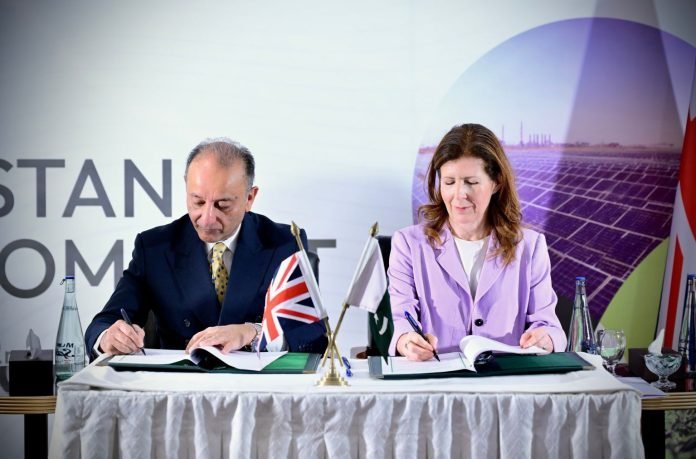
The agreement was signed in Islamabad by Federal Minister for Climate Change Dr. Musadik Malik and UK Minister for International Development Jennifer Chapman, unlocking targeted support for long-term climate action and green development.
Pakistan is one of the nations most at risk from climate change, facing increasingly unpredictable weather that has brought severe heatwaves, storms, cyclones, floods, and droughts in recent years.
Monsoon floods in 2022 claimed over 1,700 lives, displaced 33 million people, and caused losses exceeding $30 billion, while floods this year killed another 1,037 people.
The Green Compact focuses on five key pillars: climate finance and investment, clean energy transition, nature-based solutions, innovation and youth empowerment, and adaptation and resilience.
Under the pact, the UK will support Pakistan in mobilizing public and private climate finance, developing bankable green projects, and strengthening regulatory frameworks to encourage investment.
The goal is to reduce investment barriers while enhancing Pakistan’s capacity to effectively utilize climate funding.
Mohammad Saleem Shaikh, spokesperson for the Ministry of Climate Change and an expert in climate policy advocacy, described the UK–Pakistan Green Compact as a “decisive step toward practical climate action.”
He emphasized that for Pakistan, which regularly faces floods, heatwaves, and water stress, effective implementation of the Compact over the next decade will be crucial.
Both countries noted that the initiative represents a shift from policy discussions to on-ground action, especially at a time when climate risks are intensifying across South Asia, with Pakistan among the most vulnerable.
The compact also prioritizes youth-led climate initiatives, offering technical guidance, mentoring, and access to investors for climate-smart startups.
On her first official visit to Pakistan, Chapman emphasized the urgency of global climate action and the UK’s commitment to supporting renewable energy, ecosystem restoration, early-warning systems, and international climate investment in Pakistan.
The UK continues to be one of Pakistan’s key development partners, collaborating in areas such as education, health, climate resilience, and governance.
The new Green Compact builds on this longstanding partnership while introducing fresh opportunities for private-sector involvement and academic collaboration to enhance skills and research capacity.
Mohammad Saleem Shaikh highlighted the agreement’s broader diplomatic significance, noting Pakistan’s role as G77 chair at COP27 and the UK’s COP26 leadership.
He added that as climate-related challenges like floods, heatwaves, and droughts grow, both countries view this Compact as a long-term commitment rather than a one-off effort, combining expertise and influence to protect vulnerable communities and make Pakistan an attractive destination for green investment.

Minahil Khurshid holds a master’s degree in Peace and Conflict Studies from CIPS, NUST. She has a strong interest in current affairs, geopolitics, and policy analysis.