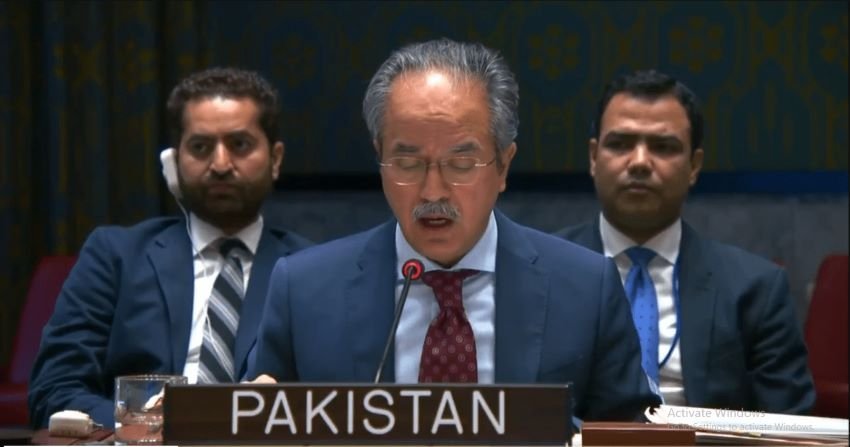
United Nations (TDI): Pakistan has once again urged the United Nations to uphold its commitments to the people of Kashmir and Palestine, saying that both continue to be denied their UN-pledged right to self-determination, a fundamental principle of the UN Charter.
Addressing the UN General Assembly’s Third Committee, which deals with social, humanitarian, and cultural matters, Ambassador Asim Iftikhar Ahmad said millions remain deprived of their basic freedoms as conflicts persist and inequalities widen around the world.
“For over seven decades, and especially since India’s illegal measures of August 2019, the people of Jammu and Kashmir have lived under repression, denied freedoms, subjected to arbitrary detentions, enforced disappearances, demographic engineering, and sexual violence against women,” he said.
Ambassador Ahmad called on the UN Security Council to honor its resolutions on Kashmir and ensure accountability for ongoing rights violations. He warned that failure to deliver justice to the Kashmiri and Palestinian peoples would seriously undermine the credibility of the international human rights system.
Read More: Peace in South Asia Elusive Without Kashmir Resolution: Pakistan
Turning to Palestine, the envoy said the humanitarian tragedy in Gaza has exposed “the cost of denying the right to self-determination,” with generations of Palestinians facing blockade, occupation, and excessive use of force.
He urged the international community to act decisively to end atrocities and to fulfill the long-denied promise of an independent, viable, and contiguous Palestinian state based on pre-1967 borders, with Al-Quds Al-Sharif (Jerusalem) as its capital.
Ambassador Ahmad also highlighted the alarming global rise in Islamophobia, noting that Muslims face hate speech, stigmatization, and attacks on places of worship.
“Islamophobia has become institutionalized in some societies, fueling division and exclusion,” he said, calling on the UN to adopt a comprehensive Action Plan to counter this growing threat.
Read More: Pakistan Highlights Plight of Women in Palestine, Kashmir at UN
He further warned that the deliberate spread of disinformation is being used as a weapon to conceal human rights abuses and malign communities. Pakistan, he noted, had led efforts that resulted in the UN General Assembly’s 2021 consensus resolution on Countering Disinformation for the Promotion and Protection of Human Rights and Fundamental Freedoms.
“Truth, not fake news and propaganda, must guide our collective response to human rights challenges,” the ambassador stressed.
The Pakistani envoy reaffirmed that the right to development is universal and essential to achieving global equality. He said developing nations face additional hurdles in realizing the Sustainable Development Goals (SDGs) due to the neglect of economic, social, and cultural rights.
Responding to Ambassador Ahmad’s remarks, Indian delegate P. P. Chaudhary claimed that Jammu and Kashmir was an “integral part of India” and criticized Pakistan’s internal politics.
In reply, Saima Saleem, Counsellor at Pakistan’s Mission to the UN, rejected India’s assertions, reiterating that Jammu and Kashmir has never been an integral part of India, as affirmed by multiple UN Security Council resolutions.
She accused India of carrying out state-sponsored terrorism, practicing institutionalized Islamophobia, and committing serious human rights violations against minorities.
“Muslims are lynched, mosques demolished, churches burned, and hate speech normalized,” Saleem said, adding that peace in South Asia would remain elusive until India ended its occupation of Jammu and Kashmir.
She also condemned India’s coercive posturing and violations of Pakistan’s sovereignty, including what she described as the “aggressive designs foiled on May 10.”
“In times of climate-induced floods and droughts, weaponizing water by withholding the Indus Waters Treaty obligations is not only a violation of international law but also an affront to human dignity,” she added.
Saleem concluded by saying that regional peace would remain out of reach until India “abandons its policy of aggression and state-sponsored terrorism.”