Nuclear weapons have not been used since 1945, although the catastrophes and destruction caused by them still haunt mankind. Pakistan remains steadfast in advocating universal and indiscriminate nuclear disarmament, while factoring in the security concerns of all states.
Nuclear disarmament must not by any means impair the ability of states to ensure comprehensive security. The first resolution on nuclear disarmament was adopted by the United Nations in 1946. Since then, the issue of nuclear disarmament has remained the overriding priority for member states.
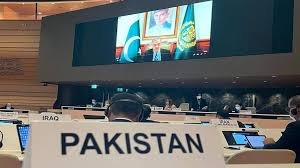
The Conference on Disarmament (CD), during its first session in 1979, included disarmament as an agenda item. During the latest Plenary meeting of the CD on agenda item 1: Cessation of the Nuclear Arms Race and Nuclear Disarmament, Pakistan delivered a comprehensive statement. The statement lamented that last year, the Subsidiary Body SB-1 on the aforementioned agenda failed to adopt a consensus report.
This failure emanates from the fractures in the international structure and diverging perspectives on the pressing issues of nuclear non-proliferation and disarmament. By virtue of great power competition, the nuclear arms race is unfolding unabated. The demise of arms control arrangements held during the Cold War further aggravates the situation.
Read More: Reassessing the Conference on Disarmament: Deadlock, Hierarchy & Pathways for Reform
Nuclear-armed countries are expanding their arsenals, diversifying means of delivery, and adopting emerging technologies in the nuclear domain, without developing guardrails for preventing haphazard. Strategic stability has been severely tested with the development of hypersonic missiles, stand-off capabilities, and AI-integrated weapon systems.
Diplomacy has been outpaced by these developments, and effective means to avoid catastrophes are losing their relevance day by day. Pakistan remains concerned with the increase in the number of warheads by different countries and the deployment of strategic capabilities in allied territories. All this has been facilitated by the tons of stockpiled uranium due to unconstrained production.
The statement categorically mentioned India for its multi-dimensional nuclear buildup, facilitated by its Fast Breeder Program outside the scope of IAEA safeguards. Alongside its development of Anti-Satellite (ASAT) capabilities, canisterization of missiles, and long-range missiles exceeding the 5000 km mark. Pakistan lamented that India is pursuing reckless behavior and launched drone and air strikes in Pakistan in May 2025.
India’s doctrinal position of NFU has been undermined by its own leadership multiple times. Hurling of nuclear threats against Pakistan in electoral rallies is highly regrettable and indicates Indian brinkmanship. India’s signing of a deal with a Western country for long-term uranium supply warrants international scrutiny, before it’s too late.
Pakistan reiterated that a nuclear arms race cannot be avoided and curtailed by one-sided proposals that favor one while creating security imperatives for the other.
In 2023, Pakistan appreciated and supported the report of the Group of Governmental Experts (GGE) on Nuclear Disarmament Verification (NDV) in the CD. Pakistan underscored the importance of verification measures, although it suggested that verification measures are meaningless unless they are tied to a treaty. Without the shelter of a treaty, verification measures are not an end in themselves.
The debate on the verification mechanisms must be taken at the conceptual level, assisting the member states to comprehend the challenges and complexities associated with these measures. Pakistan highlighted that these two GGEs focused more on the political parameters of NDV, as in defining the principles and parameters for guiding the future negotiators for a treaty.
The role of verification measures can only be evaluated on a case-by-case basis within a framework of a treaty; generic models can never be developed and adopted at this stage. The proposal of capacity building of member states for verification measures at their own pace was highly appreciated among the member states.
Pakistan stressed that time is needed to understand the contents of this report before giving any feedback or adopting anything. However, these GGEs must continue their work to bring conceptual clarity to the member states on the verification measures. United Nations Disarmament Commission (UNDC) outlined principles of verification in 1988 and concluded that verification measures can only be analyzed in the context of an agreement.
Read More: Pakistan Highlights Growing Risks to Global Nuclear Disarmament
Furthermore, in 2021, Pakistan outlined a few elements essential for achieving the goal of nuclear disarmament and cessation of the arms race. Firstly, Nuclear Weapon States (NWS) must reaffirm their commitment to nuclear disarmament with a defined and reasonable timeframe, to validate the great bargain of the NPT. Secondly, a concrete step must be taken by NWS to halt the future production of enriched uranium and eliminate all the existing stockpiles through a Fissile Material Treaty (FMT) in a non-discriminatory manner.
Thirdly, NWS must give a universal, legally binding, and unconditional pledge to the Non-Nuclear Weapon States (NNWS) that they will not be threatened with the use or the threat of use of the weapons till the moment universal nuclear disarmament is achieved. This pledge must be codified in the form of a legally binding treaty. Fourth, the level of conventional armaments must also be reduced.
Fifth, Pakistan reiterated that motives that drive states to acquire nuclear weapons must be addressed, including threats from superior conventional and other non-conventional forces. Lastly, international regimes must be strengthened to address the issue of space militarization and regulate the development of cyber and autonomous weapon systems.
Pakistan remains diplomatically active and resolved to achieve the goal of a world free of nuclear weapons, although it must be pursued in a universal, indiscriminate, and verifiable manner with well-defined time limits. The general and complete nuclear disarmament must be pursued in line with the objectives outlined in the First Special Session on Disarmament (SSOD-1) held by the UNGA in 1978.
The goal of nuclear disarmament must be achieved while ensuring undiminished security for all at the lowest levels of armaments.
*The views presented in this article are the authors’ own and do not necessarily reflect the views of The Diplomatic Insight.

Saif Ul Haq
Saif Ul Haq is a Research Officer at Strategic Vision Institute (SVI), Islamabad, and has completed M.Phil. in Defense and Strategic Studies from Quaid-i-Azam University, Islamabad. He holds certifications from the United Nations Office of Disarmament Affairs and the International Atomic Energy Agency.