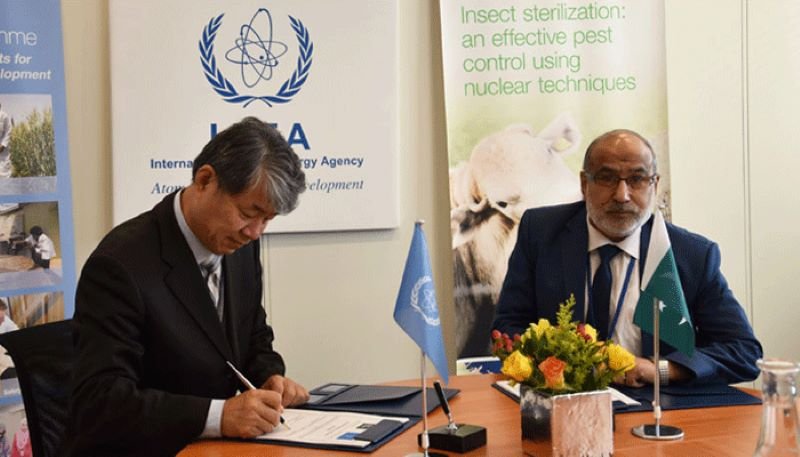
Vienna (TDI): Pakistan and the International Atomic Energy Agency (IAEA) have signed a new six-year Country Program Framework (CPF) designed to expand cooperation in peaceful uses of nuclear technology, with applications spanning agriculture, health, energy, and climate resilience.
The agreement, covering 2026 to 2031, was signed in Vienna on the sidelines of the IAEA General Conference by Pakistan Atomic Energy Commission (PAEC) Chairman Dr. Raja Ali Raza Anwar and IAEA Deputy Director General Hua Liu. It is the fifth such framework between Pakistan and the UN nuclear watchdog.
The CPF identifies five key areas of collaboration: food and agriculture, human health and nutrition, climate change and water management, nuclear power, and nuclear safety. The priorities align with Pakistan’s national development agenda and the UN Sustainable Development Goals (SDGs).
Agriculture, which contributes nearly one-fourth of Pakistan’s GDP, is set to benefit from expanded nuclear applications in crop improvement, pest control, and livestock health. In healthcare, the framework places strong emphasis on nuclear medicine and radiation oncology, building on the work of PAEC’s 20 Atomic Energy Cancer Hospitals that already treat over a million patients annually.
Read More: Forceful Compliance, Unilateral Attacks Damage IAEA’s Role: Pakistan
As one of the countries most vulnerable to climate change, Pakistan will also apply nuclear techniques such as isotope hydrology to manage scarce water resources and adapt to shifting climate patterns. On the energy front, where nuclear power supplies more than 18 percent of the country’s electricity, the agreement underscores safe operations, waste management, and long-term planning of nuclear plants.
Read More: Pakistan Urges IAEA Probe into India’s Nuclear Material Thefts
“The signing of this framework reaffirms Pakistan’s commitment to using nuclear science for peaceful purposes,” Dr. Anwar said. “With IAEA support, Pakistan will continue to harness these technologies to secure food supplies, strengthen healthcare, ensure reliable energy, and protect the environment.”
IAEA’s Hua Liu described the pact as “a shared vision for sustainable development through peaceful nuclear cooperation.”