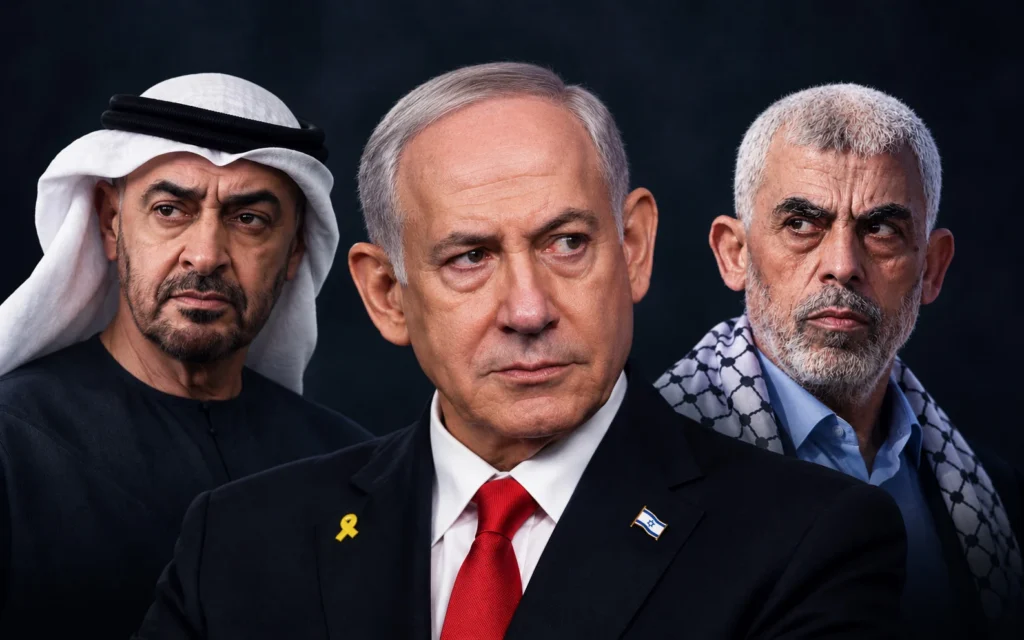
New details have emerged from Israeli Prime Minister Benjamin Netanyahu’s previously unannounced visit to the United Arab Emirates, which was first reported by Israeli media but could not be confirmed from other sources.
The UAE and Netanyahu’s office have now officially confirmed Sunday’s meeting, while subsequent reporting has linked the visit to an intensifying dispute in Israel over allegations that Netanyahu received warnings from regional countries ahead of the October 7, 2023 Hamas attack.
The UAE’s official account of the meeting remained focused on bilateral relations as the Emirates News Agency said Sheikh Mohamed received Netanyahu during his visit to the country and that the two leaders discussed UAE-Israel relations and ways to strengthen and develop them.
However, the Associated Press reported, citing two people briefed on the visit, that Netanyahu travelled to Abu Dhabi in part to seek Sheikh Mohamed’s public denial of reports that the Emirati leader had warned him of a potential Hamas attack before October 7.
One person cited by AP said the issue was raised during the meeting. The UAE has not publicly confirmed that the alleged warning or the controversy surrounding it was discussed during Sunday’s meeting.
Read More: Netanyahu Makes Unannounced Visit to UAE Amid Regional Tensions: Reports
Netanyahu’s office has strongly rejected reports that he received such an advance warning. The controversy has grown following separate reports alleging that both Emirati and Egyptian officials had raised concerns with Israel ahead of the October 7 attack. Netanyahu disputes those accounts.
The issue has gained additional political significance ahead of Israel’s October elections, with opposition politicians renewing criticism of Netanyahu over the security failures preceding the attack.
The prime minister and his government have maintained that they were not provided with the warnings described in recent media reports.
Further details released by Netanyahu’s office also showed the senior level of the Israeli delegation accompanying him to Abu Dhabi.
Mossad Director Roman Gofman, National Security Council head Shmuel Ben-Ezra, Netanyahu’s military secretary Maj. Gen. Guy Markizeno and the head of the Shin Bet Security Division were among those travelling with the prime minister.
Read More: NYT Backs Report UAE Warned Netanyahu of Hamas Attack Before October 7
Netanyahu’s wife, Sara Netanyahu, also accompanied him. The presence of senior intelligence and national security officials suggests that the talks extended beyond routine bilateral engagement, although neither government has released a detailed agenda.
Israeli reporting has separately said Iran was a major subject of discussion, but that has not been confirmed in the UAE’s official account. The secrecy surrounding the visit has also generated a separate dispute inside Israel.
Netanyahu’s office said the Shin Bet filed a complaint with Israel’s military censor after Channel 12 disclosed the trip before the prime minister had returned to Israel.
According to the Prime Minister’s Office, the early disclosure created a security risk for Netanyahu, the delegation and personnel involved in the operation. The office said the report appeared almost an hour before Netanyahu’s aircraft landed back in Israel.
Despite the controversy surrounding the visit, its official confirmation also demonstrates that direct engagement between Israel and the UAE remains active at the highest political level.
Read More: UAE Rejects Claims of Netanyahu’s Secret Trip
The two countries established diplomatic relations under the Abraham Accords in 2020. Their relationship has since faced pressure from the Gaza war and wider regional instability, but Abu Dhabi and Israel have continued to maintain political and security channels.
The latest meeting therefore carries two parallel dimensions. Publicly, the UAE has presented it as an effort to strengthen bilateral relations.
In Israel, however, the visit has become increasingly connected to the domestic debate over what Netanyahu knew before October 7 and how his government responded to warnings from regional partners.
With neither Abu Dhabi nor Netanyahu’s office confirming that the alleged pre-October 7 warning was discussed, that aspect of the meeting remains based on media reporting rather than an official account.
The new disclosures nevertheless add an important layer to Netanyahu’s previously unannounced UAE visit, shifting attention from the secrecy of the trip itself to the political and security issues that may have shaped the discussions.

Anoush Taimur is an International Relations graduate from DHA Suffa University, Karachi, currently based in Doha. Her research interests include Gulf politics, small-state diplomacy, Global South studies and conflict
mediation. Her work examines how states create influence through connectivity, institutions and strategic relationships. She can be reached at [email protected]